Where does new space come from as the universe gets bigger?

  • Thread starter Thread starter CosmicVoyager
  • Start date Start date
  • Tags Tags
    Space Universe
Click For Summary
The discussion centers on the nature of space and its expansion in the universe. Participants debate whether space is a tangible entity or merely a mathematical concept representing distance and volume. The analogy of space as a "fabric" is critiqued, with arguments that it misleads public understanding by implying space has physical properties. The conversation highlights the distinction between space being affected by mass and gravity versus being a material substance itself. Ultimately, the complexity of space's nature and its representation in scientific literature is acknowledged, emphasizing the need for clarity in communication about these concepts.
  • #91
Mordred said:
Universe geometry

The origins of the universe is unknown in cosmology. The hot big bang model only covers the history of the universe from 10-43 seconds forward. Prior to that is described as a singularity. However its important to note that the singularity is not a black hole style. Instead singularity in this case simply means a point in time where our mathematics can no longer accurately describe it. Numerous youtube videos and pop media articles would have you believe our universe exploded from some super particle. This was never predicted by the hot big bang model.

The observable universe which is the portion we can see is a finite, sphere with a radius of 46 Gly, which is equal to 46 billion light years. The 46 Gly particle horizon refers to the today's distance of objects, whose radiation emitted in the past we receive today. The overall size of the universe is not known, it could be infinite or finite. If its infinite now then it would be infinite in the past, a finite value can never become infinite. So why is geometry so important to cosmology if we know the size of the observable universe? The answer to that question lies in how geometry affects the following aspects, Light paths, rate of expansion or collapse and overall shape.

In regards to light paths and geometry a closed universe described as a sphere will have two beams of light emitted at different angles eventually converge. An open hyperbolic universe such as a saddlebag will have those same two light beams diverge. A flat universe will have parallel light paths (provided the beams at emission were parallel to begin with)
You will notice on each image there is a triangle, this triangle represents how the geometry affects our measurements. In a flat curvature the three angles of a equilateral triangle will add up to 1800. A positive curvature will add up to greater than 1800, a negative curvature will add up to less than 1800
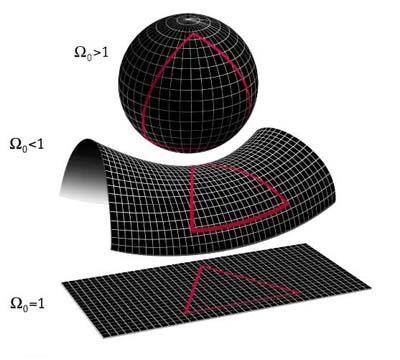

model-spacetimegeometry.jpg

Image from http://universeadventure.org

The topography of the universe is determined by a comparison of the actual density (total density) as compared to the critical density. The critical density is represented by the following formula

\rho_{crit} = \frac{3c^2H^2}{8\pi G}

\rho=energy/mass density
c=speed of light
G= gravitational constant.

density is represented by the Greek letter Omega \Omega so critical density is \Omega crit
total density is

\Omegatotal=\Omegadark matter+\Omegabaryonic+\Omegaradiation+\Omegarelativistic radiation+{\Omega_ \Lambda}

\Lambda or Lambda is the value of the cosmological constant often referred to as "dark energy" more accurately it is the vacuum pressure that attributes to expansion.
the subscript "0"for \Omega shown in the image above denotes time in the present.

Energy-density is the amount of energy stored per unit volume of space or region. Energy per unit volume has the same physical units as pressure, the energy or mass density to pressure relations are defined by the equations of state (Cosmology). see
http://en.wikipedia.org/wiki/Equation_of_state_(cosmology)

\Omega=\frac{P_{total}}{P_{crit}}
or alternately
\Omega=\frac{\Omega_{total}}{\Omega_{crit}}

Geometry in 2D
In developing a theory of space-time, where curvature is related to the mass-energy density, Scientists needed a way of mathematically describing curvature. Since picturing the curvature of a four-dimensional space-time is difficult to visualize. We will start by considering ways of describing the curvature of two-dimensional spaces and progress to 4 dimensional spaces.
The simplest of two-dimensional spaces is a plane, on which Euclidean geometry holds.
This is the geometry that we learned in high school: parallel lines will go off to infinity
without ever crossing; triangles have interior angles that add up to 180. Pythagoras’
theorem which relates the lengths of the sides of a right triangle also holds:
c2 = a2 + b2
where c is the length of the hypotenuse of the right triangle, and a and b are the
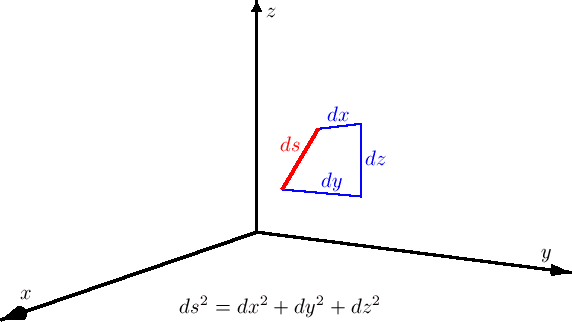
lengths of the other two sides. One can generalize the Pythagorean theorem to three dimensions as well:
c2= a2 + b2 + c2
see image 2.0 below


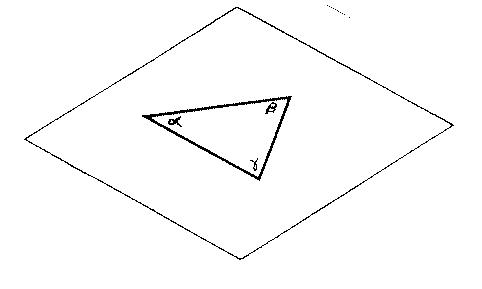
On a plane, a "geodesic" is a straight line(shortest distance between two points). If a triangle is constructed on a flat 2 dimensional plane by connecting three points with geodesics. The curvature can be represented in 2D, if you establish each angle of a equilateral triangle with
\alpha,\beta,\gamma for a flat geometry this follows the relation

\alpha+\beta+\gamma=\pi.

trianglegeodesics.JPG

image 1.0
attachment.php?attachmentid=59284.png

attachment.php?attachmentid=59285.png

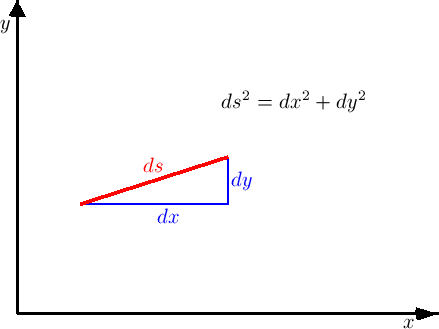
On a plane, (shown above) we can set up a cartesian coordinate system, and assign to every point a coordinate (x; y). On a plane, the distance ds between points (dx and dy) is given by the relation
d{s^2}=d{x^2}+d{y^2}

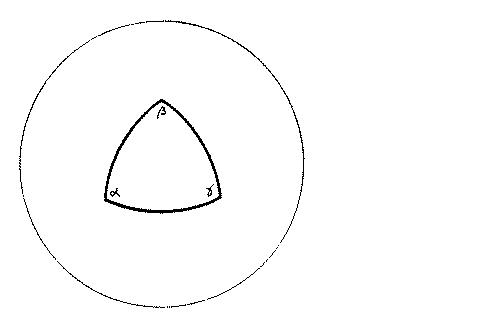
If a triangle is constructed on the surface of the sphere by connecting the angles will obey the relation

\alpha+\beta+\gamma=\pi+{AR^2}

circlegeodesics.JPG

image 1.1
where A is the area of the triangle, and R is the radius of the sphere. All spaces in which
\alpha+\beta+\gamma>\pi are called positively curved" spaces. It is a space where the curvature is homogeneous and isotropic; no matter where you draw a triangle on the surface of a sphere, or how you orient it, it must always satisfy the above equation.
"On the surface of a sphere, we can set up polar coordinates "north pole" and "south pole" and by picking a geodesic from the north to south pole to be the "prime meridian". If r is the distance from the north pole, and \theta is the azimuthal. angle measured relative to the prime meridian,"(1) then the distance ds between a point (r; \theta) and another nearby point (r+dr+\theta+d\theta) is given by the relation

{ds^2} = {dr^2} + {R^2} {sin^2}(r/R)d\theta^2

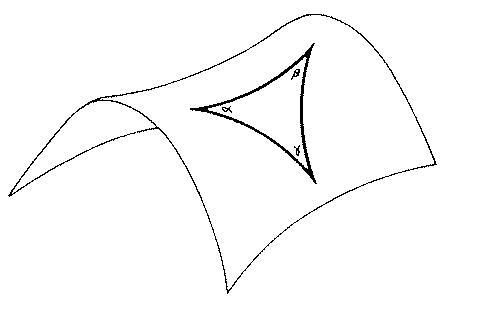
"An example of a negatively curved two-dimensional space is the hyperboloid, or saddle-shape. A surface of constant negative curvature. The saddle-shape has constant curvature only in the central region, near the "seat" of the saddle."(1). David Hilbert proved that a constant negative curvature cannot be constructed in a Euclidean 3D space. Consider a two-dimensional surface of constant negative curvature, with radius of curvature R. If a triangle is constructed on this surface by connecting three points with geodesics, the angles at its vertices \alpha
\beta,\gamma obey the relation \alpha+\beta+\gamma=\pi-{AR^2}.

{ds^2} = {dr^2} + {R^2} {sinH^2}(r/R)d\theta^2

hyperbolic.JPG

image 1.2

A negative curvature is an open topography

If a two-dimensional space has curvature or flat which is homogeneous and isotropic, its geometry can
be specified by two quantities k, and R. The number k, called the curvature constant, R is the radius

k = 0 for a flat space,
k = +1 for a positively curved space,
k = -1 for a negatively curved space

Geometry in 3D
A two dimensional space can be extended to a three-dimensional space, if its curvature is homogeneous and isotropic, must be flat, or have uniform positive curvature, or have uniform negative curvature.

The 3 possible metrics for homogeneous and isotropic 3D geometries can be represented in the form ds2=dr2=Sk(r)22

where
2=dθ2=sin2d\phi2


<br /> S\kappa(r)=<br /> \begin{cases}<br /> R sin(r/R &amp;(k=+1)\\<br /> r &amp;(k=0)\\<br /> R sin(r/R) &amp;(k=-1)<br /> \end {cases}<br />

If a three-dimensional space is flat (k = 0), it
has the metric

ds2 = dx2 + dy2 + dz2 ;

expressed in cartesian coordinates or

{ds^2} = {dr^2} +{r^2}[d\theta^2 + {sin^2} d\phi^2]

If a three-dimensional space has uniform positive curvature (k = +1), its
metric is

{ds^2} = {dr^2} +{R^2}{sin^2}(r/R)[d\theta^2 + {sin^2}\theta d\phi^2]

A negative curvature in the uniform portion has the metric (k=-1)

{ds^2} = {dr^2} +{R^2}{sinH^2}(r/R)[d\theta^2 + {sin^2}\theta d\phi^2]

Geometry in 4D

Thus far we have discussed the 2 and 3 dimensional components. The Friedmann-Lemaitre-Robertson-Walker metric (FLRW) can be used to describe the 4D dimensions with the use of a(t). a(t) is the scale factor. See the redshift and expansion article for more information or the cosmocalc.
http://cosmology101.wikidot.com/redshift-and-expansion
http://cosmocalc.wikidot.com/start

Scale factor in a homogeneous and isotropic universe describes how the universe expands or contracts with time.
The FLRW metric can be written in the form

d{s^2}=-{c^2}d{t^2}+a({t^2})[d{r^2}+{S,k}{(r)^2}d\Omega^2]

references
(1)"Introductory to Cosmology" Barbera Ryden"
images 1.0,1.1 and 1.2 (see (1))
(2)"Modern Cosmology" Scott Dodelson
(3)"lecture notes, Introductory to Cosmology" Dr. Ka Chan Lu


thank-you Mordred for your elegant solution,
Question: Would your triangle have the same topological 'argument' placed upon a mobius or Riemann sphere..?(!).
 
Space news on Phys.org
  • #92
Frank Weil said:
Hello craigi,
Could I ask if you were specifically referring to symmetry as: eightfold, global,local, patterns, symmetry break(ing) or symmetry groups per se?

I wasn't referring to any particular instance of symmetry in the laws of physics. Simply that we prefer that laws of nature are fundamentally due to symmetry, to laws that have a more complex form or laws that have unexplained constants.
 
  • #93
craigi said:
I wasn't referring to any particular instance of symmetry in the laws of physics. Simply that we prefer that laws of nature are fundamentally due to symmetry, to laws that have a more complex form or laws that have unexplained constants.

Hello again craigi,
AS you have probably realized I am interested in gauge fields, superstrings and symmetry groups. ( gauge fields,as you know, are related to the structure of space-time itself),
I was unhappy with the SU(2) x U(1) which was built out of the symmetry group SU(2) , which describes the weak nuclear force, and U(2) for the electromagnetic field.
Then along came the the new symmetry which was made by combining SU(3)--corresponding to the gluon force--with SU(2) X U(1) for the electroweak force.
SU(5) didn't last very long at the expansion (Big bang) as it separated into two groups very rapidly.
Also The SU(5) predicted new bosons with enormous masses---10^15 times bigger than the mass of the proton. Also the next SU(10) group had implications that the normal left-handed neutrino has a right-handed partner of enormous mass...
Still unhappy!
Along came Schwarz and Green and gave us a single choice of symmetry with elegance..the beautiful SO(32) symmetry.
Very happy!
 
  • #94
Frank Weil said:
thank-you Mordred for your elegant solution,
Question: Would your triangle have the same topological 'argument' placed upon a mobius or Riemann sphere..?(!).

yes, Riemann geometry, is used extensively in the 4 dimensional geometry aspects of space-time geometry. The FLRW metrics can be converted to a variety of differential geometry forms. Though the proper uses of each must follow GR and SR rules, the FLRW metric is an exact solution to the Einstein field equations.

this lengthy articles shows the usages and risks involved in the various differential geometry forms. As well as covering the FLRW metric aspects in the later chapters.

http://www.blau.itp.unibe.ch/newlecturesGR.pdf
 
  • #95
Frank Weil said:
Along came Schwarz and Green and gave us a single choice of symmetry with elegance..the beautiful SO(32) symmetry.
Very happy!
Except that it fails miserably to reproduce the Standard Model...
 
  • #96
Frank Weil said:
thank-you Mordred for your elegant solution,
Question: Would your triangle have the same topological 'argument' placed upon a mobius or Riemann sphere..?(!).

On a side note, please don't quote the entirety of very long posts. It just clutters up the thread. :biggrin:
 
  • #97
Drakkith said:
On a side note, please don't quote the entirety of very long posts. It just clutters up the thread. :biggrin:

just to add to this you can refer to a specific post by clicking the post number in the top right. of that post, it will open a new internet window then just copy and paste the address
for example using the Geometry article post

https://www.physicsforums.com/showpost.php?p=4720016&postcount=86

not that I mind seeing my articles posted :P

edit one other PF aid. this post covers how to use the Latex commands to type mathematical expressions for this site
https://www.physicsforums.com/showpost.php?p=3977517&postcount=3
 
  • #98
Mordred said:
just to add to this you can refer to a specific post by clicking the post number in the top right. of that post, it will open a new internet window then just copy and paste the address
for example using the Geometry article post.
Son of a... I didn't know that Mordred... thanks!
 
  • #99
Drakkith said:
Son of a... I didn't know that Mordred... thanks!

no problem, its useful for large posts such as the Universe geometry and Expansion and redshift article. LOL coincidentally the method was showed to me by one of the moderators. To reduce clutter of my reposting that very same article. :biggrin:
 
  • #100
Mordred said:
Space is simply volume filled with matter and energy, we have tried explaining that to you numerous times. Space itself is not a material. It is simply volume filled with matter and energy. However space itself does not have a fabric and is not a form of energy or matter, it is simply volume filled with the matter and energy content of the universe.

If this is the case then why does space expand faster than the speed of light? If the Universe is 13.8 billion years old we should only see back in time to 13.8 billion light years. Yet the visible Universe is roughly 46 billion light years. The rebuttal, as I understand it, is that space can expand faster than light because it is nothingness. Nothingness does not follow the laws of physics.

But it was said above that space, essentially, includes matter and energy. So it is not nothingness. Is not this matter and energy subject to the speed of light limitation, or is the universe expanding (creating space) into an existing space of matter and energy? Not clear to me. Or are we alluding to Dark Energy and Dark Matter which is called Dark because we do not understand it yet. But then I am just a lowly mechanical engineer. But I absolutely enjoy reading these threads. I do get a lot of insight from them.
 
Last edited:
  • #101
ptalar said:
If this is the case then why does space expand faster than the speed of light?

A few things about this. First, expansion is measured by a RATE, not a speed. By that I mean that it doesn't make sense to talk about the speed of expansion because that speed will change depending on how far away your two points of comparison are. For example, galaxies recede from each other at an increasing velocity of about 70 km/s for every megaparsec (Mpc) they are apart. So two galaxies 10 Mpc's apart will be receding from each other at approximately 700 km/s.

However, the RATE of expansion does not change in this manner. The time it takes for the distance between them to double is the same whether they are 10 Mpc's apart or 10,000 Mpc's apart.

Also, it gets us nowhere by talking about the expansion of "space itself". In reality, expansion is measured by comparing actual objects that exist within spacetime.

If the Universe is 13.8 billion years old we should only see back in time to 13.8 billion light years. Yet the visible Universe is roughly 46 billion light years.

There is no contradiction here. We CANNOT see back further than 13.8 billion years because light has not had time to travel any longer than that. (A little shorter than 13.8 billion years actually. Light wasn't free to travel until after Recombination occurred around 378,000 years after the big bang and the universe became transparent to EM radiation)

However, we have measured the radius of the observable universe and it is indeed approximately 46 billion light years from Earth to the edge, making it about 92 billion light years in diameter. Note that years is a measurement of time, while light years is a measurement of distance.

Understand that to measure the radius of the observable universe requires us to understand how expansion works, otherwise we would get the wrong value. In a non-expanding, static universe, the diameter of the observable universe would only be about 13.8 billion light years, increasing by one light year ever year. However, in an expanding universe, the galaxies we see now have actually receded from us since their light left them, making the observable universe larger than it would appear to be if you only consider the time that light has had to travel.

The argument is that space can expand faster than light because it is nothingness. Nothingness does not follow the laws of physics. But you said space includes matter and energy. Which is it?

That is not the argument. Our primary theory for understanding the universe on its largest scales is General Relativity. Under the rules of GR, the expansion is the result of dynamic geometry, not the result of space expanding as if space were something that was actually moving. Space is not moving. The concept of space being something that can move does not even apply under GR. We can set up frames of reference at different points within spacetime and watch the effects that this dynamic geometry has on them, but we cannot see "spacetime itself" nor can we assign a frame of reference to it since it is the underlying framework upon which everything occurs.
 
  • #102
Also note that, once again, just imagining that matter shrinks makes that question go away as well. Poof, no "where does the space come from," no "how can objects move away from each other faster than c." This doesn't mean matter "really does" shrink, any more than space "really expands", it just makes the point that these are all just pictures and cannot be taken seriously enough to worry about questions like these. Questions that persist in all perspectives are the "real" questions-- questions that stem from a particular picture, but go away in a different picture, are seen to stem from the pictures, not the physics.
 
  • Like
Likes 1 person
  • #103
ptalar said:
The rebuttal, as I understand it, is that space can expand faster than light because it is nothingness. Nothingness does not follow the laws of physics.

Not quite. The laws of physics are models and we do model nothingness. In fact, it's important to explain the expansion of the universe.

There's a common misconception that claims that there is nothing that can travel faster than the speed of light. In the model of special relativity, information and matter can't travel faster than the speed of light, but that isn't to say that there isn't anything that can. To illustrate this, if you project an image off into the distance and rotate your projector, there is a distance beyond which the projected image is traveling faster than the speed of light. The image is still constructed from the interaction of matter and information is still transmitted, but no matter or information moves faster than the speed of light, nevertheless the projected image can travel at unbounded speeds.
 
Last edited:
  • #104
ptalar said:
If this is the case then why does space expand faster than the speed of light? If the Universe is 13.8 billion years old we should only see back in time to 13.8 billion light years. Yet the visible Universe is roughly 46 billion light years. The rebuttal, as I understand it, is that space can expand faster than light because it is nothingness. Nothingness does not follow the laws of physics.
No, the observable universe is 46 byl across because it is expanding. Simple as that. As space expands, it brings photons along with it: as they recede from Earth they have a velocity v_{\rm rec} + c: the first term is that due to the Hubble expansion, and the second, c, is the local speed of light. Of course, as the universe expands v_{\rm rec} continuously changes. If you integrate this speed over the time the universe has existed (13.6 by), you get something larger than 13.6 bly because photons recede with speeds surpassing that of light the whole time. The universe itself "expanding faster than light speed" has nothing to do with it, and as Drakkith has explained, is not a correct way to think of expansion.
 
  • #105
ptalar said:
If this is the case then why does space expand faster than the speed of light? If the Universe is 13.8 billion years old we should only see back in time to 13.8 billion light years. Yet the visible Universe is roughly 46 billion light years. The rebuttal, as I understand it, is that space can expand faster than light because it is nothingness. Nothingness does not follow the laws of physics.

But it was said above that space, essentially, includes matter and energy. So it is not nothingness. Is not this matter and energy subject to the speed of light limitation, or is the universe expanding (creating space) into an existing space of matter and energy? Not clear to me. Or are we alluding to Dark Energy and Dark Matter which is called Dark because we do not understand it yet. But then I am just a lowly mechanical engineer. But I absolutely enjoy reading these threads. I do get a lot of insight from them.

The others have already answered the majority of your questions. However I would add the term "dark" in both dark energy and dark matter are kind of stuck to science. Although we do not completely understand them. There is a lot we do. We may not know what dark matter is, however we know how it influences the universe mass density calculations. In fact dark matter is the larger gravitational influence. Baryonic (what stars etc are made of) matter is a small fraction of the gravitational influence. In Dark energy the mystery is more that we do not know what mechanism that keeps the density of dark energy constant. As a negative pressure influence its effects are easily understood in regards to expansion. Dark energy is a contributor to the cosmological constant. Matter influence is positive vacuum, the cosmological constant is a negative influence.

Due to the ratio of dark matter and baryonic matter, dark matter is the largest contributor to positive vacuum. Due to the sheer volume of space the cosmological constant is the largest contributor to the negative vacuum pressure. So yes much of the dynamics of expansion is primarily due to the pressure relations of the cosmological constant and dark matter. More so than other forms of energy and baryonic matter

P.S I'm just a lowly Electronic controls tech, I simply spent several years studying cosmology textbooks, and asking questions on PF. Cosmology is my favorite hobby lol. Although some of the posters on this thread are physicists. I won't say who, that is their privilege to divulge

hint the tools and links to understand basic cosmology have already been posted throughout this one thread. So they don't need to be reposted. However my signature also contains many of those tools on the http://cosmology101.wikidot.com/main link. The http://www.einsteins-theory-of-relativity-4engineers.com/LightCone7/LightCone.html. Provides a handy calculator to understand the history and future expansion history. http://cosmocalc.wikidot.com/start is where to find the information on how to use that calculator
 
Last edited:
  • #106
Thanks to all for providing input and insight.
 
  • #107
Back to the OP's original concern... Brian Greene, no, was not talking purely analogy. He LITERALLY meant that space IS a "thing", and not a complete void at all. Not in the sense of the geometry or boundaries of "nothingness", but that it's not a complete void -- there is a something -- not of mass, not of standard energy, but it's a "something" of a different sort.

OP's question was whether people agree with this. The argument seemed to shift into "what he really meant".

Physics programs/documentaries do use analogies all the time. It's great. And yes, there will be little white lies that pass through and instructors/writers/presenters will forget to put an asterisk next to certain things they say because they're actually being analogous and not literal.

BUT with Brian Greene as an example, among others, they go out of their way -- loud and clear -- to make it clear as a bell that they Literally mean that space is SOMETHING -- not complete nothingness in and of itself. And others point out things very loud & clear -- not in analogy -- that space LITERALLY bends & twists with the mass residing in it.

So the question is -- do you believe that, or do you think they're mistaken themselves and that's all just a hypothesis and has no grounding (but it great for selling books and videos)?
 
  • #108
azureorb said:
So the question is -- ... do you think they're mistaken themselves and that's all just a hypothesis and has no grounding (but it great for selling books and videos)?

Yes.
 
  • #109
azureorb said:
So the question is -- do you believe that, or do you think they're mistaken themselves and that's all just a hypothesis and has no grounding (but it great for selling books and videos)?

Yes its great for selling books, and is not scientifically accurate, its great for grabbing attention though. See the reasons posted throughout this thread.
 
  • #110
azureorb said:
So the question is -- do you believe that, or do you think they're mistaken themselves and that's all just a hypothesis and has no grounding (but it great for selling books and videos)?
I'm going to go with neither of the choices, even though on the surface they seem to cover the possibilities! But there's a third possibility which I think is more the truth here, which is that science simply does not make any important distinction between a working hypothesis/theory, and a statement of "what is," such that it could ever "mistake itself" by using the latter language as a kind of rhetorical shortcut. We forget this all the time-- we have a theory that talks about protons and electrons, so we tend to imagine the protons and electrons "are," but then someone like Heisenberg comes along and says its time to stop thinking in terms of elementary particles and start to think in terms of elementary symmetries. So much for what is! It seems "what is" is very much in the eye of the beholder, the laboratory observer thinks "what is" is their apparatus, a theorist thinks "what is" is an abstract mathematical structure, and Brian Greene thinks "what is" is a twisting expanding space. These are all just pictures, we don't get to know "what is," but the language of science is more direct if we all kind of pretend like we are talking about "what is." We can even make non-scientists think that's what we are talking about, which can be a slippery slope but is still more or less unavoidable. We just don't need to really believe it ourselves.
 
  • #111
Yes its great for selling books, and is not scientifically accurate, its great for grabbing attention though. See the reasons posted throughout this thread.

But you didn't directly answer the question. :) And they aren't dancing around words to make something clearer to the masses. You could pick apart some things they're saying of course and say "Well, technically, this doesn't Really work this way, it actually works This way, but you can think about it that way because it makes more sense to understand." Sure, there's lots of that.

But the concept of space being Literally, in all aspects in all ways 100% *nothing*, nada, zip, zilch on every level from the macroscopic to the quantum level -- they're literally saying essentially "No, we used to think it was truly nothing, but it's not. It IS something in and of itself." That's Very different than forgetting to make it clear "It's not literally like this, but you can think of it this way."

So it should be of no argument that that is their claim -- not just for the masses but to physics world as well. The closest thing you could say is that they're forgetting to say that it's merely a modern-day theory, and not validated enough to say it so strongly. But it'd be silly to think "Oh, they don't Really mean that, they're just being analagous." THAT would be an incorrect observation.

So are they correct (do you share the belief) in literally saying that space in and of itself, IS in fact, something?

We forget this all the time-- we have a theory that talks about protons and electrons, so we tend to imagine the protons and electrons "are," but then someone like Heisenberg comes along and says its time to stop thinking in terms of elementary particles and start to think in terms of elementary symmetries. So much for what is!

True -- in some sense something exists in a very different way -- but presenters/instructors/writers draw it out to make it understandable even though No -- an electron doesn't exist at all (like that), but it exists in a totally different way (and can be of a totally different type of existence in another state/situation, etc).

But in the Brian Greene example (among others), it's not about exactly what space is -- it's actually a bit of a simpler, basic concept. Does it in some way, exist as something? Some type of different type of existence as a 'something', a field of sorts, as they claim it Literally is?

Again, they go out of their way to make it very clear that we used to believe space was absolutely nothing in every sense, in every dimension from the macro->quantum and in every sense of the word -- NOTHING. BUT NOW, it is shown to be something in and of itself. WHAT that is gets more complex of course. WHAT that is would easily fit the mold of language misuse and an incorrect vision of what it actually is...

... but to distinctly say that it's no longer absolutely nothing, but in and of itself it IS something -- that does not fall victim to language misuse where you can say "Oh, they don't mean it literally is something -- they're just trying to get you to understand some concepts about this and that." No, that's not what they're doing. :)
 
  • #112
well you can believe whatever makes you most comfortable, personally I studied enough to prove to myself that space isn't created, or have a substance. Its merely a change in geometric volume filled with the contents of the universe. Even my studies into strings hasn't shown me any difference in that understanding. Nor has reading Brian Greene's papers. Some articles he refers to it as a volume change, other string articles he refers to it as a space curvature. However his metrics show the geometry relations. Even in his string articles.

for example he is clear in this article, "It is the volume that grows and signals a transition to a radiation phase" page 19 section 38

http://arxiv.org/pdf/0809.1704v3.pdf
even when he discusses branes and phase space his metrics and descriptives refer to the geometric aspects and energy-density relations and distributions.

opening page he refers to toroidal volume.
http://arxiv.org/abs/0707.1062
down further he defines shape as
"As the universe cools, different species contribute to the energy density in non-relativistic matter leading to an alteration in the shape of the potential" nice accurate descriptive of topography in Cosmology applications. Very appropriate definition of space curvature if you include the potential affects of all energy density contributors, such as dark energy
 
Last edited:
  • #113
Its merely a change in geometric volume filled with the contents of the universe. Even my studies into strings hasn't shown me any difference in that understanding. Nor has reading Brian Greene's papers.

I'm sure geometric changes in it and focuses on that and such don't mean that's All there is (as he points out quite literally elsewhere in other circles that space is a substance of sorts).

However, it'd be a separate argument to say space would be a substance in the same sense that we interact with "substance". And if it's some form of field, well, that's not the same as a fabric in the sense of what we think... but again, the OP's original question was is it "something" in ANY sense of word -- which is what many uber-modern analysts will claim (like Greene).

I mean, to us, in which we directly interact with it, it could literally mean nothing -- absolutely nothing -- but still be "something".

And here's an off-shoot of the question. Whether or not space itself in any way is a 'something' ... and let's say it's not at all in any sense of the word: The boundaries, like a balloon expanding -- is that 'something'?

In a balloon, there is "nothing" (as far as the balloon itself is concerned; just air; not rubber). But the boundaries of that balloon is something (rubber).

So in that analogy of the universe (space) being like a balloon expanding -- are the edges of it 'something'?
 
  • #114
azureorb said:
... The boundaries, like a balloon expanding -- is that 'something'?

In a balloon, there is "nothing" (as far as the balloon itself is concerned; just air; not rubber). But the boundaries of that balloon is something (rubber).

There IS no "boundary". You completely misunderstand the balloon analogy. I recommend the link in my signature.
 
  • #115
azureorb said:
So in that analogy of the universe (space) being like a balloon expanding -- are the edges of it 'something'?

The surface of the balloon is a 2d boundless, edge-less, finite surface.
 
  • #116
azureorb said:
I'm sure geometric changes in it and focuses on that and such don't mean that's All there is (as he points out quite literally elsewhere in other circles that space is a substance of sorts). However, it'd be a separate argument to say space would be a substance in the same sense that we interact with "substance". And if it's some form of field, well, that's not the same as a fabric in the sense of what we think... but again, the OP's original question was is it "something" in ANY sense of word -- which is what many uber-modern analysts will claim (like Greene).

I mean, to us, in which we directly interact with it, it could literally mean nothing -- absolutely nothing -- but still be "something". ?

The something is the contents of the universe, that fills the volume. Just like if you increase a volume of a container containing gases, those gases will fill that volume. The universe is treated as a fluid, or ideal gas, defined by its energy-density relations. One unit of volume, even if it has no particles or fields within it, will have negative pressure. Energy-density has a pressure relation. Matter exerts negligible pressure. see the equations of state Cosmology.

and I quote from the wiki page, though I rarely like using wiki as a reference.

"The equation of state may be used in Friedmann–Lemaître–Robertson–Walker equations to describe the evolution of an isotropic universe filled with a perfect fluid"

http://en.wikipedia.org/wiki/Equation_of_state_(cosmology)

if you increase the volume, the effective pressure and temperature drops. Just as the ideal gas laws tells us with its corresponding equations of state.

A pressure is an energy-density relation, so an absolute nothing is never possible, within a fluid. There is always an energy-density present. However that "never means space itself.. Even one quanta of a perfect (theoretical) vacuum, will have energy potential. If you were to have a theoretical toy model universe, and were to remove all matter, all forms of radiation, and the only thing left is vacuum. That Universe has energy-density. The same as it would if it had a positive vacuum. Those universes would expand and contract according to its pressure relations between positive pressure and negative pressure.

the curvature or shape of space is a description of the energy-density relations between all the species of particles and energy contained within the measurable volume of the universe.

There is no container or walls of some mysterious substance or fabric, defining an edge of the universe
 
  • #117
Mordred said:
The something is the contents of the universe, that fills the volume.

I'm still trying to understand this, aren't we simply replacing "space" by "volume" here? What is this volume, then? I'm always coming back to this very concept; even after all the critical density talk and your article about geometry, eventually one word seems to be replaced by another and I keep getting the impression "space" or "volume" is some sort of entity whose existence as such is objected. "It's not something, it's just the distance between things in a volume." (not quoting anyone here)

Am I being a victim of semantics?
 
  • #118
azureorb said:
...

BUT with Brian Greene as an example, among others, they go out of their way -- loud and clear -- to make it clear as a bell that they Literally mean that space is SOMETHING -- not complete nothingness in and of itself. And others point out things very loud & clear -- not in analogy -- that space LITERALLY bends & twists with the mass residing in it.

...

Space is something and it's not nothing. It's the dimensions in which objects have relative position, in exactly the same way that flat Euclidean space is. It's how we define it, so what else could it possibly be?

How can anything be nothing anyway? It's logically impossible.

General relativity is visualised as a curvature of space and time, and string theory, for example, incorporates extra dimensions, but they still just represent relationships between objects.

I think the confusion arises form the popular visualisation of the "fabric" of space. It's a useful prop for learning but as others have said, don't start believing the "fabric" somehow exists. It's just a way to describe the notion that space and time aren't always "flat", in the same way that fabric isn't always flat.

Space itself can never be observed directly. We observe objects in space. Again this is the same for flat Euclidean space.

So what is "empty" space filled with? The quantum vacuum. That's something and not nothing either and again, we can't observe it directly, but we need it for our models to work.
 
Last edited:
  • #119
From wiki

"Volume is the quantity of three-dimensional space enclosed by some closed boundary, for example, the space that a substance (solid, liquid, gas, or plasma) or shape occupies or contains"

for the universe ignore the closed boundary, defining volume of an ideal gas can get tricky in Cosmology applications. I tend to think of it as the area or region that is in thermal equilibrium or can be described by the same conditions

"In differential geometry, volume is expressed by means of the volume form, and is an important global Riemannian invariant. In thermodynamics, volume is a fundamental parameter, and is a conjugate variable to pressure."

edit for example if I want to describe one gas floating in the intergalactic medium, surrounded by another gas in the same medium. I can set the volume as the measurable region occupied by the gas I wish to study. Then set the boundary where the outer gas meets the gas under study or where there is no interactions between the two. However I can then define the volume of the region of interactions as well, as the area of interactions whose boundary is the area that interactions do not occur encompassing it.

please note I do not need some "fabric" separating the two
 
Last edited:
  • #120
If you take the last post, and wish to apply it to the volume of the universe, a simple translation would be. The universe is the region of measurable influences. (Observable Universe). The Cosmic event horizon is the boundary separating the region we cannot measure and has no measurable interactions, within our observable universe. Again no fabric is needed to separate the two.
 

Similar threads

  • · Replies 20 ·
Replies
20
Views
1K
  • · Replies 2 ·
Replies
2
Views
2K
  • · Replies 25 ·
Replies
25
Views
3K
  • · Replies 5 ·
Replies
5
Views
2K
  • · Replies 9 ·
Replies
9
Views
3K
  • · Replies 87 ·
3
Replies
87
Views
8K
  • · Replies 2 ·
Replies
2
Views
2K
  • · Replies 44 ·
2
Replies
44
Views
5K
Replies
18
Views
1K
  • · Replies 4 ·
Replies
4
Views
2K