Where does the n-1 come from in 1-dimensional random walks?

Join the discussion
Registration is free. Ask a follow-up in this thread, or start your own.
6 replies · 3K views
SansaStark
Messages
15
Reaction score
0
Hello!
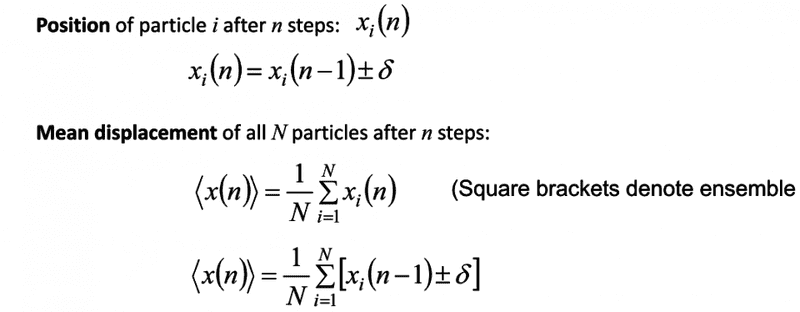
I'm struggling with a probably easy physics question concerning random walks. Here I have the slide regarding this:
Delta is the distance that a particle moves.
upload_2016-1-2_16-32-9.png


Can someone explain where the n-1 initially comes from? Does it have to do wtih the concept of the degrees of freedom?
Than you already! Regards, Vera
 
Physics news on Phys.org
Not sure if I understand the question. So your first equation states that after ##n## steps the particle is at the position it was after the previous step (which is the ##(n-1)##th step) plus some ##\delta##. If you put in ##n=1## you get that the position after the first step is the initial position plus some ##\delta##: ##x_1(1) - x_i(0) \pm \delta##. Every next step a new ##\delta## is added, so of course the position after ##n## steps depends on the position after ##(n-1)## steps. Why do you think this has to do anything with degrees of freedom?
 
  • Like
Likes   Reactions: SansaStark
After ##n-1## steps, particle i is at position ##x_i(n-1)##.
One step after that, at step ##n##, particle i has moved by ##\pm \delta##: therefore ##x_i(n)=x_i(n-1)\pm \delta##.
 
  • Like
Likes   Reactions: SansaStark
The notations ##x_n^{(i)}## and ##<x_n^{(i)} | 1≤i≤N >## might have been less confusing. Or more.
 
Oh okay, thank you. After some thinking ad not giving that much emphasis of on this n-1 (which so muchly looks like the n-1 from the df concept) I finally realized what both of you mean ;) I was really confused about why suddenly this n-1 would appear. But its probably quite reasonable. oO Thanks a lot!
 
@fresh42: More (for I have no clue what the vertical bar means AND SO ON) ;)
 
Another question:
Equation 1.) is followed by equation 2.). In equation 2.) the delta is treated separately as encircled in red colour. Is this just a process of pulling the expression after the sigma sign in equ. 1 apart?
But then, why is the second expression (in the circle) SUBTRACTED from the first part of equ. 2.)? I know it doesn't really matter as delta is 0... but just assume that the encircled expression without the minus in the beginning would equal a positive number. Then the outcome would be different compared to when the expression was negative. I know there's a mistake in thinking but I I just can figure out what's behind this. ^^

1.)
upload_2016-1-2_18-17-55.png
2.)
upload_2016-1-2_18-10-26.png
Just how I'd approach this: The first part of equ. 2.) is the average of all preceding steps (n-1) and the second part is the average of all distances after one step. Then, if I subtract all deltas and assume their average was negative (which just means this whole particle is moving in the opposite direction compared to a positive delta) this would result in a position (x) actually in the opposite direction of the negative delta average for it is subtracted from the first average...

Is that right or complete bullsh**? ;) Thanks!
 

Attachments

  • upload_2016-1-2_18-17-37.png
    upload_2016-1-2_18-17-37.png
    2.2 KB · Views: 662
Last edited: