Which angle has a larger cosine value?

  • Context: MHB 
  • Thread starter Thread starter mathdad
  • Start date Start date
  • Tags Tags
    Angle
Click For Summary
SUMMARY

The discussion centers on comparing the cosine values of two expressions: cos(B - π/2) and cos(θ + π/2). The user calculated cos(B - π/2) to be approximately 0.557 and cos(θ + π/2) to be about 0.731, concluding that cos(θ + π/2) is greater. However, the textbook asserts that cos(B - π/2) is greater, leading to confusion. The correct interpretation of the cosine values and the angles involved is crucial for resolving this discrepancy.

PREREQUISITES
  • Understanding of trigonometric functions, specifically cosine.
  • Familiarity with angle transformations involving π/2.
  • Knowledge of how to evaluate cosine values for specific angles.
  • Basic comprehension of the unit circle and quadrants in trigonometry.
NEXT STEPS
  • Review the properties of cosine transformations, particularly cos(θ + π/2) and cos(θ - π/2).
  • Study the implications of angle quadrants on cosine values.
  • Examine the derivation of cosine values from given expressions like cos(2√6/5) and cos(3/4).
  • Learn about the relationship between angle values and their cosine outputs in different quadrants.
USEFUL FOR

Students and educators in trigonometry, mathematicians analyzing angle transformations, and anyone seeking to clarify misconceptions in cosine function evaluations.

mathdad
Messages
1,280
Reaction score
0
We are given the following:

Let B = beta

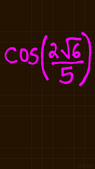
cos B = cos (2_/6)/5

cos θ = cos 3/4

Which angle is larger:

cos (B - π/2) or cos (θ + π/2)?

I found cos (B - π/2) to be about 0.557.

I found cos (θ + π/2 to be about 0.731.

So, 0.731 > 0.557.

My answer is cos (θ + π/2) > cos (B - π/2).

Book's answer is cos (B - π/2) > cos (θ + π/2).

Why is my answer wrong?
 
Mathematics news on Phys.org
what is this value supposed to be?

(2_/6)/5
 

Attachments

  • sDraw_2018-03-16_12-06-55.png
    sDraw_2018-03-16_12-06-55.png
    7.4 KB · Views: 110
recheck the problem ... are you sure it's not

$\cos{\beta} = \dfrac{2\sqrt{6}}{5}$ and $\cos{\theta} = \dfrac{3}{4}$

instead of

$\cos{\beta} = \cos\left(\dfrac{2\sqrt{6}}{5}\right)$ and $\cos{\theta} = \cos\left(\dfrac{3}{4}\right)$

?
 
Yes, you are right. So, why is the textbook right? Why is my answer wrong?
 
RTCNTC said:
Yes, you are right. So, why is the textbook right? Why is my answer wrong?

one more note regarding the problem statement ...

Which angle is larger:

cos (B - π/2) or cos (θ + π/2)?

$\cos\left(\beta - \dfrac{\pi}{2}\right)$ and $\cos\left(\theta + \dfrac{\pi}{2}\right)$ are not angle values ... maybe which value of cosine is larger?

one more question, does the problem statement say anything about which quadrant(s) $\beta$ and $\theta$ terminate?
 
Last edited by a moderator:
skeeter said:
one more note regarding the problem statement ...
$\cos\left(\beta - \dfrac{\pi}{2}\right)$ and $\cos\left(\theta + \dfrac{\pi}{2}\right)$ are not angle values ... maybe which value of cosine is larger?

one more question, does the problem statement say anything about which quadrant(s) $\beta$ and $\theta$ terminate?

I need to get back to you. I will look in the textbook.
 

Similar threads

  • · Replies 7 ·
Replies
7
Views
3K
  • · Replies 2 ·
Replies
2
Views
2K
Replies
3
Views
2K
  • · Replies 6 ·
Replies
6
Views
1K
  • · Replies 1 ·
Replies
1
Views
2K
  • · Replies 5 ·
Replies
5
Views
3K
  • · Replies 1 ·
Replies
1
Views
2K
  • · Replies 1 ·
Replies
1
Views
2K
  • · Replies 2 ·
Replies
2
Views
2K
  • · Replies 2 ·
Replies
2
Views
2K