Which interactions proceed by which fundamental force?

Click For Summary

Homework Help Overview

The discussion revolves around identifying which fundamental forces govern various neutron reactions, particularly in the context of an Intro to Modern Physics course. Participants are exploring the electromagnetic, weak, and strong forces as they relate to particle interactions.

Discussion Character

  • Exploratory, Conceptual clarification, Assumption checking

Approaches and Questions Raised

  • Participants are attempting to categorize neutron reactions based on the fundamental forces involved, questioning the reasoning behind their classifications. There is a focus on specific interactions, such as the presence of neutrinos and photons, and how these relate to the forces at play.

Discussion Status

The discussion is active, with participants sharing their thoughts and reasoning. Some have provided partial confirmations of ideas, while others are prompting further exploration of the relationships between particles and forces. There is an ongoing examination of examples and counterexamples to clarify understanding.

Contextual Notes

Participants express difficulty in finding clear guidelines in their textbooks and online resources, indicating a potential gap in accessible information regarding the classification of interactions by fundamental forces.

cp255
Messages
54
Reaction score
0
User informed about mandatory use of homework template.
I have been getting ready for my Intro to Modern Physics final. The professor likes to ask a lot of questions like

Which of the following neutron reactions proceeds via the electromagnetic force?

Or something like this...
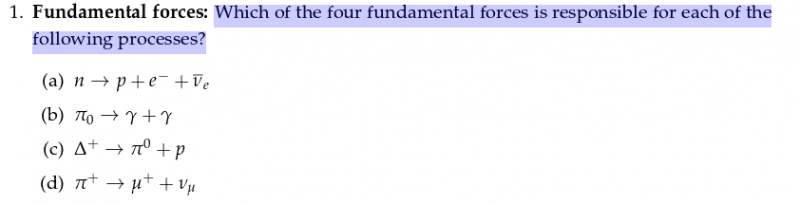
Screenshot from 2015-04-25 00:00:14.png


I have been looking all over the internet and my textbook. All I can find is kind of vague guidelines for this. How would I go about figuring it out?

I think the answers are Weak, EM, Strong, Weak (Just not completely sure why).
 
Last edited:
Physics news on Phys.org
cp255 said:
I think the answers are Weak, EM, Strong, Weak (Just not completely sure why).
You say you are not sure why, but what do you think?
 
I think I might have figure it out.

a) The weak force is needed to produce nutrinos.
b) If there are photons this implies EM
c) Strong because of baryons.
d) Weak because of neutrinos.
 
cp255 said:
a) The weak force is needed to produce nutrinos.
Correct. Neutrinos only interact through the weak interactions.
cp255 said:
b) If there are photons this implies EM
What about ##\pi^+ \to \mu^+ + \nu_\mu + \gamma##? This has photons, but also neutrinos.
cp255 said:
c) Strong because of baryons.
What about ##K^+ \to \pi^+ + \pi^0## or ##\Lambda \to p + \pi^-##?
cp255 said:
d) Weak because of neutrinos.
Correct.
 
cp255 said:
I have been looking all over the internet and my textbook. All I can find is kind of vague guidelines for this. How would I go about figuring it out?
If you're familiar with Feynman diagrams, try drawing the ones that represent a particular decay.
 

Similar threads

  • · Replies 13 ·
Replies
13
Views
2K
  • · Replies 15 ·
Replies
15
Views
4K
  • · Replies 4 ·
Replies
4
Views
3K
  • · Replies 4 ·
Replies
4
Views
3K
  • · Replies 4 ·
Replies
4
Views
5K
  • · Replies 5 ·
Replies
5
Views
4K
  • · Replies 8 ·
Replies
8
Views
3K
  • · Replies 1 ·
Replies
1
Views
4K
  • · Replies 8 ·
Replies
8
Views
2K
  • · Replies 13 ·
Replies
13
Views
2K