Why are fractions sometimes written as such: (A/B)/C?

  • Level: Undergrad 
  • Thread starter ItsTheSebbe
  • Start date
  • Tags Tags
    Fractions
1 reply · 1K views · last reply
ItsTheSebbe
Messages
10
Reaction score
1
In my physics courses I have seen this kind of notation several times now: $$ \frac {A/B} {C}$$

For instance:
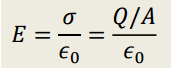
Equation E = σ/ε₀ = (Q/A)/ε₀, where E is the electric field, σ is surface charge density, Q is charge, A is area and ε₀ is the permittivity of free space.

or
Two equations for thermal expansion. Top, labelled volume: β = (ΔV/V)/ΔT. Bottom, labelled length: α = (ΔL/L)/ΔT.


To me it doesn't seem intuitive and ## \frac A {BC}## would seem like a neater way of writing it. Therefore I wonder if there's any specific reason to why people write it like this.
 
Your examples have one thing in common: they describe a rate of a quantity. The quantities are normed, i.e. they are something per unit of something. The notation ##\frac{A/B}{C}## emphasizes what it is about, namely the change of a special ratio, whereas ##\frac{A}{BC}## disguises this physically important difference even if not wrong.