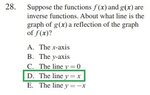
pan90 Messages 4 Reaction score 0 Thread starter Jul 30, 2019 #1 Can anyone explain the logic behind the answer? View attachment 9221 Taken from HiSet free practice test Attachments functions inverse prob.jpg 9.2 KB · Views: 147
Can anyone explain the logic behind the answer? View attachment 9221 Taken from HiSet free practice test
MarkFL Gold Member MHB Messages 13,284 Reaction score 12 Jul 30, 2019 #2 Suppose we have the point: $$(x,f(x))$$ on the plot of \(f(x)\). Then, on the plot of \(g(x)\), we must have the corresponding point: $$(f(x),x)$$ Now, consider that for all possible points, the locus of the mid-points is: $$\left(\frac{x+f(x)}{2},\frac{x+f(x)}{2}\right)$$ Thereby implying that the line of symmetry must be: $$y=x$$
Suppose we have the point: $$(x,f(x))$$ on the plot of \(f(x)\). Then, on the plot of \(g(x)\), we must have the corresponding point: $$(f(x),x)$$ Now, consider that for all possible points, the locus of the mid-points is: $$\left(\frac{x+f(x)}{2},\frac{x+f(x)}{2}\right)$$ Thereby implying that the line of symmetry must be: $$y=x$$