nazopo
- 2
- 0
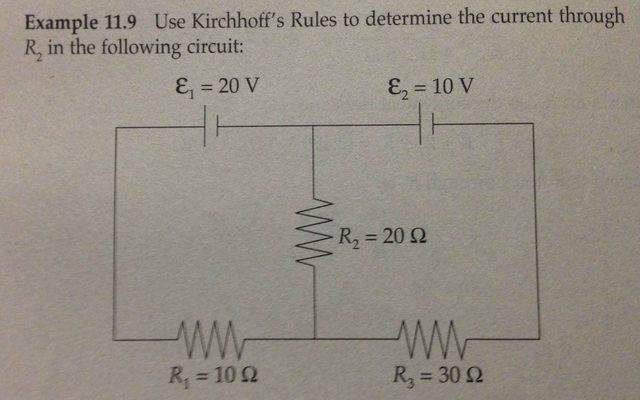
In the Princeton Review Cracking the AP Physics C Exam 2011 Edition book on example 11.9's solution, one of the batteries' terminals are swapped (the battery with 10V). I am not sure why the author's do this considering the current is drawn the same. Later on in the solution, they recognize that the terminals are switched when they state that the potential drops as a result of going from positive to negative (even though originally it was negative to positive).
PROBLEM:
Use Kirchhoff's Rules to determine the current through R2 in the following circuit:
WHERE I'M LOST:
I circled the parts of the illustration where the battery terminals are switched.
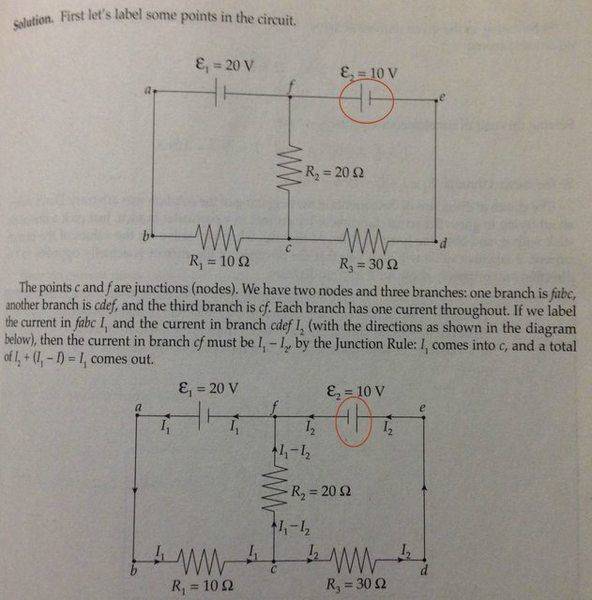
During the explanation of the solution, it states that "From e to f, we travel through E2 from the positive to the negative terminal, so the potential drops by E2." so their intentions were to switch the terminals but I'm not sure why we are allowed to do that.
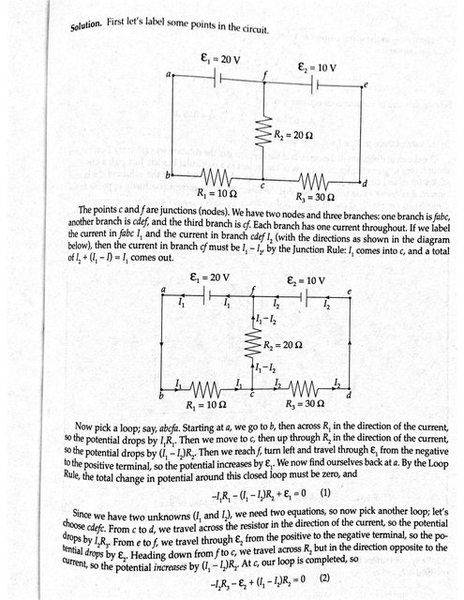
Here is a full page scan of most of the solution(the little bit that is not included here is not necessarily essential in this case)
PROBLEM:
Use Kirchhoff's Rules to determine the current through R2 in the following circuit:
WHERE I'M LOST:
I circled the parts of the illustration where the battery terminals are switched.
During the explanation of the solution, it states that "From e to f, we travel through E2 from the positive to the negative terminal, so the potential drops by E2." so their intentions were to switch the terminals but I'm not sure why we are allowed to do that.
Here is a full page scan of most of the solution(the little bit that is not included here is not necessarily essential in this case)
Last edited: