Why do exponential functions occur outside of finite walls?

  • Context: Undergrad 
  • Thread starter Thread starter jjson775
  • Start date Start date
  • Tags Tags
    Finite Quantum
Click For Summary
SUMMARY

The discussion centers on the solutions to the time-independent Schrödinger equation within and outside a finite potential well. Inside the well, where the potential energy (U0) is less than the mechanical energy (E), the solutions are sine and cosine functions. Outside the well, where U0 is greater than E, the solutions are hyperbolic sine (sinh) and hyperbolic cosine (cosh) functions, which are exponential in nature. The participants emphasize that while one can verify these solutions, understanding the logical connection requires familiarity with differential equations.

PREREQUISITES
  • Understanding of the time-independent Schrödinger equation
  • Knowledge of potential wells in quantum mechanics
  • Familiarity with differential equations
  • Basic concepts of hyperbolic functions (sinh and cosh)
NEXT STEPS
  • Study the time-independent Schrödinger equation in quantum mechanics
  • Learn about potential wells and their implications in quantum systems
  • Review differential equations, focusing on solutions involving exponential functions
  • Explore hyperbolic functions and their applications in physics
USEFUL FOR

Students and professionals in physics, particularly those studying quantum mechanics, as well as anyone seeking to deepen their understanding of differential equations and their applications in physical systems.

jjson775
Messages
112
Reaction score
26
TL;DR
Why are exponential functions the solution to the time independent Schrödinger equation outside the walls of a finite well?
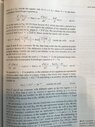
Between the walls of a finite well, the solution to the time independent Schrödinger equation is a combination of sines and cosines. Outside the walls where E - Uo is positive, the solutions are exponential functions. Why?
 

Attachments

  • IMG_0232.jpeg
    IMG_0232.jpeg
    62.9 KB · Views: 102
Physics news on Phys.org
Those are the solutions to the differential equation in each case. You can directly check they are solutions, even if you don't know how to solve the equations themselves.
 
  • Like
Likes   Reactions: Vanadium 50
I understand that and have checked the solutions. The wording of the text is “Uo - E is positive, so the solutions are exponential functions“. Is this supposed to follow logically? If you drop the word “so”, I am OK.
 
If the particle is inside the well (which I think is U0 - E < 0 im your notation), the solutions are sines and cosines. If it is outside (which I think is U0 - E > 0 im your notation) the solutions are siinh and cosh, i.e. exponential.

As mentioned, you can verify these solutions even if you cannot solve for them,
 
  • Like
Likes   Reactions: vanhees71
Vanadium 50 said:
If the particle is inside the well (which I think is U0 - E < 0 im your notation), the solutions are sines and cosines. If it is outside (which I think is U0 - E > 0 im your notation) the solutions are siinh and cosh, i.e. exponential.

As mentioned, you can verify these solutions even if you cannot solve for them,
That’s what I said In my post. My reply to PeroK shows my point of confusion. Also, my post has a typo, should have been Uo - E, potential energy > mechanical energy.
 
jjson775 said:
The wording of the text is “Uo - E is positive, so the solutions are exponential functions“. Is this supposed to follow logically?
Yes, by solving the relevant differential equations. If you are unable to solve them yourself, you will not be able to make the logical connection in question yourself. But you can still verify the connection by verifying that exponentials are solutions.
 
  • Like
Likes   Reactions: vanhees71
Alright. You can’t tell by inspection that the solutions are exponential just because Uo > E is positive, but through solution of the differential equations. I have verified the solutions.
 
jjson775 said:
You can’t tell by inspection that the solutions are exponential just because Uo > E is positive
Well, people who are familiar enough with the relevant differential equations can, because they already have more than enough experience in solving them. Any veteran of a college level differential equations course will understand what I mean. :wink:
 
  • Like
Likes   Reactions: mattt, vanhees71 and Vanadium 50
I don't know what to tell you. It seems like you are saying that you can't do the math and can;t follow the words, but also don't want to trust what the people who do say. You've kind of painted yourself into a corner there.
 
  • Like
Likes   Reactions: vanhees71
  • #10
PeterDonis said:
Well, people who are familiar enough with the relevant differential equations can, because they already have more than enough experience in solving them. Any veteran of a college level differential equations course will understand what I mean. :wink:
Your answer is what I was looking for. Thanks. I did take differential equations 60+ years ago but never used it professionally.
 
  • Like
Likes   Reactions: vanhees71 and berkeman

Similar threads

  • · Replies 4 ·
Replies
4
Views
2K
  • · Replies 5 ·
Replies
5
Views
2K
  • · Replies 10 ·
Replies
10
Views
2K
  • · Replies 24 ·
Replies
24
Views
3K
  • · Replies 6 ·
Replies
6
Views
2K
  • · Replies 2 ·
Replies
2
Views
2K
  • · Replies 1 ·
Replies
1
Views
2K
  • · Replies 9 ·
Replies
9
Views
3K
  • · Replies 12 ·
Replies
12
Views
12K
  • · Replies 39 ·
2
Replies
39
Views
5K