Acez
- 5
- 0
Solving displacement using compoenents
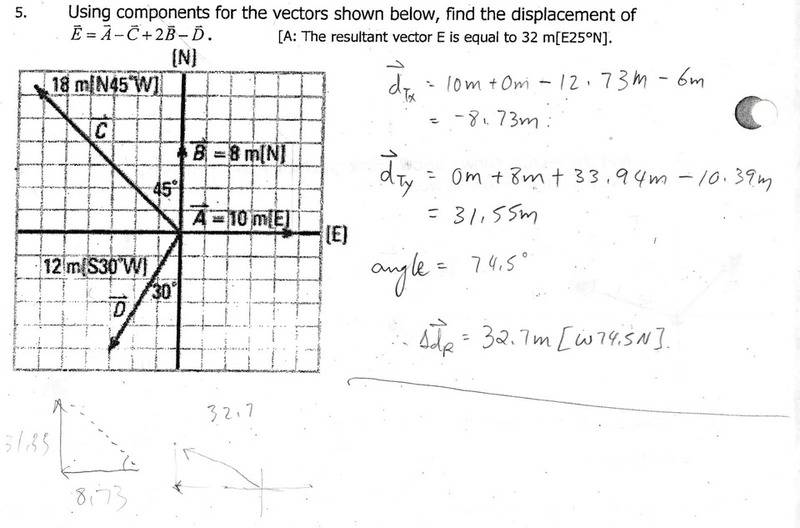
I decided to use the horizontal and vertical component method to solve for the displacement of E and got the answer 32.7m [W74.5N] (above). However the answer provided by the question states that the resultant vector E is actually 32m [E25N] (above)
Please refer to the above pic.
Am I using the correct approach to solve for the resultant vector E/displacement of E=A-C+2B-D?
Please help
Homework Statement
Homework Equations
I decided to use the horizontal and vertical component method to solve for the displacement of E and got the answer 32.7m [W74.5N] (above). However the answer provided by the question states that the resultant vector E is actually 32m [E25N] (above)
The Attempt at a Solution
Please refer to the above pic.
Am I using the correct approach to solve for the resultant vector E/displacement of E=A-C+2B-D?
Please help
Last edited: