Why Do We Draw Dimensionless Unit Vectors in Diagrams?

Click For Summary

Discussion Overview

The discussion revolves around the nature of unit vectors, particularly their dimensionality and representation in diagrams. Participants explore whether unit vectors are truly dimensionless and how they relate to physical quantities that have dimensions, such as velocity and force. The conversation includes theoretical considerations, conceptual clarifications, and some debate regarding the implications of drawing unit vectors in a physical context.

Discussion Character

  • Debate/contested
  • Conceptual clarification
  • Exploratory

Main Points Raised

  • Some participants assert that unit vectors are dimensionless and have a magnitude of 1, while others argue that vectors themselves have dimensions in a physical context.
  • There is a contention about whether the norm of a vector can be considered dimensionless, with some stating that it is a scalar and others disagreeing.
  • Participants discuss the implications of drawing unit vectors, questioning how a dimensionless vector can be represented visually and suggesting that the length of the vector in diagrams is determined by the context of the drawing.
  • Some contributions emphasize that while unit vectors indicate direction and are dimensionless, they are often used alongside scalar quantities that do have dimensions, leading to confusion.
  • There is a proposal that unit vectors regain their dimensionality when drawn, as they are scaled by the units of the diagram.
  • Several participants highlight the distinction between vectors as physical quantities with dimensions and unit vectors as abstract representations of direction.

Areas of Agreement / Disagreement

Participants do not reach a consensus on the dimensionality of unit vectors. Some agree that unit vectors are dimensionless, while others maintain that vectors in physics have dimensions. The discussion remains unresolved with competing views on the nature of unit vectors and their representation.

Contextual Notes

Limitations include varying interpretations of dimensionality in different contexts, the dependence on definitions of vectors and scalars, and the ambiguity in how unit vectors are represented in diagrams.

etotheipi
A unit vector, ##\frac{\vec{v}}{|\vec{v}|}##, has dimensions of ##\frac{L}{L} = 1##, i.e. it is dimensionless. It has magnitude of 1, no units.

For a physical coordinate system, the coordinate functions ##x^i## have some units of length, e.g. ##\vec{x} = (3\text{cm})\hat{x}_1 + (6\text{cm})\hat{x}_2##. For instance, the axes might arbitrarily be labelled with values in "centimetres": however this choice itself is not too important since there is a one-to-one correspondence between the values of any given length measured in two different units.

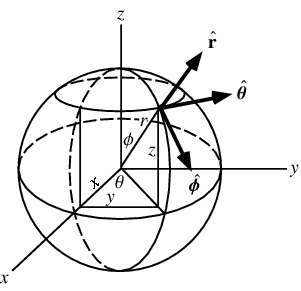
We often draw the unit vectors inside the Euclidian space, like this:
1592089848421.png


However, if the unit vectors are dimensionless, why does it make sense to draw them on the diagram? That is to say, how do you judge how long a length of a "vector of magnitude 1 (dimensionless)" is?
 
Last edited by a moderator:
  • Like
Likes   Reactions: Lnewqban
Mathematics news on Phys.org
Vectors itself don't have dimensions (in the physical sense).

What would be the dimension of the vector ##(1,2,3)= e_1 + 2e_2 + 3e_3 \in \mathbb{R}^3##?
 
It is not dimensionless. ##|\vec{v}|## is considered a dimensionless scalar. Otherwise ##\left|\dfrac{\vec{v}}{|\vec{v}|}\right|\neq \dfrac{|\vec{v}|}{|\vec{v}|}=1## since only scalars can pulled out of the absolute value function. Thus the unit vector keep the dimension of the vector.
 
  • Like
Likes   Reactions: Adesh
Math_QED said:
Vectors don't have dimensions (in the physical sense).

What would be the dimension of the vector ##(1,2,3) \in \mathbb{R}^3##?
They do in physics, e.g.velocity has a dimension ##LT^{-1}##.
 
fresh_42 said:
They do in physics, e.g.velocity has a dimension ##LT^{-1}##.

Yes, but can't you always reduce a vector to a scalar by taking the norm? I was never taught to assign a dimension to a non-scalar quantity. But I didn't have much physics to begin with, so I may be completely wrong here.
 
fresh_42 said:
It is not dimensionless. ##|\vec{v}|## is considered a dimensionless scalar. Otherwise ##\left|\dfrac{\vec{v}}{|\vec{v}|}\right|\neq \dfrac{|\vec{v}|}{|\vec{v}|}=1## since only scalars can pulled out of the absolute value function. Thus the unit vector keep the dimension of the vector.

These notes suggested to me that a unit vector is dimensionless, and of magnitude 1, whilst the vector components and the magnitude of the vector have dimensions. Specifically,
A unit vector is a dimensionless vector one unit in length used only to specify a given direction

Doesn't it make sense to say ##|\vec{v}| = 10\text{ms}^{-1}##?
 
Math_QED said:
Yes, but can't you always reduce a vector to a scalar by taking the norm? I was never taught to assign a dimension to a non-scalar quantity. But I didn't have much physics to begin with, so I may be completely wrong here.
IMO it should be mandatory to note all units throughout a physical calculation. Thus the vectors have units and therewith a dimension.

Maybe I was wrong to consider the length dimensionless, and the unit vector shouldn't have one and it is a pure direction. Then the solution of the paradoxon is that it only regains its dimension if drawn, i.e. we actually draw ##\dfrac{\vec{v}}{|\vec{v}|}\cdot |\vec{1}|## where ##\vec{1}## carries the units of our drawing.

The typical case is ##|\vec{v}|=\sqrt{v_1^2[m^2]+\ldots+v_n^2[m^2]}= \ldots [m].##

I officially declare post #3 wrong.
 
Last edited:
  • Haha
  • Like
Likes   Reactions: S.G. Janssens and etotheipi
fresh_42 said:
Then the solution of the paradox is that it only regains its dimension if drawn, i.e. we actually draw ##\dfrac{\vec{v}}{|\vec{v}|}\cdot |\vec{1}|## where ##\vec{1}## carries the units of our drawing.

I see! That makes sense. Thanks!
 
Last edited by a moderator:
etotheipi said:
These notes suggested to me that a unit vector is dimensionless, and of magnitude 1, whilst the vector components and the magnitude of the vector have dimensions. Specifically,
A unit vector is a dimensionless vector one unit in length used only to specify a given direction

Doesn't it make sense to say ##|\vec{v}| = 10\text{ms}^{-1}##?
In the linked-to notes, the examples are either vectors with no dimensions given or one about the coordinates of a park in Salt Lake City, in which he was careful to exclude any information about units.

None of the examples deals with vector quantities such as velocity or force, that do have dimensions. If you have a vector that represents the wind's velocity, a unit vector in the same direction would have the same units: miles per hour, or km per hour, or whatever.
 
  • #10
I think a unit vector is considered dimensionless and only indicates a direction.

However when paired with a scalar quantity such as speed it becomes a vector quantity velocity.
 
  • Like
Likes   Reactions: archaic, etotheipi, PeroK and 1 other person
  • #11
jedishrfu said:
I think a unit vector is considered dimensionless and only indicates a direction.
I disagree. Forces are vectors, as are velocities, accelerations, and many other physical entities.
If you multiply a vector by a scalar, you get a new vector that points in the same or opposite direction, but still having the same units (e.g. Newtons, pounds, whatever). If you multiply a vector by the reciprocal of its magnitude/norm, the new vector still has the same units, but has a magnitude of 1.
jedishrfu said:
However when paired with a scalar quantity such as speed it becomes a vector quantity velocity.
... which has the same units.
 
  • Skeptical
Likes   Reactions: weirdoguy
  • #12
Mark44 said:
I disagree. Forces are vectors, as are velocities, accelerations, and many other physical entities.
If you multiply a vector by a scalar, you get a new vector that points in the same or opposite direction, but still having the same units (e.g. Newtons, pounds, whatever). If you multiply a vector by the reciprocal of its magnitude/norm, the new vector still has the same units, but has a magnitude of 1.
... which has the same units.

A unit vector is, by definition, dimensionless and independent of the units. In both SI and Imperial units, for example, a unit vector has magnitude ##1## and not ##1m## or ##1ft## respectively.

The units come from the quantity you multiply the unit vector by.
 
  • Like
Likes   Reactions: yosmod04, Adesh and etotheipi
  • #13
I agree that unit vectors are dimensionless.

When we draw them we probably do silently a convention that they are in the units of the diagram in which we draw them at.
 
  • Like
Likes   Reactions: robphy and etotheipi
  • #14
In an expression like
$$
\vec{v} = v_x \hat{\imath} + v_y \hat{\jmath} + v_z \hat{k}
$$
I expect the ##v_i##'s to have units of velocity, not ##\{ \hat{\imath}, \hat{\jmath}, \hat{k} \}##.
 
  • Like
Likes   Reactions: wrobel, archaic, Vanadium 50 and 4 others
  • #15
We’re conflating two concepts into one here. A vector may represent a physical quantity such a position, velocity, acceleration ... with units of measure but it may also represent simply a direction without any units.

In physics, you get used to the notion that in some instances a vector has units and in other instances it doesn’t. When a vector is divided by its length, you get a unitless unit vector. This vector is useful for determining direction. It’s components are known as direction cosines.

When describing vector quantities, we often use unit vectors like i, j, and k in vector expressions like

$$x \hat {i} + y \hat {j}+z \hat {k} $$

where it is understood that x,y and z have units of measure but the i,j,k unit vectors do not.
 
Last edited:
  • Like
Likes   Reactions: Adesh
  • #16
etotheipi said:
However, if the unit vectors are dimensionless, why does it make sense to draw them on the diagram? That is to say, how do you judge how long a length of a "vector of magnitude 1 (dimensionless)" is?

The appropriate length of the unit vector is determined not by the vector nor by the pencil but by the paper...:smile:
 
  • #17
hutchphd said:
The appropriate length of the unit vector is determined not by the vector nor by the pencil but by the paper...:smile:
Or short: You cannot draw pure direction.
 
  • Like
Likes   Reactions: etotheipi

Similar threads

  • · Replies 1 ·
Replies
1
Views
3K
  • · Replies 1 ·
Replies
1
Views
2K
  • · Replies 13 ·
Replies
13
Views
3K
Replies
11
Views
2K
  • · Replies 3 ·
Replies
3
Views
3K
  • · Replies 14 ·
Replies
14
Views
3K
Replies
1
Views
1K
  • · Replies 5 ·
Replies
5
Views
2K
  • · Replies 42 ·
2
Replies
42
Views
5K
Replies
1
Views
3K