Math Amateur
Gold Member
MHB
- 3,920
- 48
- TL;DR
- I need further help in order to fully understand an example concerning convergence in the space of real numbers with the co-countable topology ...
I am reading Tej Bahadur Singh: Elements of Topology, CRC Press, 2013 ... ... and am currently focused on Chapter 4, Section 4.1: Sequences ...
I need some further help in order to fully understand Example 4.1.1 ...Example 4.1.1 reads as follows:
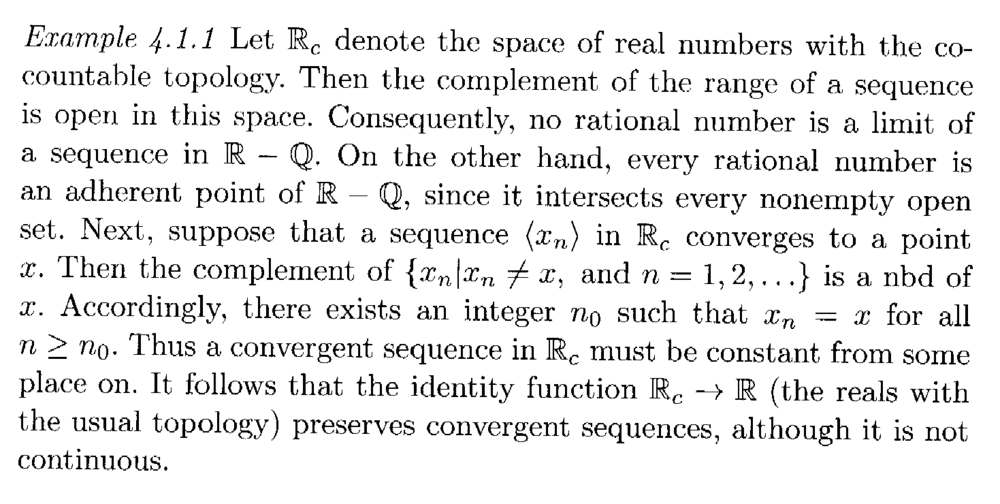 In the above example from Singh we read the following:
" ... ...Then the complement of ##\{ x_n \ | \ x_n \neq x \text{ and } n = 1,2, ... \}## is a nbd of ##x##. Accordingly, there exists an integer ##n_0## such that ##x_n = x## for all ##n \geq n_0##. ... ... "My question is as follows: Why, if the complement of ##\{ x_n \ | \ x_n \neq x## and ##n = 1,2, ... \}## is a nbd of ##x## does there exist an integer ##n_0## such that ##x_n = x## for all ##n \geq n_0##. ... ... ?Help will be much appreciated ... ...
Peter
=====================================================================================It may help readers of the above post to have access to Singh's definition of a neighborhood and to the start of Chapter 4 (which gives the relevant definitions) ... so I am providing the text as follows:

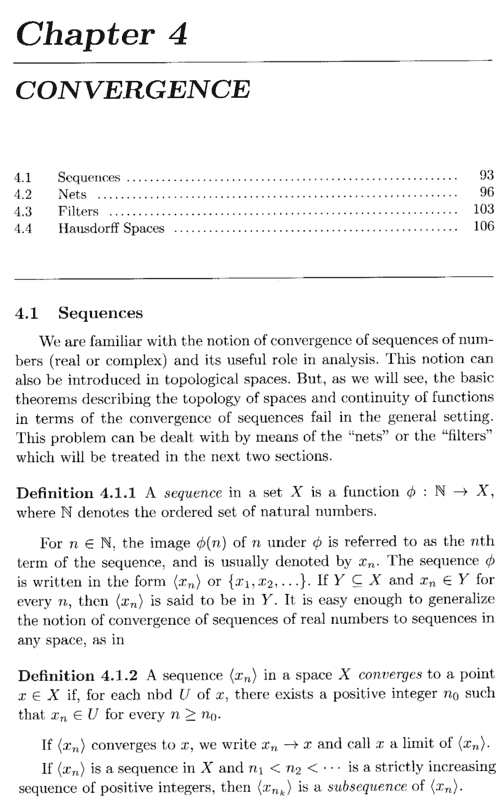
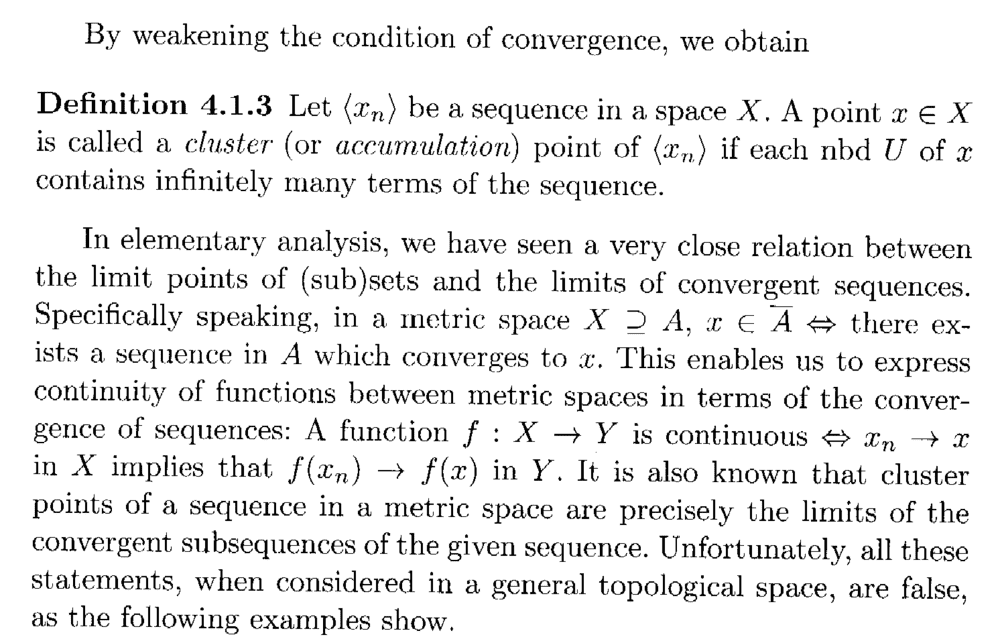
Hope that helps ...
Peter
I need some further help in order to fully understand Example 4.1.1 ...Example 4.1.1 reads as follows:
" ... ...Then the complement of ##\{ x_n \ | \ x_n \neq x \text{ and } n = 1,2, ... \}## is a nbd of ##x##. Accordingly, there exists an integer ##n_0## such that ##x_n = x## for all ##n \geq n_0##. ... ... "My question is as follows: Why, if the complement of ##\{ x_n \ | \ x_n \neq x## and ##n = 1,2, ... \}## is a nbd of ##x## does there exist an integer ##n_0## such that ##x_n = x## for all ##n \geq n_0##. ... ... ?Help will be much appreciated ... ...
Peter
=====================================================================================It may help readers of the above post to have access to Singh's definition of a neighborhood and to the start of Chapter 4 (which gives the relevant definitions) ... so I am providing the text as follows:
Hope that helps ...
Peter