ge.vasiliou
- 9
- 0
Hi guys,
For one more time I need your opinion in a kind of strange issue, which escapes my understanding.
Performing a single line to ground short circuit calculations (Low Voltage Side) in a simple Generator power plant using a step up to transformer, we can observe the two following facts:
1. For a stand alone generator (not parallel to the grid) single line to ground fault current (low voltage side) equals to 30kA. This value actually represents that behavior of the generator itself.
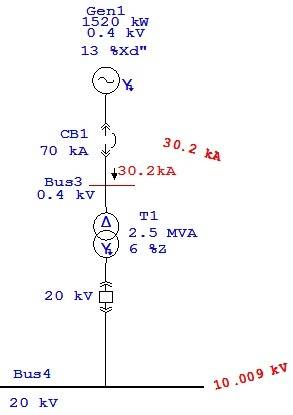
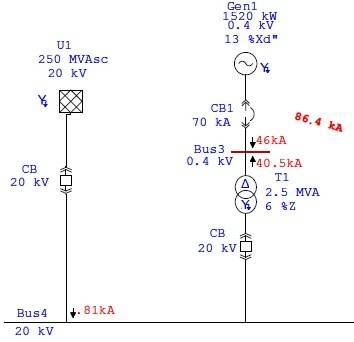
2. If generator works in parallel to the existed grid, results of the short circuit fault current calculation equals to 86,4kA. This total fault current splits to 46kA coming from Generator side, and rest 40,5 kA come from grid side.
The question is:
Since generator as a source is capable to provide 30kA on it's own, how is it possible in a parallel to grid configuration to have 46 kA coming from the generator side?
It seems 16 kA have been added to the generator side. Is this fault current actually going thru generator windings?
PS1 : Please notice that the above results in both cases can be reached either by a simulation software or by hand calculations using symmetrical components analysis.
PS 2: Quick Description of equipment:
Generator is 1,9MVA , cosF 0,8, 400Volts, 50Hz, Star connected, solid grounding, Xd'' = 0,13 p.u and Xo=0,02p.u. Step Up Transformer is 2,5 MVA, 6% impedance, Delta connection at LV Side, Star Connection (solid grounding) at 20kV Side. Grid is 20 kV , 250MVAsc, star – solid ground.
For one more time I need your opinion in a kind of strange issue, which escapes my understanding.
Performing a single line to ground short circuit calculations (Low Voltage Side) in a simple Generator power plant using a step up to transformer, we can observe the two following facts:
1. For a stand alone generator (not parallel to the grid) single line to ground fault current (low voltage side) equals to 30kA. This value actually represents that behavior of the generator itself.
2. If generator works in parallel to the existed grid, results of the short circuit fault current calculation equals to 86,4kA. This total fault current splits to 46kA coming from Generator side, and rest 40,5 kA come from grid side.
The question is:
Since generator as a source is capable to provide 30kA on it's own, how is it possible in a parallel to grid configuration to have 46 kA coming from the generator side?
It seems 16 kA have been added to the generator side. Is this fault current actually going thru generator windings?
PS1 : Please notice that the above results in both cases can be reached either by a simulation software or by hand calculations using symmetrical components analysis.
PS 2: Quick Description of equipment:
Generator is 1,9MVA , cosF 0,8, 400Volts, 50Hz, Star connected, solid grounding, Xd'' = 0,13 p.u and Xo=0,02p.u. Step Up Transformer is 2,5 MVA, 6% impedance, Delta connection at LV Side, Star Connection (solid grounding) at 20kV Side. Grid is 20 kV , 250MVAsc, star – solid ground.