Why does my integrator pole disappear when I simplify this?

  • Context: Engineering 
  • Thread starter Thread starter CoolDude420
  • Start date Start date
  • Tags Tags
    Pole Simplify
Join the discussion
Ask a follow-up here, or get your own question answered by working scientists, mathematicians and engineers — people, not an autocomplete.
Real named experts · corrections over time · the nuance an AI answer skips
4 replies · 2K views
CoolDude420
Messages
199
Reaction score
9
Homework Statement
I have a 2nd order low-pass filter (expected to be driven by a current source) that I know has an integrator pole, a LHP pole and a LHP zero.

I need to find the location of these which I am doing by trying to find the impedance of this circuit.
Relevant Equations
n/a
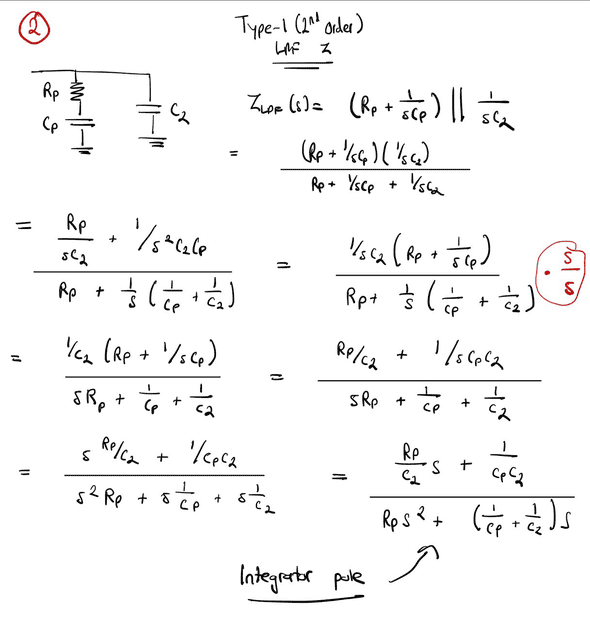
I have tried two attempts at this and the strange this is - depending on where and how I apply my algebraic simplification (multiplying by s/s), I get a different answer. In attempt 1, I lose the integrator s=0 pole some how but in attempt 2, it's all fine.

Attempt 1
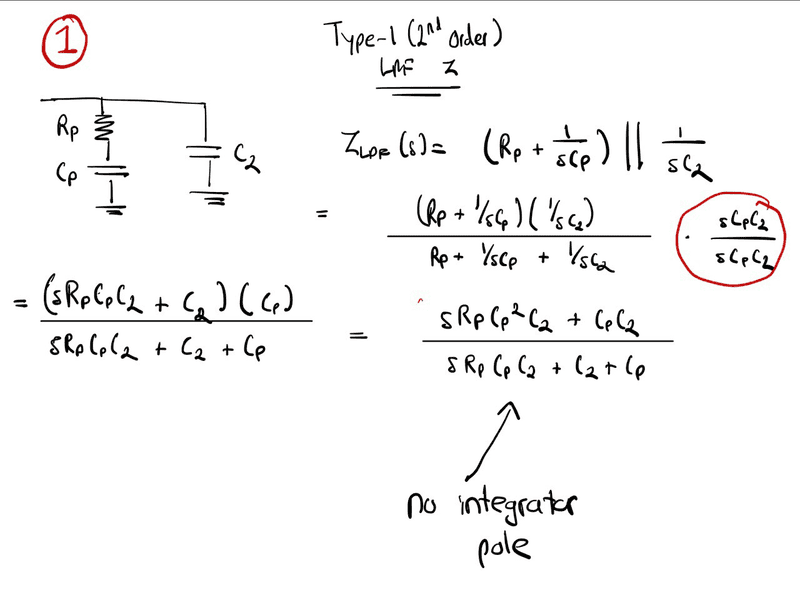
1714300951872.png


Attempt 2
1714300980690.png


PS: I have not completed this, my question is purely regarding why does the integrator pole dissapear.

So, why does the integrator pole in attempt 1 disappear but not in attempt 2?? I am really confused!
 
Physics news on Phys.org
1714309976049.png

BLUE BOX should be
[tex]R_\rho C_\rho +1/s[/tex]
which makes attempts 1 and 2 have same result.
 
Reply
  • Like
Likes   Reactions: berkeman and BvU
anuttarasammyak said:
View attachment 344193
BLUE BOX should be
[tex]R_\rho C_\rho +1/s[/tex]
which makes attempts 1 and 2 have same result.
Oops. Can't believe I did that even though I reviewed my work 3 times! I was going crazy!
Thank you.
 
Reply
  • Like
Likes   Reactions: berkeman
anuttarasammyak said:
View attachment 344193
BLUE BOX should be
[tex]R_\rho C_\rho +1/s[/tex]
which makes attempts 1 and 2 have same result.
A follow up question - does it matter when I equate the denominator to 0 to get the poles. For example, if I replaced the blue box with [tex]R_\rho C_\rho +1/s[/tex], there would a 1/s term at the top, yet the bottom would be unchanged. If I just left the 1/s term on top and equated the bottom to zero at this stage of the work, I would still lose my s = 0 pole.

Do I have to ensure that the entire function is in standard terms of 's' and no quotients before equating to zero?
 
The result of attempt 2 would be written as
[tex]\frac{A}{s}+\frac{B}{s+c}[/tex]
where
[tex]c=R_\rho^{-1}(C_\rho^{-1}+C_2^{-1})[/tex]
You can get constants A and B by calculation. You find it sum of simple pole functions. You do not have to do this reduction in applying residue theorem. The result of attempt 2 is well enough to do it. But be cafeful in your formula so that numerator does not diverge at poles.
 
Last edited:
Reply
  • Like
Likes   Reactions: berkeman