Why does the dot product in this solution equal zero?

Join the discussion
Ask a follow-up here, or get your own question answered by working scientists, mathematicians and engineers — people, not an autocomplete.
Real named experts · corrections over time · the nuance an AI answer skips
3 replies · 2K views
Darkmisc
Messages
222
Reaction score
31
Homework Statement
Prove that the medians bisecting the equal sides of an isosceles triangle are equal.
Relevant Equations
a · b = |a| × |b| × cos(θ)
a · b = ax × bx + ay × by
Hi everyone

I have the solutions for the problem. It makes sense except for one particular step.

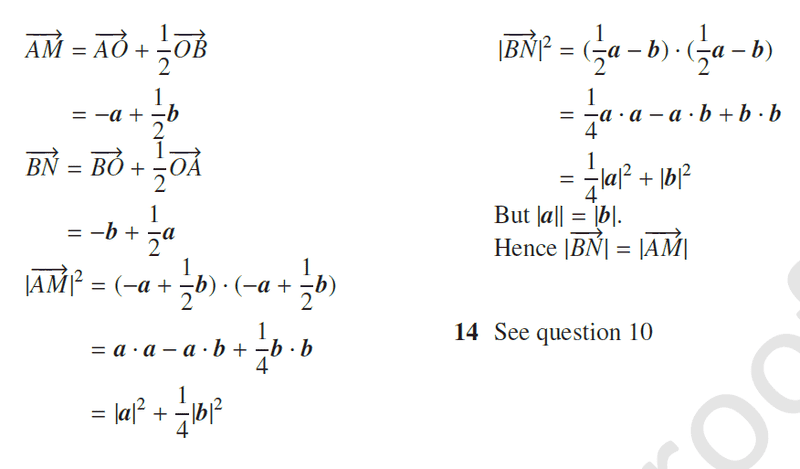
Why does the dot product of a and b equal zero? I thought this would only be the case if a and b were at right angles to each other. The solutions seem to be a general proof and should work for all isosceles triangles (not just right angle triangles).

The solution would still make sense even if a · b didn't equal zero. Why does it equal zero here?

Thanks
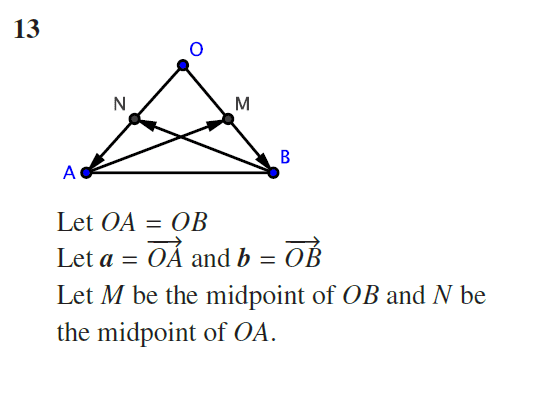
image_2022-09-21_131238624.png

image_2022-09-21_131315774.png
 
Physics news on Phys.org
Darkmisc said:
Homework Statement:: Prove that the medians bisecting the equal sides of an isosceles triangle are equal.
Relevant Equations:: a · b = |a| × |b| × cos(θ)
a · b = ax × bx + ay × by

Hi everyone

I have the solutions for the problem. It makes sense except for one particular step.

Why does the dot product of a and b equal zero? I thought this would only be the case if a and b were at right angles to each other. The solutions seem to be a general proof and should work for all isosceles triangles (not just right angle triangles).

The solution would still make sense even if a · b didn't equal zero. Why does it equal zero here?

Thanks
View attachment 314417
View attachment 314418
I don't think you need a b = 0 for the proof to work.
Edit: Now I just saw that you wrote just that.
Maybe they just forgot the missing terms.
 
Last edited:
Reply
  • Like
Likes   Reactions: Darkmisc
Darkmisc said:
Homework Statement:: Prove that the medians bisecting the equal sides of an isosceles triangle are equal.
Relevant Equations:: a · b = |a| × |b| × cos(θ)
a · b = ax × bx + ay × by

Hi everyone

I have the solutions for the problem. It makes sense except for one particular step.

Why does the dot product of a and b equal zero? I thought this would only be the case if a and b were at right angles to each other. The solutions seem to be a general proof and should work for all isosceles triangles (not just right angle triangles).

The solution would still make sense even if a · b didn't equal zero. Why does it equal zero here?

Thanks

View attachment 314417
View attachment 314418
I'll echo Philip Koeck above, it does not matter if ##a \cdot b = 0##. As you can see, if |a| = |b| then
##a \cdot a - a \cdot b + \dfrac{1}{4} b \cdot b = \dfrac{1}{4} a \cdot a - a \cdot b + b \cdot b##
whether ##a \cdot b = 0## or not. But (never trust a diagram!) it almost looks like the diagram has a and b perpendicular. It seems that this is the whole problem statement but is there somewhere that says a and b are perpendicular?

-Dan
 
Reply
  • Like
Likes   Reactions: Darkmisc
topsquark said:
I'll echo Philip Koeck above, it does not matter if ##a \cdot b = 0##. As you can see, if |a| = |b| then
##a \cdot a - a \cdot b + \dfrac{1}{4} b \cdot b = \dfrac{1}{4} a \cdot a - a \cdot b + b \cdot b##
whether ##a \cdot b = 0## or not. But (never trust a diagram!) it almost looks like the diagram has a and b perpendicular. It seems that this is the whole problem statement but is there somewhere that says a and b are perpendicular?

-Dan
No, it wasn't specified that a and b are perpendicular. I also think Philip Koeck was right about them forgetting to delete a · b.

There was a previous problem in which a and b were perpendicular. Maybe that's what caused the authors to mistakenly say that a · b = 0 in the present problem.
 
Reply
  • Like
Likes   Reactions: topsquark