Why does the lion look inverted in the water?

  • Thread starter Thread starter NumFront
  • Start date Start date
  • Tags Tags
    Water
Click For Summary
SUMMARY

The inverted appearance of the lion in water is primarily due to specular reflection, where light rays reflect off the water's surface, creating a mirror image. This phenomenon is governed by the laws of reflection, which dictate that light travels in straight lines and reflects at equal angles. Total internal reflection does not apply in this scenario, as it involves light transitioning from a denser to a rarer medium. Instead, the image inversion occurs simply because the brain interprets the light rays as coming from their source, resulting in the perception of both the actual lion and its reflection.

PREREQUISITES
  • Understanding of basic optics principles
  • Familiarity with the laws of reflection
  • Knowledge of specular and diffuse reflection
  • Concept of light ray behavior in different media
NEXT STEPS
  • Research the laws of reflection in detail
  • Study the principles of specular and diffuse reflection
  • Explore the Fresnel Reflection Formula and its applications
  • Learn about light refraction and total internal reflection
USEFUL FOR

Students studying physics, educators teaching optics, and anyone interested in understanding the behavior of light and reflections in various mediums.

NumFront
Messages
5
Reaction score
2
Thread moved from the technical forums, so no Homework Template is shown
Hello
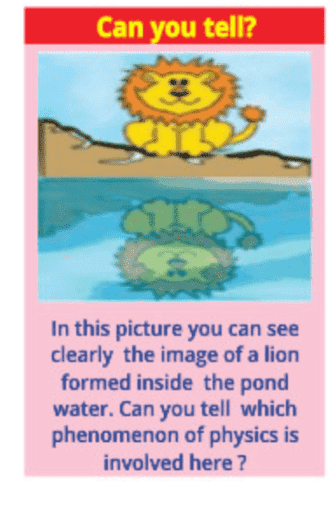
Screenshot_2018-12-31-20-03-13.png
(This image is taken from Physics textbook grade 10. The book has been published in Pakistan)

My question is: why do see the lion inverted in water in this image? I think it is due to the process of continuous reflection. But I am not sure. I need your help.

Thanks.
 

Attachments

  • Screenshot_2018-12-31-20-03-13.png
    Screenshot_2018-12-31-20-03-13.png
    40.6 KB · Views: 1,453
Physics news on Phys.org
NumFront said:
I think it is due to the process of continuous reflection
What is the "process of continuous reflection"? I had never encountered the term. A quick trip to Google reveals a best-guess meaning that has nothing to do with physics.
 
  • Like
Likes   Reactions: PeroK
Can you explain, please, which phenomena of physics is involved there? Is it refraction?
 
NumFront said:
Can you explain, please, which phenomena of physics is involved there? Is it refraction?
Refraction involves a light path that goes through a region with a high refractive index, across a boundary into and through a material with a low refractive index (or vice versa going from low to high instead). Does the light coming to your eye from the lion follow such a path?

Again, I ask, what is "continuous reflection".
 
@NumFront I gather from this post and your other posts that you misunderstand this forum. You think it is just a Q&A forum where you ask a question and get an answer. There are LOTS of such forums on the internet but this is not one of them. What we do is try to help you figure out answers to your questions YOURSELF. That is why jbriggs has answered your question with a question and forum manners dictate that you have to answer him before others are supposed to give you any further help.

By the way, welcome to the forum.
 
  • Like
Likes   Reactions: FactChecker
NumFront said:
Hello

View attachment 236633 (This image is taken from Physics textbook grade 10. The book has been published in Pakistan)

My question is: why do see the lion inverted in water in this image? I think it is due to the process of continuous reflection. But I am not sure. I need your help.

Thanks.
Your guess is true, it is because of specular reflection. You see the lion and its mirror image.
See https://www.sciencelearn.org.nz/resources/48-reflection-of-light
Try to draw light rays arriving to your eyes from the lion. Some rays go to your eyes directly from the lion. Other rays reach your eyes after having reflected from the water surface. And you see a picture in the direction from where the light rays came.
 
  • Like
Likes   Reactions: Delta2
Consider the angles involved and how reflection works.
 
Look up the Laws of Reflection. There are hundreds of lines available from Google. Pick one that you fancy.
Look up Specular and Diffuse reflection, too.
 
Isn't this a case of Total Internal Reflection, where, beyond a critical angle, light just reflects back into the rarer medium?
 
  • #10
Sammit Dhar said:
Isn't this a case of Total Internal Reflection, where, beyond a critical angle, light just reflects back into the rarer medium?
In total internal reflection, light reflects back into the more dense medium. There is no critical angle for light arriving at the boundary from the rarer medium. For such light, you always have a mixture of refraction into the denser medium and reflection into the rarer medium.
 
  • #11
Sammit Dhar said:
Isn't this a case of Total Internal Reflection, where, beyond a critical angle, light just reflects back into the rarer medium?
No, it is not, and total internal reflection happens when, beyond a critical angle, the light totally reflects back into the denser medium
 
  • #12
ehild said:
No, it is not, and total internal reflection happens when, beyond a critical angle, the light totally reflects back into the denser medium
. . . . . . and the only reflection is due to the Fresnel Reflection Formula. The inversion of the image is due to the simple laws of reflection in a mirror.
 
  • Like
Likes   Reactions: FactChecker
  • #13
See the picture. It shows light rays starting from the head of the lion. The orange ray directly goes to your eyes; the blue one reflects from the water, and then reaches your eyes. Your brain knows that the light travels along straight lines, so you see the head of lion in the direction from where the ray came. You see one lion head where it really is; and an other one deep inside the water: the mirror image .
(Sorry, I could not draw a better lion.)
upload_2019-1-3_7-3-38.png
 

Attachments

  • upload_2019-1-3_7-3-38.png
    upload_2019-1-3_7-3-38.png
    4.2 KB · Views: 753
  • Like
Likes   Reactions: FactChecker

Similar threads

  • · Replies 7 ·
Replies
7
Views
1K
  • · Replies 6 ·
Replies
6
Views
2K
  • · Replies 7 ·
Replies
7
Views
2K
  • · Replies 29 ·
Replies
29
Views
4K
Replies
15
Views
3K
  • · Replies 3 ·
Replies
3
Views
14K
  • · Replies 15 ·
Replies
15
Views
4K
Replies
7
Views
2K
  • · Replies 15 ·
Replies
15
Views
2K
  • · Replies 9 ·
Replies
9
Views
4K