Why doesn't the cyclic rule give zero for Cp – Cv derivation?

2 replies · 2K views · last reply
11thHeaven
Messages
48
Reaction score
0
Hi all, I'm working through a derivation of the general relationship between Cp and Cv and there's one point which is confusing me.

I understand that
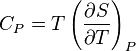
Equation C_P = T (∂S/∂T) at constant pressure, written as heat capacity at constant pressure equals temperature times the partial derivative of entropy with respect to temperature, subscript P.


and

Total differential of entropy: dS = (∂S/∂T) at constant V times dT, plus (∂S/∂V) at constant T times dV.


and that this implies the following:

Equation: (∂S/∂T) at constant P equals (∂S/∂T) at constant V plus (∂S/∂V) at constant T times (∂V/∂T) at constant P.


but isn't this equal to 0? Shouldn't the two partial derivatives on the right hand side, by the cyclic rule, multiply to -(∂S/∂T)V?

I know that I'm missing something here but I can't work out what it is.

Help appreciated!
 
Hm, I'm not sure what you want to derive, but let's start defining the heat capacities and see, where this leads to.

Start from energy conservation employing the 1st and 2nd fundamental laws
$$\mathrm{d} U=\mathrm{d} Q-p \mathrm{d} V=T \mathrm{d} S-p \mathrm{d} V.$$
This implies
$$C_V:=\left (\frac{\partial Q}{\partial T} \right)_{V}=\left (\frac{\partial U}{\partial T} \right)_V=T \left (\frac{\partial S}{\partial T} \right)_V.$$
For ##C_p## we need the enthalpy, given by the Legendre transform
$$H=U+p V ; \Rightarrow \; \mathrm{d} H=T \mathrm{d} S+V \mathrm{d} p,$$
and thus
$$C_p=\left (\frac{\partial H}{\partial T} \right )_p=T \left (\frac{\partial S}{\partial T} \right)_p.$$
Now we can use
$$\frac{C_p}{T}=\left (\frac{\partial S}{\partial T} \right)_p = \det \left (\frac{\partial(S,p)}{\partial(T,p)} \right) = \det \left (\frac{\partial(S,V)}{\partial(T,V)} \right) \det \left (\frac{\partial(T,V)}{\partial(T,p)} \right) = \left [ (\partial_T S)_V (\partial_V p)_T-(\partial_V S)_T (\partial_T p)_V \right ] (\partial_p V)_T = \frac{C_V}{T} - (\partial_p S)_T (\partial_T p)_V.$$
Now we can use the Gibb's free energy
$$G=U-TS+pV \; \Rightarrow \; \mathrm{d} G=-S \mathrm{d} T+V \mathrm{d} p,$$
to derive
$$\partial_p \partial_T G=-(\partial_p S)_T=\partial_T \partial_p G=(\partial_T V)_p$$
to get
$$C_p-C_v=T (\partial_T p)_V (\partial_T V)_p.$$

