Why is (5.302) an Approximation of Exponential Operators?

Click For Summary
The discussion centers on the approximation of the exponential operator in quantum mechanics, specifically why the equation (5.302) is an approximation rather than an equality. The primary reason identified is the non-commutation of the operators T and V, which leads to discrepancies in their exponential forms. The participants explore the implications of the Baker-Campbell-Hausdorff formula and the Lie-Trotter product formula, concluding that while the approximation holds in the limit as N approaches infinity, it does not hold for finite values of N. The conversation highlights the importance of recognizing the order of terms in expansions and the conditions under which certain identities are valid. Ultimately, the approximation is deemed necessary due to the inherent properties of the operators involved.
Happiness
Messages
686
Reaction score
30
Why is (5.302) an approximation instead of an equality?

Let ##T## be the operator ##\frac{p_x^2}{2m}##.

By the law of indices, we should have ##e^{-\frac{i}{\hbar}(T+V)\Delta t}=e^{-\frac{i}{\hbar}T\Delta t} e^{-\frac{i}{\hbar}V\Delta t}## exactly. Is it because ##T## and ##V## do not commute? So the correct equation should be ##e^{-\frac{i}{\hbar}(T+V)\Delta t}=\frac{1}{2}[e^{-\frac{i}{\hbar}T\Delta t} e^{-\frac{i}{\hbar}V\Delta t}+e^{-\frac{i}{\hbar}V\Delta t} e^{-\frac{i}{\hbar}T\Delta t}]##?

But if this is so, shouldn't (5.302) be correct up to terms of order ##\Delta t## instead of order ##(\Delta t)^2## as claimed by the book?
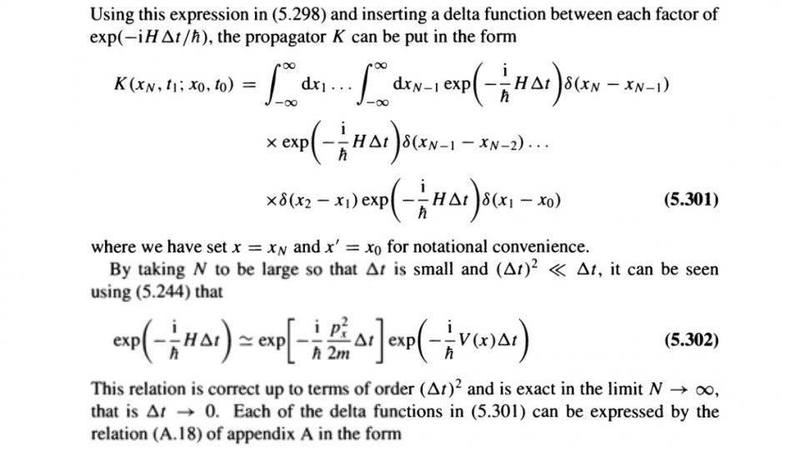
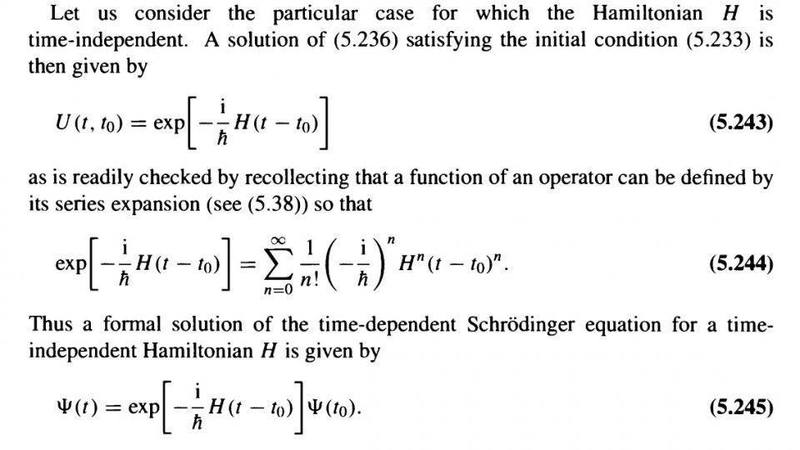
image.jpg

image.jpg
 
Last edited:
Physics news on Phys.org
Happiness said:
[...] Is it because ##T## and ##V## do not commute?
Yes.

So the correct equation should be ##e^{-\frac{i}{\hbar}(T+V)\Delta t}=\frac{1}{2}[e^{-\frac{i}{\hbar}T\Delta t} e^{-\frac{i}{\hbar}V\Delta t}+e^{-\frac{i}{\hbar}V\Delta t} e^{-\frac{i}{\hbar}T\Delta t}]##?
Not in general. Check out the Baker-Campbell-Hausdorff formula(s).
 
  • Like
Likes vanhees71, Happiness and bhobba
When I work out the term of order ##(\Delta t)^2##, the left hand side gives ##\frac{1}{2}(-\frac{i}{\hbar})^2(T^2+TV+VT+V^2)(\Delta t)^2## but the right hand side gives ##\frac{1}{2}(-\frac{i}{\hbar})^2(T^2+2TV+V^2)(\Delta t)^2##. They are not equal. So is the book wrong?
 
Which book is it?
 
strangerep said:
Which book is it?

It's Quantum Mechanics 2nd ed. by Bransden & Joachain, page 243.
 
Happiness said:
When I work out the term of order ##(\Delta t)^2##, the left hand side gives ##\frac{1}{2}(-\frac{i}{\hbar})^2(T^2+TV+VT+V^2)(\Delta t)^2## but the right hand side gives ##\frac{1}{2}(-\frac{i}{\hbar})^2(T^2+2TV+V^2)(\Delta t)^2##. They are not equal. So is the book wrong?
To 2nd order, the BCH identity reads
e^{\lambda (T+V)/N} = e^{\lambda T/N}\ e^{\lambda V/N} - \frac{1}{2}(\frac{\lambda}{N})^{2} [ T , V ]
However, one can prove that, as N \to \infty,
\left( e^{\lambda (T+V)/N} \right)^{N} = \left( e^{\lambda T/N}\ e^{\lambda V/N} \right)^{N}
This helps you to rewrite the Green's function as
\langle x | e^{\lambda H} | y \rangle = \langle x | ( e^{\lambda H /N} )^{N}| y \rangle = \langle x | ( e^{\lambda T /N} e^{\lambda V /N} )^{N}| y \rangle ,
which leads to the Path Integral when you insert the identity operators
\int dx_{j} |x_{j}\rangle \langle x_{j}| = I, \ \ \ \int dp |p \rangle \langle p| = I.
 
  • Like
Likes strangerep, vanhees71 and bhobba
Happiness said:
When I work out the term of order ##(\Delta t)^2##, the left hand side gives ##\frac{1}{2}(-\frac{i}{\hbar})^2(T^2+TV+VT+V^2)(\Delta t)^2## but the right hand side gives ##\frac{1}{2}(-\frac{i}{\hbar})^2(T^2+2TV+V^2)(\Delta t)^2##. They are not equal. So is the book wrong?

I think you are right and the book is wrong.
 
  • Like
Likes Happiness
samalkhaiat said:
However, one can prove that, as N \to \infty,
\left( e^{\lambda (T+V)/N} \right)^{N} = \left( e^{\lambda T/N}\ e^{\lambda V/N} \right)^{N}

But this equation can be simplified to one independent of ##N##:

e^{\lambda (T+V)} = e^{\lambda T}\ e^{\lambda V}

So if it is true as N \to \infty, then shouldn't it be true for all values of ##N##? But this is not true, so the equation should not be true for any value of ##N##?
 
  • #10
Happiness said:
But this equation can be simplified to one independent of ##N##:

e^{\lambda (T+V)} = e^{\lambda T}\ e^{\lambda V}

So if it is true as N \to \infty, then shouldn't it be true for all values of ##N##? But this is not true, so the equation should not be true for any value of ##N##?
If ##T## and ##V## do not commute, you can't interchange ##e^{\lambda T}## and ##\ e^{\lambda V}##.
 
  • #11
blue_leaf77 said:
If ##T## and ##V## do not commute, you can't interchange ##e^{\lambda T}## and ##\ e^{\lambda V}##.

So that means
\left( e^{\lambda (T+V)/N} \right)^{N} = \left( e^{\lambda T/N}\ e^{\lambda V/N} \right)^{N}
is false even as N \to \infty?

I think the correct statement should instead be as N \to \infty,

e^{\lambda (T+V)/N} = e^{\lambda T/N}\ e^{\lambda V/N}

Is this correct?
 
Last edited:
  • #12
What I implied is that, I don't think you can reduce the RHS of ##\left( e^{\lambda (T+V)/N} \right)^{N} = \left( e^{\lambda T/N}\ e^{\lambda V/N} \right)^{N}## to ##\left( e^{\lambda T}\ e^{\lambda V} \right)## because in doing so, you must have brought ##N## in the outer most to inside, which means you are interchanging some pairs of the two exponential operators in the process.
 
  • Like
Likes Happiness
  • #13
samalkhaiat said:
To 2nd order, the BCH identity reads
e^{\lambda (T+V)/N} = e^{\lambda T/N}\ e^{\lambda V/N} - \frac{1}{2}(\frac{\lambda}{N})^{2} [ T , V ]

Since (https://en.wikipedia.org/wiki/Baker–Campbell–Hausdorff_formula)
Screen Shot 2016-01-02 at 3.12.33 am.png

then to the second order, ##\ e^Xe^Y=e^{X+Y+\frac{1}{2}[ X , Y ]}##.

So shouldn't it be

e^{\lambda (T+V)/N} = e^{\lambda T/N}\ e^{\lambda V/N}\ e^{\frac{1}{2}(\frac{\lambda}{N})^{2} [ T , V ]}?
 
  • #14
@Happiness,

Sam has (almost) given you the crucial missing piece in post #7. I'm reasonably sure Sam meant "in the limit as ##N\to\infty##". In general, some properties might be true only in the sense of limits, though untrue for finite values of ##N##.

I should have also given you the Wiki link to the Lie-Trotter product formula. I.e., $$e^{A+B} ~=~ \lim_{N\to\infty} \Big( e^{A/N} e^{B/N} \Big)^N ~.$$The way your textbook expresses it seems a bit misleading, imho, but the proper Lie-Trotter formula can be applied more successfully in the path integral material.
 
  • Like
Likes bhobba
  • #15
Happiness said:
But this equation can be simplified to one independent of ##N##:

e^{\lambda (T+V)} = e^{\lambda T}\ e^{\lambda V}

So if it is true as N \to \infty, then shouldn't it be true for all values of ##N##? But this is not true, so the equation should not be true for any value of ##N##?

No. You can write
e^{H} = (e^{H/N})^{N} ,
But
(e^{T/N}e^{V/N})^{N} = (e^{T/N}e^{V/N}) \cdots N \mbox{-factors} \cdots (e^{T/N}e^{V/N}) .
 
  • Like
Likes Happiness
  • #16
Happiness said:
So that means
\left( e^{\lambda (T+V)/N} \right)^{N} = \left( e^{\lambda T/N}\ e^{\lambda V/N} \right)^{N}
is false even as N \to \infty?
No. It is true and has a name. It is called the Lie-Trotter product formula. You should not jump to a wrong conclusion just because you can not prove it. Do you think I lied to you when I said “we can prove that”?

I think the correct statement should instead be as N \to \infty,

e^{\lambda (T+V)/N} = e^{\lambda T/N}\ e^{\lambda V/N}

Is this correct?
Yes, it is correct because as I said
e^{T/N}e^{V/N} - e^{(T+V)/N} = \frac{1}{2N^{2}} [ T , V ] \sim \mathcal{O}(\frac{1}{N^{2}}) . \ \ \ \ (1)
So,
\lim_{N \to \infty} \left( e^{T/N}e^{V/N} - e^{(T+V)/N} \right) = 0 .
But this does not help you in setting up the Path integral representation of the propagator. In fact, we can use this result to prove the Lie-Trotter formula which is essential in deriving the path integral. Let me show you how. Let A and B be two operators, and consider the difference A^{N} - B^{N}. By adding and subtracting equal terms, I can write the following identity
<br /> \begin{equation*}<br /> \begin{split}<br /> A^{N} - B^{N} =&amp; (AB^{N-1} - B^{N}) + (A^{2}B^{N-2} - AB^{N-1}) \\<br /> &amp; + (A^{3}B^{N-3} - A^{2}B^{N-2}) + (A^{4}B^{N-4} - A^{3}B^{N-3}) \\<br /> &amp; + \cdots + (A^{N} – A^{N-1}B) .<br /> \end{split}<br /> \end{equation*}<br />
This can be rewritten as
<br /> \begin{equation*}<br /> \begin{split}<br /> A^{N} - B^{N} =&amp; (A - B ) B^{N-1} + A (A - B ) B^{N-2} \\<br /> &amp; + A^{2} (A - B ) B^{N-3} + A^{3} (A - B ) B^{N-4} \\<br /> &amp; + \cdots + A^{N-1} ( A - B ) .<br /> \end{split}<br /> \end{equation*}<br />
Okay, now take
A = e^{T/N}e^{V/N} , \ \ B = e^{(T+V)/N} .
But, we know that
A - B = \frac{1}{2N^{2}} [ T , V ] \sim \mathcal{O}(N^{-2}) .
So, (A-B) \to 0 as N \to \infty. Now, the above identity consists of N terms each of which has the factor (A-B) which is of order (1/N^{2}). Hence, in the limit N \to \infty, the difference A^{N} - B^{N} is zero. Thus, we obtain the Lie-Trotter formula
\lim_{N \to \infty} \left( e^{T/N}e^{V/N} \right)^{N} = \lim_{N \to \infty} \left( e^{(T+V)/N} \right)^{N} = e^{(T+V)} .
 
  • Like
Likes strangerep and Happiness
  • #17
Happiness said:
...
then to the second order, ##\ e^Xe^Y=e^{X+Y+\frac{1}{2}[ X , Y ]}##.
This equation is correct to all orders provided that
[ X , [ X , Y ] ] = [ Y , [ X , Y ] ] = 0 .
We speak of “orders” when we expand the exponentials.


So shouldn't it be

e^{\lambda (T+V)/N} = e^{\lambda T/N}\ e^{\lambda V/N}\ e^{\frac{1}{2}(\frac{\lambda}{N})^{2} [ T , V ]}?
No. Again, if [ T , V ] commutes with both T and V, you can write
e^{\lambda (T + V)/N } = e^{\lambda T/N} e^{\lambda V/N} e^{- \frac{1}{2}(\frac{\lambda}{N})^{2} [ T , V ] } .
Notice the minus sign on the right hand side.
But, when I wrote
e^{X+Y} = e^{X}e^{Y} - \frac{1}{2} [ X , Y ], \ \ \ \ (2)
I did not assume that [ X , Y ] commutes with both X and Y. Equation (2) is an identity up to quadratic terms, i.e., when you expand and keep only the quadratic terms X^{2},Y^{2},XY and YX.
 
  • Like
Likes Happiness
  • #18
samalkhaiat said:
No. You can write
e^{H} = (e^{H/N})^{N} ,
But
(e^{T/N}e^{V/N})^{N} = (e^{T/N}e^{V/N}) \cdots N \mbox{-factors} \cdots (e^{T/N}e^{V/N}) .

Yes, I realized my mistake when @blue_leaf77 pointed it out earlier in post #12, sorry!
 

Similar threads

  • · Replies 2 ·
Replies
2
Views
1K
  • · Replies 2 ·
Replies
2
Views
889
  • · Replies 9 ·
Replies
9
Views
2K
  • · Replies 1 ·
Replies
1
Views
1K
  • · Replies 7 ·
Replies
7
Views
2K
  • · Replies 5 ·
Replies
5
Views
2K
  • · Replies 5 ·
Replies
5
Views
2K
  • · Replies 5 ·
Replies
5
Views
2K
  • · Replies 17 ·
Replies
17
Views
3K
  • · Replies 10 ·
Replies
10
Views
3K