Why Is Catalyst 'C' Less Effective Than Catalyst 'B'?

  • Thread starter Thread starter dRic2
  • Start date Start date
  • Tags Tags
    Comparison
Click For Summary

Discussion Overview

The discussion revolves around the effectiveness of two catalysts, 'B' and 'C', in a chemical reaction. Participants explore the reasons why catalyst 'C' is perceived as less effective than catalyst 'B', focusing on the concepts of activation energy, intermediate states, and the thermodynamic and kinetic aspects of the reaction.

Discussion Character

  • Debate/contested, Technical explanation, Conceptual clarification

Main Points Raised

  • Some participants suggest that catalyst 'C' is worse because, despite having a lower activation energy, the energy required for its intermediate state to evolve into products is higher than that for catalyst 'B'.
  • Others argue that the intermediate state of catalyst 'C' is thermodynamically similar to the final products, which may lead to a higher likelihood of reverting to the initial state rather than proceeding to the final state.
  • A participant mentions that both catalysts induce a change in mechanism and that while 'C' may create intermediates faster, it does not necessarily lead to a higher overall product accumulation compared to 'B'.
  • There is a discussion about the probability of the intermediate state returning to the initial state versus progressing to the final state, with some participants noting that this probability is higher for catalyst 'C'.
  • One participant acknowledges a misunderstanding regarding the energy potential barriers, indicating that the kinetic probabilities may not favor the final product as initially thought.
  • Another participant asserts that the intermediate in catalyst 'C' is favored over the final product, supporting the view that catalyst 'B' is more effective in producing the final product.

Areas of Agreement / Disagreement

Participants express differing views on the effectiveness of catalyst 'C' compared to 'B', with no consensus reached. Some believe 'C' is less effective due to its intermediate state dynamics, while others argue that both catalysts have their merits in terms of reaction mechanisms.

Contextual Notes

Participants discuss the implications of thermodynamic and kinetic factors without resolving the complexities of the energy barriers and reaction pathways involved.

dRic2
Gold Member
Messages
887
Reaction score
225
Hi, PF

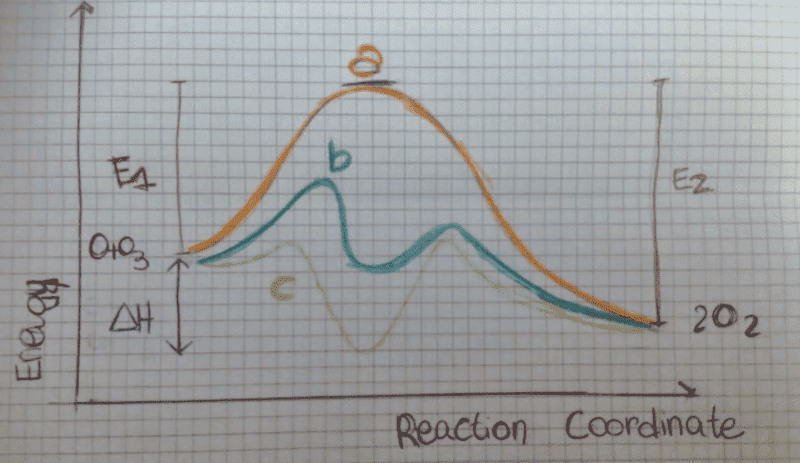
I have to comment this graphic about a reaction with and without catalysis.
Schermata 2018-01-22 alle 02.21.35.png

It's clear that the 'b' and 'c' line represent the catalysed processes, but I don't get one thing: my professor said that 'c' is a worse catalyst than 'b'. Why?

Thank you
 

Attachments

  • Schermata 2018-01-22 alle 02.21.35.png
    Schermata 2018-01-22 alle 02.21.35.png
    118.8 KB · Views: 877
Physics news on Phys.org
Think about the intermediate state. Which is more kinetically favorable to proceed from that intermediate state to the final state? B or C?EDIT: Isn't this thread more suitable in the Homework forum?
 
Sorry for the late replay

So basically C is worse because, although it requires a smaller activation energy, his intermediate state needs more energy to evolve into the products than B intermediate state ?

HAYAO said:
EDIT: Isn't this thread more suitable in the Homework forum?
Think you're right, I was in hurry and didn't notice there is a section about chemistry homework
 
dRic2 said:
Sorry for the late replay

So basically C is worse because, although it requires a smaller activation energy, his intermediate state needs more energy to evolve into the products than B intermediate state ?

Pretty much summarizes it.

The energy of the intermediate state of C is about the same as the product. If this is a thermodynamics dominated reaction, then at thermal equilibrium, we'll get (very) roughly something like 4:48:48 of initial, intermediate, and final state. If this is a kinetics dominated reaction, then the reaction from the intermediate to final state is significantly slower for C than B. In fact, it is more probable for the intermediate state of C to return back to the initial state than the final state.
 
Last edited:
  • Like
Likes   Reactions: dRic2
Moved to Chemistry homework - no template, which is okay for this thread.
 
HAYAO said:
The energy of the intermediate state of C is about the same as the product. If this is a thermodynamics dominated reaction, then at thermal equilibrium, we'll get (very) roughly something like 4:48:48 of initial, intermediate, and final state. If this is a kinetics dominated reaction, then the reaction from the intermediate to final state is significantly slower for C than B. In fact, it is more probable for the intermediate state of C to return back to the initial state than the final state.

Very clear! Nice explanation. I didn't think about this in particular:

HAYAO said:
In fact, it is more probable for the intermediate state of C to return back to the initial state than the final state.

Thank you, I like this kind of comments.
 
dRic2 said:
Thank you, I like this kind of comments.
Excuse me, I made a mistake. I thought that that initial energy potential barrier is lower than the second one. So from this diagram, kinetically, it is just as probable to produce initial state from the intermediate state as producing the final state.
 
Ahahaha Same here! I didn't notice either (I didn't draw this)... strange optic effect
 
I wouldn’t say that c is a worse catalyst than b. I think you could say that both b and c induce a change of mechanism relative to what is happening in a. They catalyse a mechanism that goes through a relatively stable, macroscopically accumulating intermediate which corresponds to the troughs.The intermediate would drain away with nearly the same rate constant in both cases but there would be more of it in case c because it is created the faster, and overall rate of accumulation of product consequently would be higher in case c .
 
  • #10
I think that c intermediate is thermodynamically equivalent (more or less) to the products, so I don't see a reason for the products to be favored. Therefor I have to give more energy to the system resulting in the possibility to reverse the reaction.

this is what I got thinking about @HAYO's reply and it sounds reasonable
 
  • #11
Yes, in c the intermediate is actually favoured over the final product. Not in b, so in that sense your Prof is right, b gives you more final product.
 
  • #12
Yes, problem solved. Thanks
 

Similar threads

  • · Replies 6 ·
Replies
6
Views
2K
Replies
4
Views
2K
  • · Replies 19 ·
Replies
19
Views
10K
  • · Replies 40 ·
2
Replies
40
Views
5K
Replies
1
Views
2K
  • · Replies 40 ·
2
Replies
40
Views
5K
  • · Replies 16 ·
Replies
16
Views
6K
  • · Replies 16 ·
Replies
16
Views
2K
  • · Replies 8 ·
Replies
8
Views
4K
  • · Replies 12 ·
Replies
12
Views
2K