Why is Griffiths Treating the Summation Like This?

Click For Summary

Discussion Overview

The discussion revolves around the treatment of summations in a derivation from Griffiths' quantum mechanics textbook. Participants explore the mathematical justification for manipulating infinite summations and their interchange with integrals, particularly in the context of quantum mechanics. The scope includes technical reasoning and mathematical principles related to series and integrals.

Discussion Character

  • Technical explanation
  • Mathematical reasoning
  • Debate/contested

Main Points Raised

  • One participant expresses confusion about Griffiths' manipulation of summations and seeks clarification on the transition from an integral of a product of sums to a double sum of integrals.
  • Another participant suggests that the multiplication of sums follows from the distributive law, questioning the interchange of summation and integration.
  • A later reply indicates that the ability to swap summations and integrals is justified because the integral depends only on x, while the summations depend on n, allowing for separation of terms.
  • Concerns are raised about the validity of distribution without absolute convergence, with a specific example provided to illustrate potential issues with alternating series.
  • One participant acknowledges the need for absolute convergence for the interchange of integrals and summations but admits to not correcting the earlier claim.

Areas of Agreement / Disagreement

Participants do not reach a consensus on the treatment of summations and integrals, with some agreeing on the justification for manipulation while others express caution regarding convergence issues.

Contextual Notes

Participants highlight the importance of absolute convergence when discussing the interchange of summation and integration, indicating that the discussion may depend on specific conditions that are not fully resolved.

bluepilotg-2_07
Messages
12
Reaction score
2
TL;DR
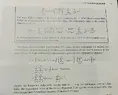
From line one to two in the image, the summations go from ##\int(\sum_{m=1}^\infty c_m\psi_m)* \, (\sum_{n=1}^\infty c_n\psi_n)dx## to ##\sum_{n=1}^\infty \sum_{m=1}^\infty c_m * c_n \int \psi_m * \psi_n dx##. Can someone explain why please.
I am self-studying quantum mechanics from Griffiths' textbook and some other sources. I have come across this derivation shown in the photo. I've taken all three major calculus courses for physics, linear algebra, ODE, PDE, Complex Analysis, etc.
However, I do still struggle with rules for summations. I do not understand why Griffiths goes from ##\int(\sum_{m=1}^\infty c_m\psi_m)* \, (\sum_{n=1}^\infty c_n\psi_n)dx## to ##\sum_{n=1}^\infty \sum_{m=1}^\infty c_m * c_n \int \psi_m * \psi_n dx##. I was under the impression that summations do not "multiply" in this way. I have not found another explanation online so far. Could someone kindly explain. Thanks.
 

Attachments

  • IMG_0392.webp
    IMG_0392.webp
    51.1 KB · Views: 23
Physics news on Phys.org
Just multiply the sums:
$$
\left( \sum_{n=1}^\infty a_n \right) \cdot \left( \sum_{m=1}^\infty b_m \right)= \sum_{k=2}^\infty \sum_{n+m=k}a_nb_m= \sum_{n=1}^\infty \sum_{m=1}^\infty a_nb_m
$$
by the distributive law. The real question is why you can swap the infinite summation with the integral.
 
Last edited:
  • Like
Likes   Reactions: PeroK and dextercioby
Hi, thanks for responding! Just after posting, I finally found a resource that explained what I wanted to know. It feels as if it should have been obvious now that I have read about it. In response to the question you posited, we should be able to swap the summations and integral because the integral is only dependent on x and functions of x while the summations are only dependent on n. Then we use the fact that we can break up any summations in the integrand into separate integrals. So if we view our double summation notation as what it really is: just a sum over a bunch of terms, then we can break all of those terms into separate integrals, and thus we get a summation over integrals.
 
fresh_42 said:
Just multiply the sums:
$$
\left( \sum_{n=1}^\infty a_n \right) \cdot \left( \sum_{m=1}^\infty b_m \right)= \sum_{k=2}^\infty \sum_{n+m=k}a_nb_m= \sum_{n=1}^\infty \sum_{m=1}^\infty a_nb_m
$$
by the distributive law. The real question is why you can swap the infinite summation with the integral.

Well hold on, even the distribution is sketchy if you don't have absolute convergence. I would be pretty nervous distributing
$$\sum \frac{(-1)^n}{\sqrt{n}} \sum \frac{(-1)^n}{\sqrt{n}}$$
 
  • Like
Likes   Reactions: fresh_42
Office_Shredder said:
Well hold on, even the distribution is sketchy if you don't have absolute convergence. I would be pretty nervous distributing
$$\sum \frac{(-1)^n}{\sqrt{n}} \sum \frac{(-1)^n}{\sqrt{n}}$$
Yes. I thought about correcting it, but as we need absolute convergence for the integral exchange anyway, I was lazy.
 

Similar threads

  • · Replies 8 ·
Replies
8
Views
9K
  • · Replies 4 ·
Replies
4
Views
3K
  • · Replies 5 ·
Replies
5
Views
3K
  • · Replies 11 ·
Replies
11
Views
2K
  • · Replies 7 ·
Replies
7
Views
2K
  • · Replies 2 ·
Replies
2
Views
2K
  • · Replies 5 ·
Replies
5
Views
4K
  • · Replies 12 ·
Replies
12
Views
4K
  • · Replies 11 ·
Replies
11
Views
4K
Replies
1
Views
2K