Why Is k' Introduced in the Bloch Theorem Derivation?

Click For Summary

Homework Help Overview

The discussion revolves around the derivation of Bloch theorem in solid state physics, specifically focusing on the introduction of the wave vector k' and its implications in the context of Fourier series representations of potential energy and electron plane waves.

Discussion Character

  • Conceptual clarification, Assumption checking

Approaches and Questions Raised

  • Participants express confusion regarding the introduction of k' in the derivation, questioning its relationship to k and the implications of changing indices in the coefficients. There are inquiries about the reasoning behind renaming k' to k and the treatment of coefficients in the equations.

Discussion Status

Some participants have provided insights into the reasoning behind the introduction of k' and its simplification in the exponential argument. However, questions remain regarding the consistency of notation and the treatment of coefficients, indicating an ongoing exploration of these concepts.

Contextual Notes

Participants are working from a series of PowerPoint slides provided by their professor, which may contain assumptions or notations that are not fully clarified in the discussion. There is a noted lack of clarity in the transition between different representations of k and k'.

patric44
Messages
308
Reaction score
40
Homework Statement
some questions about the derivation of Bloch theorem
Relevant Equations
in the attachments
hi guys
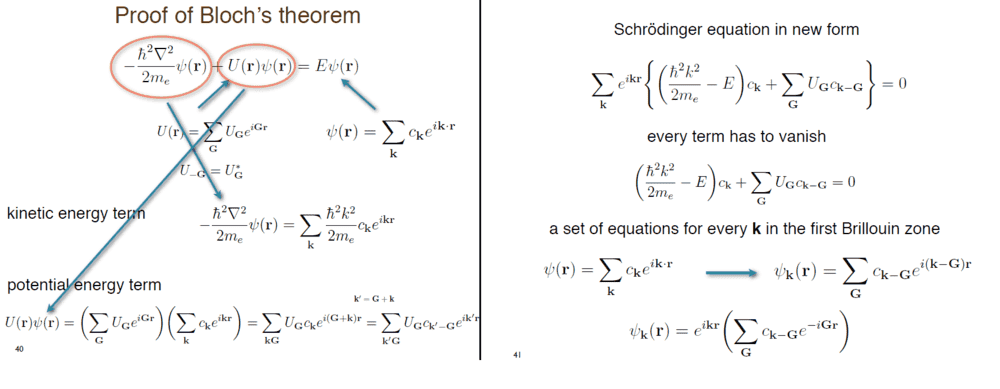
our solid state professor gave us a series of power point slides that contains the derivation of Bloch theorem , but some points is not clear to me , and when i asked him his answer was also not clear :
bloch.png

in the first part i understand the he represented both the potential energy and the electron plane wave as a Fourier series
but when he multiplied both together in the last equation he introduced k' why is that ! sinse k=k+G as it wil repreat in the next parabolic dispersion and subsequently he changed the index of Ck ⇒ Ck'-G isn't that also k ?
in the next page he set again k=k+g and took the exponential as a common factor but yet leaves the "C" coefficient as k-G
why he keep alternating between k'-G , k ...
and the jump from
$$ Ψ(r) ⇒Ψk(r) $$
is not very clear to me ?

- and how i suppose to solve this Schrödinger equation i mean its no longer a differential eq ?
 
Physics news on Phys.org
patric44 said:
Homework Statement:: some questions about the derivation of Bloch theorem
Relevant Equations:: in the attachments

hi guys
our solid state professor gave us a series of power point slides that contains the derivation of Bloch theorem , but some points is not clear to me , and when i asked him his answer was also not clear :
View attachment 260161
in the first part i understand the he represented both the potential energy and the electron plane wave as a Fourier series
but when he multiplied both together in the last equation he introduced k' why is that ! sinse k=k+G as it wil repreat in the next parabolic dispersion and subsequently he changed the index of Ck ⇒ Ck'-G isn't that also k ?
He just introduced ##\vec{k'} \equiv \vec{G} + \vec{k} ## so that the argument of the exponential would be ##i \vec{k'} \cdot \vec{r} ## (he wanted that argument to be as simple as possible). So basically he replaces ##\vec{k}## by ##\vec{k'} - \vec{G}##.
 
  • Like
Likes   Reactions: gh136
nrqed said:
He just introduced ##\vec{k'} \equiv \vec{G} + \vec{k} ## so that the argument of the exponential would be ##i \vec{k'} \cdot \vec{r} ## (he wanted that argument to be as simple as possible). So basically he replaces ##\vec{k}## by ##\vec{k'} - \vec{G}##.
i know that , why did he changed that into k in the next page as you can see when he took the e^ikr as a common factor .
and if he is considering k' = k+G = k then why didn't he drop it from the coefficient C ?
that is my question
 
patric44 said:
i know that , why did he changed that into k in the next page as you can see when he took the e^ikr as a common factor .
and if he is considering k' = k+G = k then why didn't he drop it from the coefficient C ?
that is my question
Ok, your questions were not very clear.

In the next page, he just renamed ##\vec{k}' \rightarrow \vec{k} ##. Since the sum is over the vectors, one can rename them, they are dummy indices.
 
  • Like
Likes   Reactions: patric44

Similar threads

  • · Replies 1 ·
Replies
1
Views
3K
  • · Replies 1 ·
Replies
1
Views
3K
  • · Replies 1 ·
Replies
1
Views
2K
  • · Replies 9 ·
Replies
9
Views
3K
  • · Replies 1 ·
Replies
1
Views
2K
  • · Replies 8 ·
Replies
8
Views
1K
Replies
2
Views
5K
Replies
1
Views
6K
  • · Replies 5 ·
Replies
5
Views
2K
  • · Replies 1 ·
Replies
1
Views
2K