Why is moment generated by force P equal to PLsin(θ)?

2 replies · 2K views · last reply
GBE111
Could someone please explain to me how the moment generated by P is calculated by PLsin@. I understand the length I just can't figure out how it is Psin@. I believe the moment acts opposite to force F but when I build my triangle for trigonometry I'm getting it wrong?
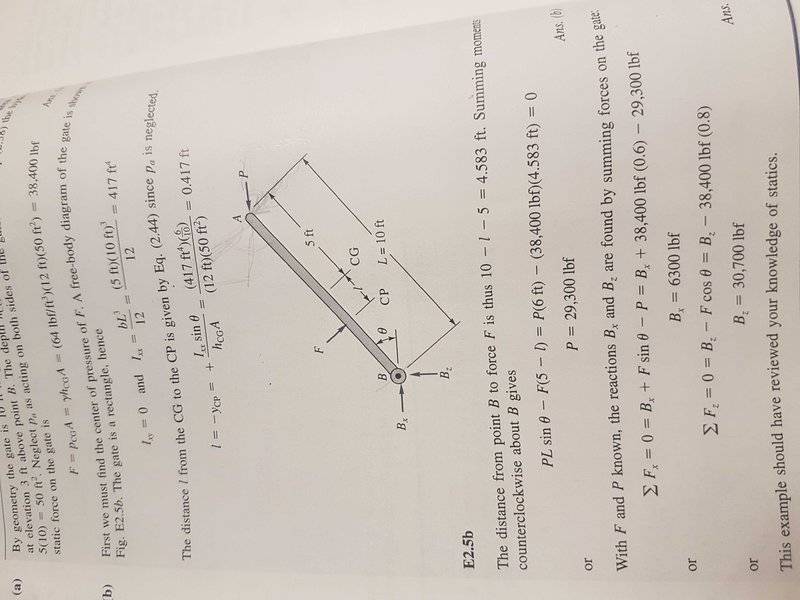
Free-body diagram of an inclined rectangular gate hinged at point B, with force P applied at top end A, force F acting perpendicular to the gate, reactions Bx and Bz at B, and dimensions 5 ft, L = 10 ft, and CG and CP marked, with the solution text E2.5b beside it.
 
Attachments
  • Free-body diagram of an inclined rectangular gate hinged at point B, with force P applied at top end A, force F acting perpendicular to the gate, reactions Bx and Bz at B, and dimensions 5 ft, L = 10 ft, and CG and CP marked, with the solution text E2.5b beside it.
    1514906555403.jpg
    52.4 KB · Views: 631
I moved your thread from ME to the schoolwork forums.

Can you show us your force triangle? When gravity acts vertically on that rod, in which direction is the moment vector on it?
 
L*sin(theta) is the perpendicular distance (lever arm) of force P about point B. Sin(theta) "acts" on the distance L, not the Force.

Moment = Force ( Cross Product) Distance in 3D
Moment = Force * Perpendicular distance in 2D