Why Is the d-Orbital Considered in Sc Term Symbols?

Join the discussion
Registration is free. Ask a follow-up in this thread, or start your own.
5 replies · 3K views
physicisttobe
Messages
56
Reaction score
13
Homework Statement
electron configuration of SC
Relevant Equations
...
I've solved further Term Symbol problems. The task is: derive the term symbols of the ground states of the following atoms: a) H, b) F, c) Cu, d) F- , e) P, f) Na, g) Sc

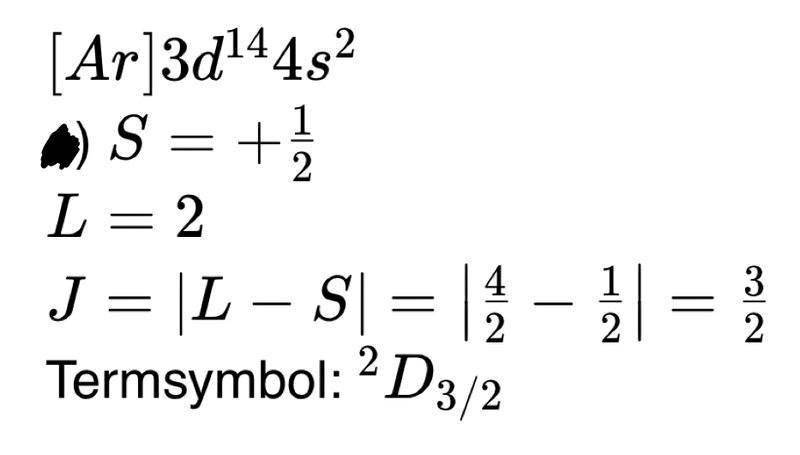
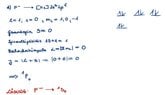
Why is the d-orbital considered here in g)? Why isn't the s orbital taken into account here? The 4s orbital is energetically higher than the 3d orbital, so why don't you look at the 4s orbital. I also post the solution and my approach to this problem. I can't explain why my approach is incorrect. Can someone help me?

my approach:
C5D1F174-C00B-4242-A072-B400DE853580.jpeg


solution:
ECB91335-C5CF-470D-94EE-3DA783A57DF4.jpeg
 
Physics news on Phys.org
The s orbital is full. The net contribution of all filled subshells to L and S is zero, so you only need to consider partially filled subshells. (And I assume 3d14 is a typo for 3d1.)

Oh, and if you meant Sc you should have said so. SC is something very different!
 
  • Like
Likes   Reactions: jim mcnamara
mjc123 said:
The s orbital is full. The net contribution of all filled subshells to L and S is zero, so you only need to consider partially filled subshells.
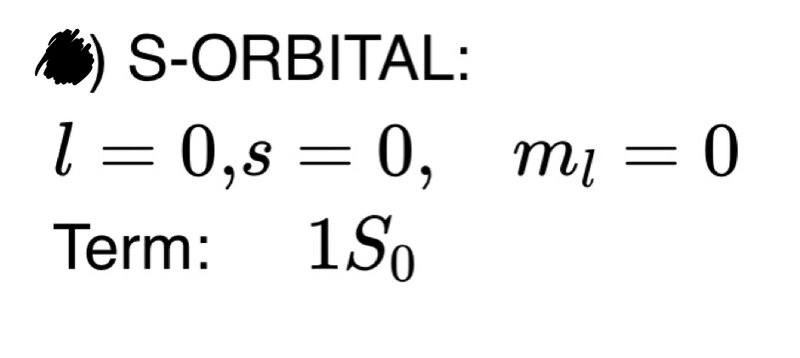
All right, but what about F-? We have the configuration [He]2s^2 2p^6, both orbitals are full.
I thought it would be 1P0 but it's wrong. The solution is 1S0, but I can't explain why 1S0.
I solved this problem like this:

EE4B9EA0-09D4-4259-8706-EEB25FFD77E8.jpeg

mjc123 said:
(And I assume 3d14 is a typo for 3d1.)
Yes, it's a typo, sorry for that.
mjc123 said:

Oh, and if you meant Sc you should have said so. SC is something very different!
Oh, sorry, I mean Sc, of course.
mjc123 said:
The s orbital is full. The net contribution of all filled subshells to L and S is zero, so you only need to consider partially filled subshells. (And I assume 3d14 is a typo for 3d1.)

Oh, and if you meant Sc you should have said so. SC is something very different!
 

Attachments

  • 9383CF58-1003-4E6C-96F1-A7FC418E457B.jpeg
    9383CF58-1003-4E6C-96F1-A7FC418E457B.jpeg
    20.4 KB · Views: 184
physicisttobe said:
All right, but what about F-? We have the configuration [He]2s^2 2p^6, both orbitals are full.
I thought it would be 1P0 but it's wrong. The solution is 1S0, but I can't explain why 1S0.

What is your reasoning for selecting ##P## in your solution ##^1P_0##?
A full orbital subshell has zero net orbital angular momentum.
 
Last edited:
TSny said:
What is your reasoning for selecting ##P## in your solution ##^1P_0##?
A full orbital subshell has zero net orbital angular momentum.
All right, I get it. Thank you so much for your help!
If any questions arise, I'll get in touch here
 
  • Like
Likes   Reactions: TSny and berkeman