Why is the first term zero in the Virial Theorem derivation?

Join the discussion
Registration is free. Ask a follow-up in this thread, or start your own.
5 replies · 3K views
rexregisanimi
Messages
42
Reaction score
6
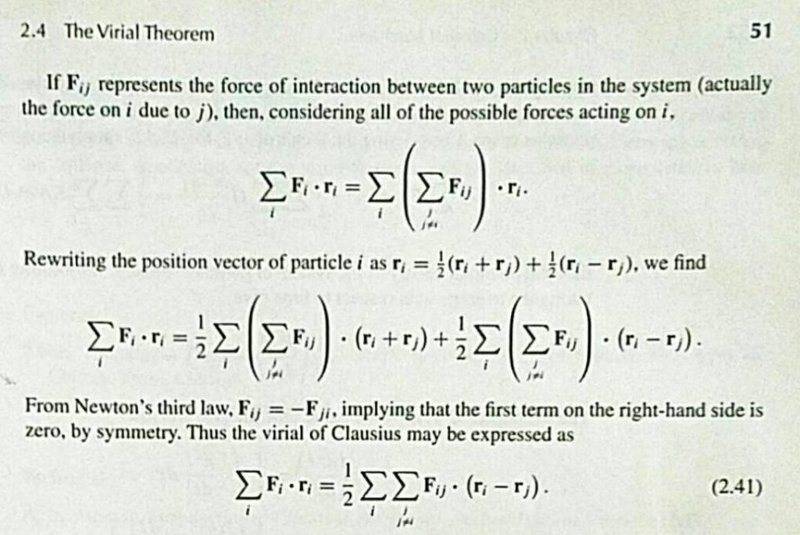
Hello everyone! I am reviewing the derivation of the Virial Theorem from an introductory Astrophysics book (Carroll and Ostlie's) and found a step I couldn't follow. I've attached a photo of the step.

Can anyone explain how Newton's Third Law brings about eqn 2.41? I don't see how that first term in the right side previous to eqn 2.41 goes to zero. What symmetry is being referenced?
1482184447251.jpg
 
Last edited:
Mathematics news on Phys.org
Consider the ##ij##-th term
$$
\mathbf F_{ij} \cdot (\mathbf r_i + \mathbf r_j)
$$
and the ##ji##-th term
$$
\mathbf F_{ji} \cdot (\mathbf r_j + \mathbf r_i) = -\mathbf F_{ij} \cdot (\mathbf r_i + \mathbf r_j)
$$
The two terms has equal magnitude but opposite sign, so they will cancel. The same is true for other pair of terms connected by interchanging the indices.
 
So, in other words, the top triangular part of the F_ij matrix cancels with the bottom triangular part because of the Third Law; this leaves the diagonals only which are zero because a particle will not exert a force on itself. Is that correct?
 
You actually don't sum the vector F_ij, instead you are summing over the component of F_ij along the position vector of the central point in the line connecting the two particles.
 
Thank you for your replies.

Why then isn't the second term zero? If we're just concerned about those values, shouldn't both terms go to zero?
 
rexregisanimi said:
Thank you for your replies.

Why then isn't the second term zero? If we're just concerned about those values, shouldn't both terms go to zero?
When you exchange the indices, the vector ##\mathbf r_i - \mathbf r_j## also changes sign.