SUMMARY
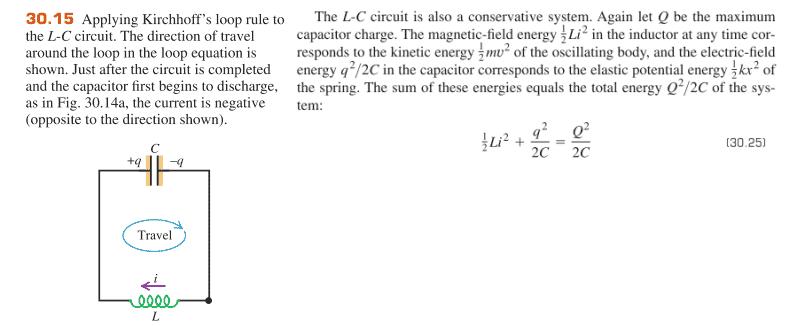
The total energy of the system is represented as Q^2/2C, where Q is the maximum charge on the capacitor and C is its capacitance. In this scenario, when the capacitor reaches its maximum charge, it prevents current flow, resulting in the inductor holding no energy. Therefore, the energy in the system is solely attributed to the capacitor, confirming the relationship derived in University Physics 13e by Young and Freedman.
PREREQUISITES
- Understanding of capacitor charge and energy storage
- Familiarity with inductors and their energy dynamics
- Knowledge of basic electrical circuit concepts
- Ability to interpret physics equations related to energy
NEXT STEPS
- Study the derivation of energy stored in capacitors using the formula U = Q^2/2C
- Explore the relationship between capacitors and inductors in RLC circuits
- Investigate energy conservation principles in electrical systems
- Review Chapter 30 of University Physics 13e by Young and Freedman for deeper insights
USEFUL FOR
Students of physics, electrical engineers, and anyone interested in understanding energy dynamics in capacitors and inductors.