Why is the Water Molecule Electrically Neutral Despite Charge Imbalance?

  • Thread starter Thread starter Tam Le
  • Start date Start date
  • Tags Tags
    Polarity Water
Click For Summary
SUMMARY

The water molecule (H2O) is electrically neutral despite having a slight negative charge on the oxygen atom and slight positive charges on the hydrogen atoms. This neutrality arises because the total charge of the molecule sums to zero, with the negative charge on oxygen being twice that of each hydrogen's positive charge. Electrically neutral means that the overall charge is zero, even if the charge distribution is non-uniform. The concept of dipole-dipole interaction explains how electrically neutral molecules can still attract each other.

PREREQUISITES
  • Understanding of molecular structure and charge distribution
  • Familiarity with basic chemistry concepts, including electronegativity
  • Knowledge of dipole-dipole interactions
  • Basic understanding of electrical neutrality in molecules
NEXT STEPS
  • Research the concept of electronegativity and its role in molecular charge distribution
  • Learn about dipole-dipole interactions and their significance in molecular chemistry
  • Explore the properties of polar vs. nonpolar molecules
  • Investigate how molecular geometry affects charge distribution and interactions
USEFUL FOR

Students of chemistry, educators explaining molecular interactions, and anyone interested in the properties of water and its implications in chemical reactions.

Tam Le
Messages
23
Reaction score
1
I understand that, in the molecule H2O, O has a slight negative charge while the two H's have a slight positive charge. However, I do not understand why the molecule as a whole is considered electrically neutral.

Also, how is electrically neutral defined? Does it mean that the electrical forces of attraction and repulsion negate each other?
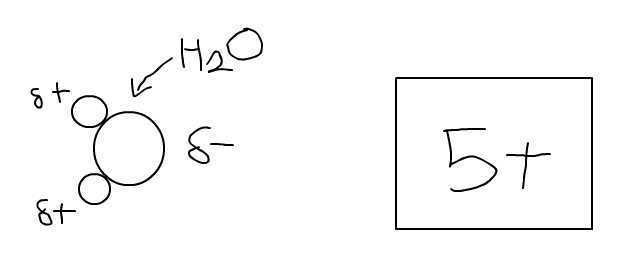
Snapshot2.jpg


For example, in this drawing, the attraction between the O and the positively charged object would equal the repulsion between the H's and the positively charged object. Is this what being electrically neutral means?
 
Chemistry news on Phys.org
the oxygen atom is written as [O][/2-] while Hydrogen ion is [H[/+] so the net charge on the molecule will be zero, hence nuetral.
 
Electrically neutral means - total charge is zero.

Actually that's the starting point here, not the other way around. We know water molecule is electrically neutral, so we know even if the charge distribution is not uniform, whatever excess of positive charge is present in some place (or some places) of the molecule, identical amount of negative charge is present in other places. In the case of water molecule it means that the negative charge on the oxygen atom is twice as large as the positive charge on each hydrogen atom.

Even if a molecule is electrically neutral it can have non-uniform charge distribution, and it can attract other electrically neutral molecules. We call it - in the simplest form - dipole-dipole interaction.
 
  • Like
Likes   Reactions: Tam Le

Similar threads

  • · Replies 6 ·
Replies
6
Views
869
  • · Replies 3 ·
Replies
3
Views
2K
  • · Replies 11 ·
Replies
11
Views
3K
  • · Replies 28 ·
Replies
28
Views
2K
  • · Replies 23 ·
Replies
23
Views
7K
  • · Replies 3 ·
Replies
3
Views
7K
  • · Replies 4 ·
Replies
4
Views
2K
  • · Replies 3 ·
Replies
3
Views
1K
  • · Replies 6 ·
Replies
6
Views
3K
  • · Replies 20 ·
Replies
20
Views
2K