Why Normalize Boundary Conditions in PDEs?

Click For Summary
SUMMARY

This discussion focuses on the normalization of boundary conditions in partial differential equations (PDEs), specifically in the context of temperature profiles in spherical coordinates. The normalization process involves a linear rescaling function, f : [a,b] → [0,1], defined as f(x) = (x - a) / (b - a), which simplifies the boundary conditions. The concept of nondimensionalization is highlighted as a key reason for this normalization, making it easier to handle boundary conditions at infinity and initial conditions.

PREREQUISITES
  • Understanding of partial differential equations (PDEs)
  • Familiarity with spherical coordinates
  • Knowledge of boundary and initial conditions in mathematical modeling
  • Concept of nondimensionalization in applied mathematics
NEXT STEPS
  • Research the application of nondimensionalization in solving PDEs
  • Explore linear rescaling techniques in mathematical modeling
  • Study the implications of boundary conditions in spherical coordinates
  • Learn about temperature profile modeling in physics and engineering contexts
USEFUL FOR

Mathematicians, physicists, and engineers involved in solving partial differential equations, particularly those working with thermal dynamics and boundary condition normalization.

garcijon
Messages
1
Reaction score
0
Hi All,

This is my first post on these forums. I am not looking for a solution to this problem but more interested in seeing if someone can point me to a resource that can explain the following. Thanks in advance for any help.

I'm trying to solve a pde which gives a temperature profile.
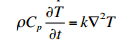
upload_2014-11-21_15-54-40.png

We end up changing over to spherical coordinates where our boundary conditions are not completely clear although our initial condition is.
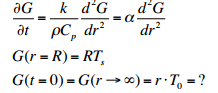
upload_2014-11-21_15-56-36.png


The professor writes something like this. basically it normalizes the boundary conditions to (0,1). I can't wrap my head around this and googling for a while hasn't given me any results that clarify this.

upload_2014-11-21_15-58-26.png
 
garcijon said:
The professor writes something like this. basically it normalizes the boundary conditions to (0,1). I can't wrap my head around this and googling for a while hasn't given me any results that clarify this.

View attachment 75728

This is a straightforward linear rescaling of the form <br /> f : [a,b] \to [0,1] : x \mapsto \frac{x - a}{b - a}. Observe that f is strictly increasing with f(a) = 0 and f(b) = 1.

If what you are struggling with is "why does he bother to do this?" then the concept you are looking for is nondimensionalization. Also it's easier to work with G(t = 0) = G(r \to \infty) = 0 rather than G(t = 0) = rT_0 and G(r \to \infty) = \infty.
 

Similar threads

  • · Replies 4 ·
Replies
4
Views
3K
  • · Replies 1 ·
Replies
1
Views
2K
  • · Replies 2 ·
Replies
2
Views
2K
Replies
3
Views
3K
  • · Replies 4 ·
Replies
4
Views
4K
  • · Replies 6 ·
Replies
6
Views
3K
  • · Replies 3 ·
Replies
3
Views
5K
  • · Replies 1 ·
Replies
1
Views
2K
  • · Replies 3 ·
Replies
3
Views
2K
  • · Replies 4 ·
Replies
4
Views
2K