Why Straggling Appears - A Closer Look

  • Thread starter Thread starter abotiz
  • Start date Start date
Click For Summary
SUMMARY

The discussion centers on the phenomenon of range straggling in particle radiation, specifically addressing the differences in the shape of the range distribution curve for single versus multiple particles. It highlights that while a single particle exhibits a pointy curve, multiple particles display a rounded curve due to statistical variations in collision interactions. The concept is supported by references from Evans' "The Atomic Nucleus," which explains that identical charged particles from a monoenergetic source show a normal distribution in range due to statistical fluctuations in collisions with atomic electrons. The Bethe-Bloch equation is also mentioned as foundational for understanding energy loss in these interactions.

PREREQUISITES
  • Understanding of particle radiation and its interactions with matter
  • Familiarity with statistical distributions, particularly Gaussian distribution
  • Knowledge of the Bethe-Bloch dE/dx energy loss equation
  • Basic concepts of Coulomb scattering and its effects on charged particles
NEXT STEPS
  • Study the Bethe-Bloch equation in detail to understand energy loss mechanisms
  • Research statistical mechanics as it applies to particle collisions
  • Explore the concept of range straggling further in advanced nuclear physics texts
  • Investigate experimental methods for measuring range and energy straggling in particle physics
USEFUL FOR

Physicists, nuclear engineers, and students studying particle physics who seek to deepen their understanding of range straggling and its implications in radiation interactions.

abotiz
Messages
72
Reaction score
0
Hi!

I would like some clarification about the straggeling phenomena, why the tip of the curve is pointy ( stiff ) att the topp for 1 particle, but for several particles the top is rounded off.
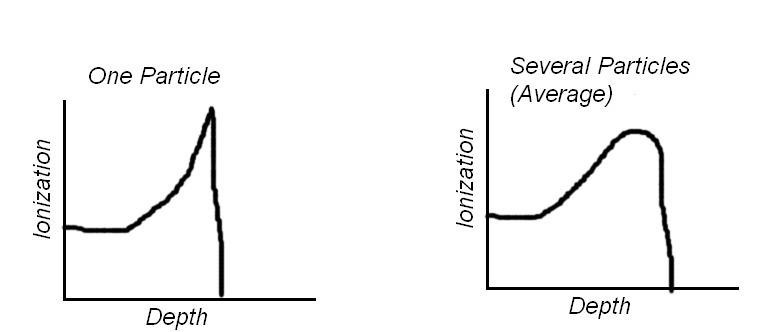
Straggeling.jpg


I founf Wikis explanation a little bit dry, or perhaps that is the only way to describe it?


http://en.wikipedia.org/wiki/Range_(particle_radiation)"

" [...] a range may be well defined for that radiation, depending on its energy and charge, as well as the ionisation energy of the stopping medium. Since the nature of such interactions is statistical, the number of collisions required to bring a radiation particle to rest within the medium will vary slightly with each particle, i.e. some may travel further and undergo less collisions than others. Hence, there will be a small variation in the range, known as straggling."

Thanks!
 
Last edited by a moderator:
Physics news on Phys.org
Here is a quote from Evans The Atomic Nucleus, (McGraw Hill) page 660

"Identical charged particles, all having the same initial velocity do not all have the same range. The observed ranges of individual particles from any monoenergetic source will show a normal (gaussian) distribution about the mean range. As early as 1912. Darwin correctly identified this distribution as due to statistical fluctuations in the individual collisions between the charged particle and atomic electrons, and named the effect range straggling."

Evans then goes on to derive both range and energy straggling statistically, on pages 660-667. few other authors go into as much detail as Evans.

As you may recall, the Bethe-Bloch dE/dx energy loss equation is based on many collisions between the charged particle and atomic electrons (and not the nucleus).

Multiple scattering IS caused by the charged particle scattering off the nucleus (Coulomb scattering).

Bob S
 
Last edited:
Thank you for you reply.

I understand this much better

Thanks!
 

Similar threads

  • · Replies 2 ·
Replies
2
Views
3K
Replies
1
Views
1K
  • · Replies 19 ·
Replies
19
Views
5K
  • · Replies 21 ·
Replies
21
Views
5K
  • · Replies 30 ·
2
Replies
30
Views
8K
  • · Replies 12 ·
Replies
12
Views
8K
  • · Replies 5 ·
Replies
5
Views
3K
  • · Replies 46 ·
2
Replies
46
Views
5K
  • · Replies 4 ·
Replies
4
Views
16K
  • · Replies 8 ·
Replies
8
Views
7K