Why there are summer and winter seasons?

  • Context: High School 
  • Thread starter Thread starter Hectix
  • Start date Start date
  • Tags Tags
    Seasons Summer
Click For Summary

Discussion Overview

The discussion revolves around the explanation of the four seasons, focusing on why they occur in regular intervals each year. Participants explore the roles of Earth's axial tilt and orbital eccentricity in shaping seasonal changes, as well as the relationship between the Earth's position relative to the sun during different times of the year.

Discussion Character

  • Exploratory
  • Technical explanation
  • Conceptual clarification
  • Debate/contested

Main Points Raised

  • Some participants suggest that the Earth's axial tilt is a significant factor in the seasonal changes, particularly noting the extreme daylight and darkness experienced at the poles.
  • Others point out that while the Earth's orbit is not perfectly circular, its eccentricity has a lesser effect on seasons compared to axial tilt.
  • A participant mentions that winter in the northern hemisphere begins when the Earth is closest to the sun (perihelion), while summer occurs when it is farthest away (aphelion), raising questions about the implications of this relationship.
  • There is a reiteration of the fact that summer in one hemisphere corresponds to winter in the opposite hemisphere, emphasizing the global nature of seasonal changes.

Areas of Agreement / Disagreement

Participants express differing views on the relative importance of axial tilt versus orbital eccentricity in explaining the seasons. There is no consensus on the completeness of the explanations provided, indicating ongoing debate.

Contextual Notes

Some assumptions about the relationship between Earth's distance from the sun and seasonal effects remain unresolved, as well as the implications of axial tilt and orbital eccentricity on solar radiation received by Earth.

Hectix
Messages
2
Reaction score
0
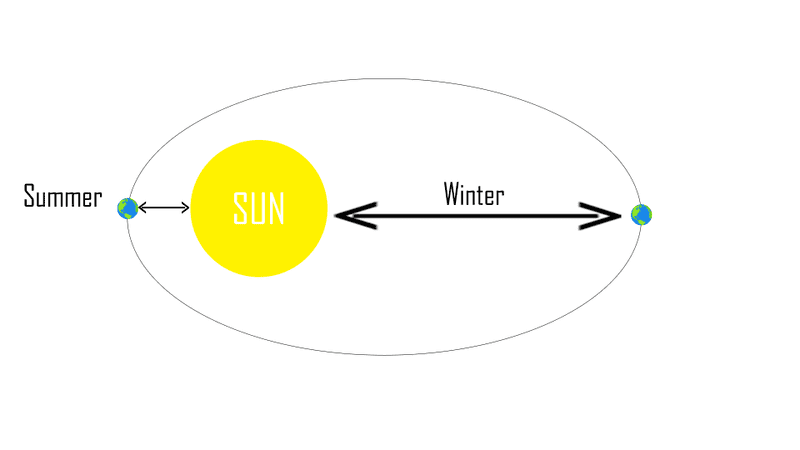
Hello guys, can someone explain me the four seasons ? Why they repeat in same intervals every year ? I think of this:

Thanks
Untitled-1.png
 
Astronomy news on Phys.org
Hectix said:
Hello guys, can someone explain me the four seasons ? Why they repeat in same intervals every year ? I think of this:

ThanksView attachment 93000
That picture is not the reason for the seasons (at least, not the whole story).

In fact, in the northern hemisphere, winter is just getting started when the Earth passes thru the perihelion (closest approach to the sun), somewhere along about January 3 or so. When summer is at its height in July in the northern hemisphere, the Earth is passing thru its aphelion (farthest point away from the sun). What is this sorcery?

https://en.wikipedia.org/wiki/Perihelion_and_aphelion

It's explained here:

https://en.wikipedia.org/wiki/Season
 
Thanks
 
As you suggested, the Earth's orbit is not perfectly circular, but it's not as an extreme elipse as your diagram suggests.
While that does make some difference to the overall amount of solar radiation arriving on Earth, that effect is vastly less than the effect produced by the Earth's axial tilt.
The effect of the axial tilt is such that in the northern hemisphere, 'Summer' in the polar regions is 6 months of continuous daylight, and winter is 6 months of darkness.
The same thing happens at the South pole, but the opposite way around, Summer in the northern hemisphere is winter in the south.
Outside of the polar regions there are longer days in summer, but the Sun does set for a while every day.
 
Last edited:
rootone said:
As you suggested, the Earth's orbit is not perfectly circular, but it's not as an extreme elipse as your diagram suggests.
While that does make some difference to the overall amount of solar radiation arriving on Earth, that effect is vastly less than the effect produced by the Earth's axial tilt.
The effect of the axial tilt is such that in the northern hemisphere, 'Summer' in the polar regions is 6 months of continuous daylight, and winter is 6 months of darkness.
The same thing happens at the South pole, but the opposite way around, Summer in the northern hemisphere is winter in the south.
Outside of the polar regions there are longer days in summer, but the Sun does set for a while every day.

The orbital eccentricity of the Earth is about 0.017, which means that the Earth's max. and min distances from the sun differ by about 5 million km (out of about 150 million km average distance)

https://en.wikipedia.org/wiki/Earth
 

Similar threads

  • · Replies 4 ·
Replies
4
Views
2K
  • · Replies 56 ·
2
Replies
56
Views
7K
  • · Replies 26 ·
Replies
26
Views
2K
  • · Replies 10 ·
Replies
10
Views
3K
  • · Replies 4 ·
Replies
4
Views
3K
  • · Replies 1 ·
Replies
1
Views
2K
  • · Replies 10 ·
Replies
10
Views
4K
  • · Replies 5 ·
Replies
5
Views
6K
  • · Replies 8 ·
Replies
8
Views
5K
  • · Replies 4 ·
Replies
4
Views
2K