Wilson Line Propagator: Understanding Eqtn 5.7 & 5.8

  • Context: Graduate 
  • Thread starter Thread starter Elmo
  • Start date Start date
  • Tags Tags
    Line Propagator
Click For Summary
SUMMARY

The discussion centers on the evaluation of the integrals in Eqtn 5.7 and 5.8 of the Wilson Line Propagator. Participants clarify that the introduction of a small variable, ε > 0, allows the integral to converge as λ approaches -∞, effectively transforming the exponential term. The limit process, specifically limε→0+, is crucial for understanding the behavior of the integrals and resolving the undefined terms at infinity. The final expression does not retain the exponentials due to the limits applied during integration.

PREREQUISITES
  • Understanding of complex analysis, particularly limits and convergence.
  • Familiarity with integral calculus, specifically improper integrals.
  • Knowledge of Feynman rules in quantum field theory.
  • Basic concepts of exponential functions and their behavior at infinity.
NEXT STEPS
  • Study the properties of improper integrals in calculus.
  • Learn about the role of convergence in complex integrals.
  • Investigate the application of limits in quantum field theory calculations.
  • Explore the derivation and implications of Feynman rules in particle physics.
USEFUL FOR

Physicists, mathematicians, and students engaged in quantum field theory, particularly those working with Wilson lines and complex integrals.

Elmo
Messages
37
Reaction score
6
TL;DR
An undefined term in the wilson line propagator
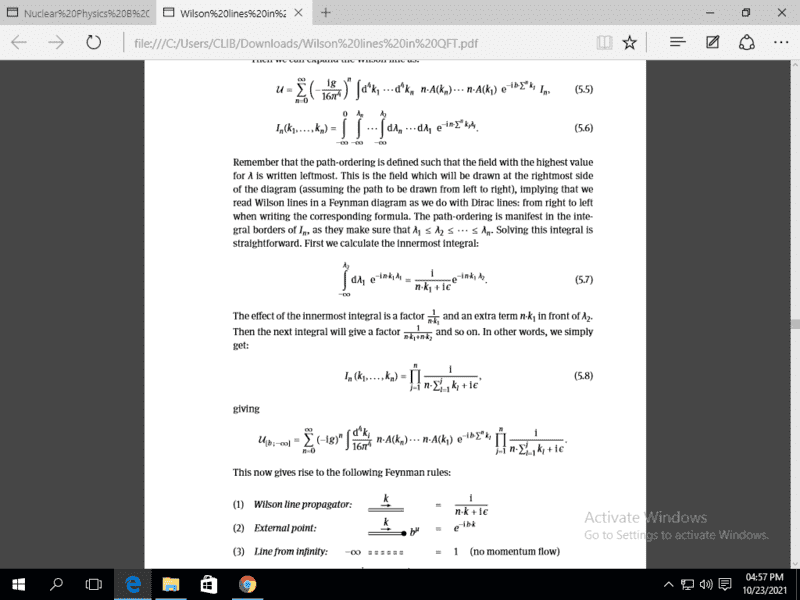
I asked this from a number of people but no one knew what to do about this exponential with iota infinity in the power,in Eqtn 5.7
The textbook seems to imply that it is zero but cos and sine are undefined at infinity.
Also,all the exponentials seem to vanish from the final result of Eqtn 5.8 whereas the integration of exponential function should still leave behind the function.
Where do all the exponentials go ?
Screenshot (1).png
 
Physics news on Phys.org
I think the author intoduces a small variable ##\epsilon > 0## so to write the integral in 5.7 as:

$$\lim_{\epsilon \rightarrow 0^+} \int_{-\infty}^{\lambda_2} d\lambda e^{-i(nk + i \epsilon)\lambda}$$

In this way you will have your original exponential multiplied by ##e^{\epsilon \lambda}##. This will assure the convergence of the function as ##\lambda## goes to ##-\infty## because it will exponentially go to zero.
The result of the integral is to be understood with a ##\lim_{\epsilon \rightarrow 0^+}## in front.
 
  • Like
Likes   Reactions: Elmo
dRic2 said:
I think the author intoduces a small variable ##\epsilon > 0## so to write the integral in 5.7 as:

$$\lim_{\epsilon \rightarrow 0^+} \int_{-\infty}^{\lambda_2} d\lambda e^{-i(nk + i \epsilon)\lambda}$$

In this way you will have your original exponential multiplied by ##e^{\epsilon \lambda}##. This will assure the convergence of the function as ##\lambda## goes to ##-\infty## because it will exponentially go to zero.
The result of the integral is to be understood with a ##\lim_{\epsilon \rightarrow 0^+}## in front.
Seems good though it introduces another undefined term as the lower limit, in the form of
$$e^{-n\epsilon\infty} $$
And as ##\epsilon \rightarrow 0## is being multiplied with infinity ,should that not again be undefined ?
Also,my other question remains that what happens to the exponentials in the upper limit ?
Why don't they show up in the final expression or the list of Feynman rules.
 
Elmo said:
should that not again be undefined
No. You take the ##\lim_{\epsilon->0^+}## at the end of all the calculations. So, first, you do the definite integral (that is first you take the limit as ##\lambda \rightarrow - \infty## which annihilates the exponential).

As for your second question, I don't see it immediately. If I have time I'll check more carefully. Sorry
 
Elmo said:
Also,my other question remains that what happens to the exponentials in the upper limit ?
You are performing the integrals in (5.6) one after the other. The explicit example is for the innermost one (over ##\lambda_1##). Have you verified the claim about the ##\lambda_2## integral? The upper limit in the last integral (the leftmost integral symbol) is 0, giving you ##e^0 = 1##.
 

Similar threads

  • · Replies 2 ·
Replies
2
Views
2K
  • · Replies 4 ·
Replies
4
Views
3K
  • · Replies 12 ·
Replies
12
Views
11K
  • · Replies 1 ·
Replies
1
Views
1K
  • · Replies 11 ·
Replies
11
Views
11K
  • · Replies 0 ·
Replies
0
Views
5K
Replies
2
Views
677
  • · Replies 19 ·
Replies
19
Views
4K
  • · Replies 25 ·
Replies
25
Views
5K
  • · Replies 13 ·
Replies
13
Views
3K