Work per particle of a NaCl chain

Join the discussion
Registration is free. Ask a follow-up in this thread, or start your own.
5 replies · 2K views
guyvsdcsniper
Messages
264
Reaction score
37
Homework Statement
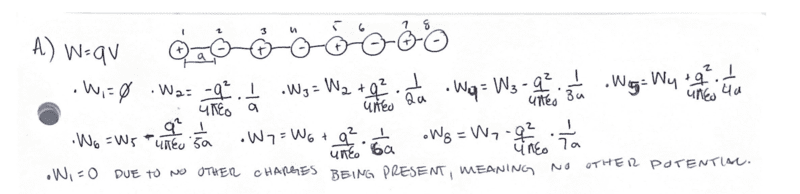
Find the work per particle required to assemble such a configuration.
Problem
Relevant Equations
W=qV
The problem states to find the work per particle to assemble the following NaCl chain.
I just want to post my work here to verify I have the correct answer.

My work is attached in the image provided.
Screen Shot 2022-02-28 at 5.02.37 PM.png
 
Physics news on Phys.org
ergospherical said:
Is this chain supposed to be infinite? (or of length 8?)
Ah it does say infinite, I missed that in the question.
 
Right. Well in that case, focus on a particular ion in the chain (labelled "0" below):
##\dots \ominus_{-3} \oplus_{-2} \ominus_{-1} \oplus_0 \ominus_1 \oplus_{2} \ominus_{3} \dots##

Let the interaction energy between ##m## and ##n## be ##U(m,n)##. Assuming each ion to be separated by a distance ##a## from its nearest neighbours, what's the sum of the interaction energies of all the pairs including the ion ##n=0##, i.e. ##U(0,1) + U(-1,0) + U(0,2) + U(-2,0) + \dots##?

How might you use this to work out the total energy per particle, which is proportional to ##\sum\limits_{\substack{m,n \\ m<n}} U(m,n)##? Be careful not to double count.
 
  • Like
Likes   Reactions: guyvsdcsniper and Hamiltonian
Edited

If you haven't already sorted this out, here are a couple of hints which should help:
- familiarise yourself with the series expansion of ##ln(2)##;
- make your working simpler/neater by defining ##A = \frac {q^2}{4 \pi \epsilon_0}##.
 
Last edited:
  • Like
Likes   Reactions: guyvsdcsniper and Hamiltonian
I figured it out. Thank you both for your help.
 
  • Like
Likes   Reactions: Steve4Physics