[Worksheet] Horizontal/Vertical components + other

  • Thread starter Thread starter Torald
  • Start date Start date
  • Tags Tags
    Components
Click For Summary

Homework Help Overview

The discussion revolves around a physics worksheet related to horizontal and vertical components of motion, specifically in the context of projectile motion. The original poster expresses confusion about the problem setup and calculations, mentioning an upcoming assessment in Higher Physics.

Discussion Character

  • Exploratory, Conceptual clarification, Mathematical reasoning, Problem interpretation

Approaches and Questions Raised

  • Participants discuss the use of trigonometry to resolve components of velocity into horizontal and vertical components. Questions arise regarding the relationships between these components and their calculations. There is also exploration of how to determine the time it takes for a projectile to reach a certain distance and its vertical position at that time.

Discussion Status

Some participants have provided guidance on calculating the components of velocity using trigonometric functions. There is ongoing exploration of the implications of these calculations, particularly regarding the vertical position of the projectile and the effects of gravity. Multiple interpretations of the problem are being considered, particularly in relation to the horizontal velocity and the time of flight.

Contextual Notes

Participants note the importance of considering gravity in the calculations and express uncertainty about the initial conditions and the setup of the problem. There are indications of missing information, such as the specific details of the worksheet that the original poster forgot to include.

Torald
Messages
2
Reaction score
0
Hey there.

Was given this sheet a while ago. Went over it in class a week ago, completely forgot everything about it today (This is a fresh sheet, lost the one I did.). Have an NAB tomorrow, and couldn't find my physics teacher today to get this worked out.

So, the problem is that I have no clue with what to do. I got some basic info down, but that is it.

Course is in Higher Physics.


Thanks in advance.

Edit : FORGOT THE WORKSHEET!
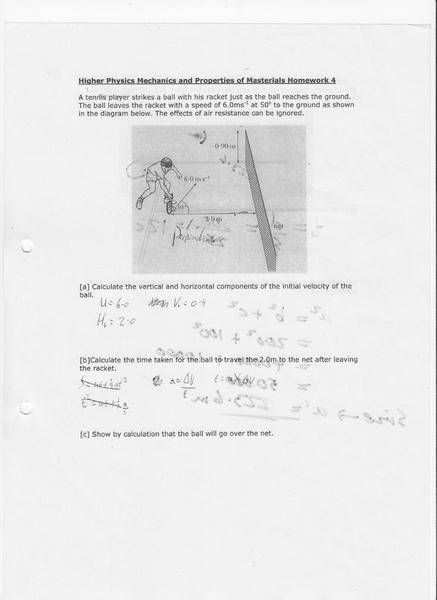
Phys_001.jpg
 
Physics news on Phys.org
I don't understand what you wrote there.

For (a), you should consider a triangle, where one angle is 50° and the other one is 90° ("standing" on the ground). This will give a relation between horizontal speed and total speed, as well as a relation between vertical and total speed via trigonometry.

For b: Does the horizontal velocity change? If not, how can you calculate the time until the ball reaches the net?

c: What is the vertical position of the ball after that time?
 
Thanks for the reply.

U = Initial Velocity (6.0 m/s)

Hv = Horizontal Component (2.0m)

Vv = Vertical Component (0.9m)

Focusing on question a):

[STRIKE]Trigonometry...Egh. Hate it.

Since the Hv is perpendicular (90 degrees), to calculate the components, it would involve cos(x), right?
Don't know what do with that, though. For the Hv, would I do (As in, punt into a calculator) "6.0cos(90)"? Or "2.0cos(90)"? Or...?

As I said, I have not much of a clue as to what to do here.

Your help is most appreciated.

Edit: Alright. I think I figured out how to calculate the components.

Vv = 6sin(50) = 3.9

Hv = 6cos(50) = 4.5

But shouldn't they add up to 6? 3.9 + 4.5 = 8.4

Gah. Confuzzled.[/STRIKE]

Got it!

The Hv = Vcos(Θ)
= 6cos(50)
= 3.9

Trick to remember : HC - Horizontal Cos


The Vv = Vsine(Θ)
= 6sine(50)
= 4.5

Trick to remember : VS - Vertical Sine


For

D = 2.0
V = 6.0

So, use d=v/t |With rearranging| t = d/v

2.0/6.0 = 0.3


Although, I don't know what to do for [c]. Help would be good. I assume it involves the Vv, Velocity, time.
 
Last edited:
For c) so at 3 s it reaches the net. How far will it travel vertically in 3s with initial velocity 6sin30? If this is greater than 0.9 then it makes it over the net.
 
Torald said:
The Vv = Vsine(Θ)
= 6sine(50)
= 4.5
You should be careful with rounding (4.596...)

For

D = 2.0
V = 6.0

So, use d=v/t |With rearranging| t = d/v

2.0/6.0 = 0.3

No, it is a horizontal distance, and the horizontal speed is not 6m/s.


@ofeyrpf: Don't forget gravity.
 

Similar threads

  • · Replies 4 ·
Replies
4
Views
7K
  • · Replies 6 ·
Replies
6
Views
6K
  • · Replies 2 ·
Replies
2
Views
5K
  • · Replies 7 ·
Replies
7
Views
2K
  • · Replies 5 ·
Replies
5
Views
2K
  • · Replies 1 ·
Replies
1
Views
7K
  • · Replies 6 ·
Replies
6
Views
10K
  • · Replies 4 ·
Replies
4
Views
3K
  • · Replies 12 ·
Replies
12
Views
3K
  • · Replies 54 ·
2
Replies
54
Views
8K