Justice Hunter
- 98
- 7
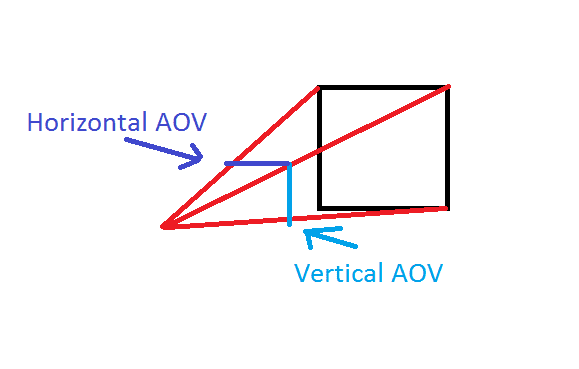
This is a representation of a square, and a triangle that creates an angle between that square. In this case, the horizontal and vertical components to the Angle of View are the same.
Now, change this square into a rectangle, and the relationship to the horizontal and vertical components are changed by a proportion. Let's assume it's a 16:9 proportion.
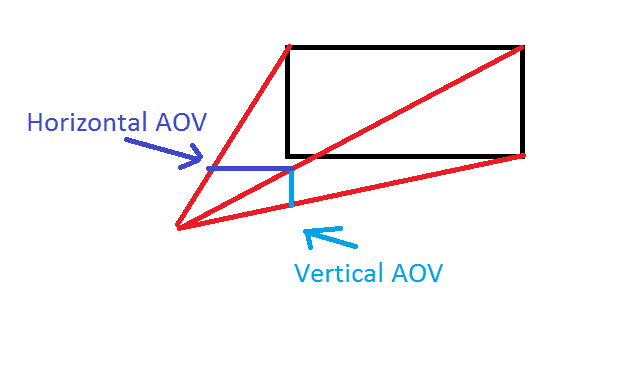
So this should have technically been correct...16/9 (1920/1080) should equal 160/90...but this turned out to give me a not so right answer.
I went and used this calculator, the results of a 90 Degree Vertical FOV yields "121" degree Horizontal FoV. for 1920/1080 pixels.
This calculator is nice and all, but
a) it's not exact enough for the calculation for what I'm doing, and...
b) What am i missing that it yields 90x121 rather than 90x160? I understand that as the AOV's approach 180 degrees, the FOV approaches infinity, so i know the two arn't the same, but it also means that the equation isn't just defined by a proportion.
Before anyone jumps to the comments, i want to point out that no, this situation is strictly mathematical in nature and has no analog to the physical world, or measuring distances in terms of feet or inches.
Thanks in advance.
Now, change this square into a rectangle, and the relationship to the horizontal and vertical components are changed by a proportion. Let's assume it's a 16:9 proportion.
So this should have technically been correct...16/9 (1920/1080) should equal 160/90...but this turned out to give me a not so right answer.
I went and used this calculator, the results of a 90 Degree Vertical FOV yields "121" degree Horizontal FoV. for 1920/1080 pixels.
This calculator is nice and all, but
a) it's not exact enough for the calculation for what I'm doing, and...
b) What am i missing that it yields 90x121 rather than 90x160? I understand that as the AOV's approach 180 degrees, the FOV approaches infinity, so i know the two arn't the same, but it also means that the equation isn't just defined by a proportion.
Before anyone jumps to the comments, i want to point out that no, this situation is strictly mathematical in nature and has no analog to the physical world, or measuring distances in terms of feet or inches.
Thanks in advance.