Write this Equation using Mathematica

  • Context: Mathematica 
  • Thread starter Thread starter EngWiPy
  • Start date Start date
  • Tags Tags
    Mathematica
Click For Summary

Discussion Overview

The thread discusses how to write a specific equation using Mathematica, particularly focusing on the use of the tricomi's confluent hypergeometric function, as well as exploring the concept of finding a general rule for sequences in Mathematica.

Discussion Character

  • Technical explanation
  • Homework-related
  • Debate/contested

Main Points Raised

  • One participant requests assistance in writing an equation in Mathematica, specifically mentioning the use of HypergeometricU for the tricomi's confluent hypergeometric function.
  • Another participant questions the difficulty of the request, suggesting it seems straightforward given the knowledge of HypergeometricU.
  • A participant later clarifies that their initial confusion stemmed from issues with signs and powers in their implementation, which they resolved after posting.
  • Another participant inquires about the "law of formation of sequence" in Mathematica, seeking help with this concept.
  • Responses to the sequence inquiry include a definition of a sequence and a discussion on the impossibility of determining a general rule without prior knowledge of the sequence's formation.
  • Participants mention the FindSequenceFunction in Mathematica, with one expressing disappointment that it does not yield a general term for a specific sequence provided.
  • Another participant reinforces the idea that finding a general term for a sequence is fundamentally challenging and expresses surprise that any function can work at all.

Areas of Agreement / Disagreement

Participants express differing views on the difficulty of writing the equation in Mathematica and the feasibility of finding a general term for sequences. No consensus is reached on these topics.

Contextual Notes

Participants mention specific issues related to signs and powers in Mathematica, as well as the limitations of the FindSequenceFunction in generating general rules for sequences.

EngWiPy
Messages
1,361
Reaction score
61
Hello everyone,

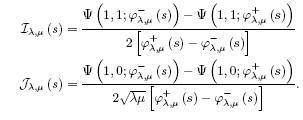
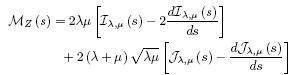
I have the following equation, and I want to write it using mathematica:
attachment.php?attachmentid=19507&stc=1&d=1246303265.jpg

where:
attachment.php?attachmentid=19506&stc=1&d=1246303265.jpg

and:
attachment.php?attachmentid=19505&stc=1&d=1246303265.jpg

Where [tex]\Psi[/tex] is the tricomi's confluent hypergeometric function, built-in Mathimatica as HypergeometricU[ , , ].
Can anyone help me, please?
Thanks in advance
Best regards
 

Attachments

  • Eq 1.JPG
    Eq 1.JPG
    2.6 KB · Views: 939
  • Eq 2.JPG
    Eq 2.JPG
    7.5 KB · Views: 758
  • Eq 3.JPG
    Eq 3.JPG
    4.2 KB · Views: 702
Physics news on Phys.org
I don't understand. What exactly is the difficulty? It seems straightforward, especially since you already know HypergeometricU.
 
DaleSpam said:
I don't understand. What exactly is the difficulty? It seems straightforward, especially since you already know HypergeometricU.

Than you DaleSpam for replying. Actually, I took this equation from a paper which plotted it. When I tried to so do, the program gave may little bit different results, so, I thought that I wrote the program incorrectly using Mathematica. But after I posted this thread, I solved the problem, which was a matter of signs and powers.

Sorry for that, and thanks again.

Regards
 
how we can find the law of formation of sequence in mathimatica? pleasezz help.
 
Hi Mike^now, welcome to PF

What does "law of formation of sequence" mean?
 
it is a general rule to write a sequence. like 1/2,1/4,1/8/1/16,1/32... has a general rule (1/2^n. where n = number of term.
 
That is not possible to do in general. No matter how many terms you write out, unless you already know the rule, you cannot know the next term.

For example, with the sequence you gave the next number could be 1/32, or the sequence could be cyclic and the next number could be 1/2 again, or it could be a bitshift of a floating point number with 5 bits of precision so that the next term is 0, etc.
 
Hmm, apparently they have a function which tries anyway:
FindSequenceFunction
 
This function does not provide general term of sequence ( 4/3,5/4,6/5,7/6...)

By writting FindSequenceFunction[{1, 4/3, 5/4, 6/5, 7/6, 8/7, 9/8}, n] produce as it is. no result.

even i tried sequence starting from 0 as well as from 1 and still it does not produce any formula of general term.
 
Last edited:
  • #10
Well, that does not surprise me. As I said, it is fundamentally an impossible question. It is pretty impressive that it ever works.
 

Similar threads

  • · Replies 4 ·
Replies
4
Views
4K
  • · Replies 4 ·
Replies
4
Views
4K
  • · Replies 5 ·
Replies
5
Views
3K
  • · Replies 0 ·
Replies
0
Views
2K
  • · Replies 19 ·
Replies
19
Views
3K
  • · Replies 2 ·
Replies
2
Views
3K
  • · Replies 3 ·
Replies
3
Views
2K
  • · Replies 23 ·
Replies
23
Views
3K
  • · Replies 3 ·
Replies
3
Views
2K
  • · Replies 5 ·
Replies
5
Views
2K