Write this Equation using Mathematica

  • Topic: Mathematica 
  • Thread starter EngWiPy
  • Start date
  • Tags Tags
    Mathematica
9 replies · 7K views · last reply
EngWiPy
Messages
1,361
Reaction score
61
Hello everyone,

I have the following equation, and I want to write it using mathematica:
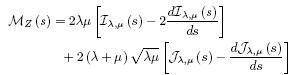
Equation for M_Z(s) as 2λμ times [I_{λ,μ}(s) - 2 dI_{λ,μ}(s)/ds] plus (λ + μ) times sqrt(λμ) times [J_{λ,μ}(s) - dJ_{λ,μ}(s)/ds], written in LaTeX.

where:
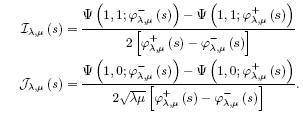
Two displayed equations defining I_{\lambda\mu}(s) and J_{\lambda\mu}(s) as ratios involving the Tricomi function Psi(1,1;phi^-(s)), Psi(1,1;phi^+(s)), Psi(1,0;phi^-(s)) and Psi(1,0;phi^+(s)), with denominators containing phi^+(s) minus phi^-(s) and the square root of lambda mu.

and:
Equation: phi^{±}_{λ,μ}(s) = (1/2)[s + λ + μ ± sqrt((s + λ + μ)^2 - 4λμ)], with s-subscript λ, μ on the left and the square root term inside the brackets.

Where [tex]\Psi[/tex] is the tricomi's confluent hypergeometric function, built-in Mathimatica as HypergeometricU[ , , ].
Can anyone help me, please?
Thanks in advance
Best regards
 
Attachments
  • Equation defining phi with plus or minus superscript at lambda, mu, s: one half times the bracket of s + lambda + mu plus or minus the square root of (s + lambda + mu) squared minus 4 lambda mu.
    Eq 1.JPG
    2.6 KB · Views: 961
  • Two-line display of equations defining I with subscripts lambda mu of s and J with subscripts lambda mu of s as ratios of Psi terms with phi plus and phi minus differences, with a sqrt(lambda mu) factor in the denominator of J.
    Eq 2.JPG
    7.5 KB · Views: 773
  • Equation for M_Z(s) = 2λμ [I_{λ,μ}(s) − 2 dI_{λ,μ}(s)/ds] + 2(λ + μ)√(λμ) [J_{λ,μ}(s) − dJ_{λ,μ}(s)/ds]
    Eq 3.JPG
    4.2 KB · Views: 720
I don't understand. What exactly is the difficulty? It seems straightforward, especially since you already know HypergeometricU.
 
DaleSpam said:
I don't understand. What exactly is the difficulty? It seems straightforward, especially since you already know HypergeometricU.

Than you DaleSpam for replying. Actually, I took this equation from a paper which plotted it. When I tried to so do, the program gave may little bit different results, so, I thought that I wrote the program incorrectly using Mathematica. But after I posted this thread, I solved the problem, which was a matter of signs and powers.

Sorry for that, and thanks again.

Regards
 
how we can find the law of formation of sequence in mathimatica? pleasezz help.
 
it is a general rule to write a sequence. like 1/2,1/4,1/8/1/16,1/32... has a general rule (1/2^n. where n = number of term.
 
That is not possible to do in general. No matter how many terms you write out, unless you already know the rule, you cannot know the next term.

For example, with the sequence you gave the next number could be 1/32, or the sequence could be cyclic and the next number could be 1/2 again, or it could be a bitshift of a floating point number with 5 bits of precision so that the next term is 0, etc.
 
This function does not provide general term of sequence ( 4/3,5/4,6/5,7/6...)

By writting FindSequenceFunction[{1, 4/3, 5/4, 6/5, 7/6, 8/7, 9/8}, n] produce as it is. no result.

even i tried sequence starting from 0 as well as from 1 and still it does not produce any formula of general term.
 
Last edited:
Well, that does not surprise me. As I said, it is fundamentally an impossible question. It is pretty impressive that it ever works.