MisterX
- 758
- 71
Faraday's law is
$$\nabla \times \mathbf{E} = - \frac{d\mathbf{B}}{dt} $$
If we let our time dependent surface be ##\Sigma(t)## and its boundary ##\partial \Sigma(t)##, then by Stokes' theorem
$$ \oint_{\partial \Sigma(t)} \mathbf{E} \cdot d\boldsymbol{\ell} = - \int_{\Sigma(t)} \frac{\partial \mathbf{B}}{\partial t} \cdot d\mathbf{A}$$
The crucial thing to notice is that in general
$$\int_{\Sigma(t)} \frac{\partial \mathbf{B}}{\partial t} \cdot d\mathbf{A} \neq \frac{d}{dt} \int_{\Sigma(t)} \mathbf{B}\cdot d\mathbf{A} $$
You cannot take the time derivative out of the integral when the boundary of the integral changes in time. So when the loop changes in time,
$$ \oint_{\partial \Sigma(t)} \mathbf{E} \cdot d\boldsymbol{\ell} \neq \frac{d\Phi}{dt}$$
Yet, I have repeatedly seen introductory physics students being expected to use Faraday's law for time changing loops. One type of relevant problem is the bar on a rail problem1.
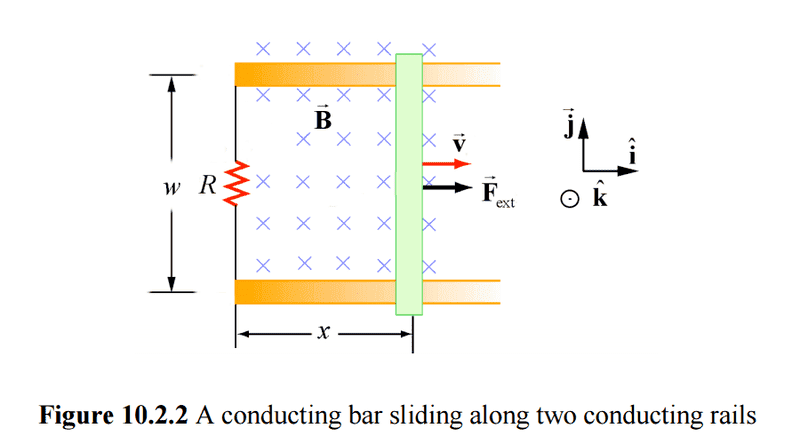
The correct interpretation is that magnetic forces on the electrons in the bar lead to a buildup of electric charge that supports a flow of current. Note that the charges produce a conservative electric field. Contrast this with the non-conservative electric field produced by Faraday's law. It is wrong to teach these as two equivalent approaches, because they are conceptually different. It is arguably mere coincidence that they might sometimes produce the same result for the current. As an aside, if we say the bar has some resistance, the matter is further complicated because we can no longer use the argument that ##\mathbf{E} = 0## in the bar to have equilibrium. I mention this because I have seen problems given to students that involve the moving portions of loops having resistance.
If you happen to be involved in teaching introductory physics, I encourage you to consider not asking questions that lead the students to use Faraday's law in these situations where it doesn't really apply. If any of you have an argument why we can generalize the concept of emf being related to change in flux to include the potential due to static charge buildup in moving loops in a way that is always correct, I might like to see that argument.
1 Figure resused from from MIT under Creative Commons License
$$\nabla \times \mathbf{E} = - \frac{d\mathbf{B}}{dt} $$
If we let our time dependent surface be ##\Sigma(t)## and its boundary ##\partial \Sigma(t)##, then by Stokes' theorem
$$ \oint_{\partial \Sigma(t)} \mathbf{E} \cdot d\boldsymbol{\ell} = - \int_{\Sigma(t)} \frac{\partial \mathbf{B}}{\partial t} \cdot d\mathbf{A}$$
The crucial thing to notice is that in general
$$\int_{\Sigma(t)} \frac{\partial \mathbf{B}}{\partial t} \cdot d\mathbf{A} \neq \frac{d}{dt} \int_{\Sigma(t)} \mathbf{B}\cdot d\mathbf{A} $$
You cannot take the time derivative out of the integral when the boundary of the integral changes in time. So when the loop changes in time,
$$ \oint_{\partial \Sigma(t)} \mathbf{E} \cdot d\boldsymbol{\ell} \neq \frac{d\Phi}{dt}$$
Yet, I have repeatedly seen introductory physics students being expected to use Faraday's law for time changing loops. One type of relevant problem is the bar on a rail problem1.
The correct interpretation is that magnetic forces on the electrons in the bar lead to a buildup of electric charge that supports a flow of current. Note that the charges produce a conservative electric field. Contrast this with the non-conservative electric field produced by Faraday's law. It is wrong to teach these as two equivalent approaches, because they are conceptually different. It is arguably mere coincidence that they might sometimes produce the same result for the current. As an aside, if we say the bar has some resistance, the matter is further complicated because we can no longer use the argument that ##\mathbf{E} = 0## in the bar to have equilibrium. I mention this because I have seen problems given to students that involve the moving portions of loops having resistance.
If you happen to be involved in teaching introductory physics, I encourage you to consider not asking questions that lead the students to use Faraday's law in these situations where it doesn't really apply. If any of you have an argument why we can generalize the concept of emf being related to change in flux to include the potential due to static charge buildup in moving loops in a way that is always correct, I might like to see that argument.
1 Figure resused from from MIT under Creative Commons License