What Does a Broad Peak at 2θ = 20.92° Indicate in Polymer XRD Analysis?

Click For Summary
SUMMARY

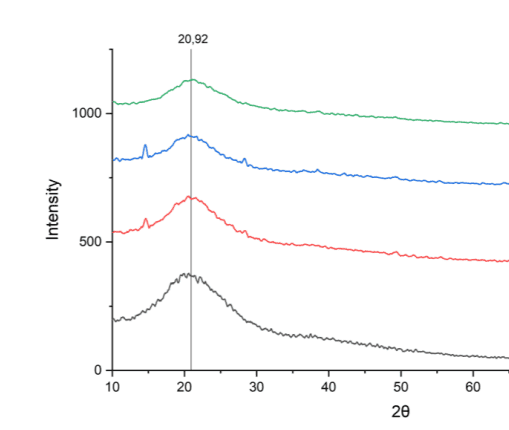
The forum discussion centers on the interpretation of a broad peak at 2θ = 20.92° in X-ray diffraction (XRD) analysis of a polymer specimen, specifically a composite of Chitosan, PEO, and LiClO4 with varying amounts of Al2O3 filler. The presence of a broad peak indicates an amorphous structure, which becomes more pronounced with increased filler content, suggesting a decrease in crystallinity. The discussion highlights the need for baseline intensity plots to accurately assess the contributions of the polymer and filler to the observed XRD patterns.

PREREQUISITES
  • Understanding of X-ray diffraction (XRD) principles
  • Knowledge of polymer crystallinity and amorphous materials
  • Familiarity with polymer composites and fillers
  • Experience with image processing for data analysis
NEXT STEPS
  • Investigate the effects of different fillers on polymer crystallinity
  • Learn about XRD baseline correction techniques
  • Explore the relationship between filler content and XRD peak broadening
  • Study the impact of polymer processing conditions on crystallinity
USEFUL FOR

Researchers, materials scientists, and polymer engineers interested in analyzing polymer crystallinity and the effects of fillers on material properties.
SPEOTW
Messages
4
Reaction score
0
TL;DR
Confusion about amorphous and crystalline region on XRD result
So i just have my XRD result (Polymer Specimen) which i use to determine crystallinity of my material, and it turns out that my material has no obvious peak, and have a broad peak which usually associated with amorphous material. I added some filler to my material and it became more and more broad but the peak stays there. does it mean my material become "more amorphous" or what does it mean
1690031515625.png
 
Engineering news on Phys.org
What do the different coloured traces represent?
What was the filler you added to the polymer?

I agree, it does look like an amorphous material.
What was the isomer and catalyst?
Does it progressively crystallise over time?
 
Hii thanks for answering my question , my material was Chitosan + PEO + LiClO4 and i added Al2O3 in it, the black one represent 0% filler, red one is 3%, blue is 5%, and green is 7%.

So the trend i saw here is the peak became broader and broader, what does it correlates to the crystallinity of my material.
 
A quick evaluation in an image processing program indicates that the peaks are indentical in width but their amplitude above their baselines decreases as filler is added.

This would indicate that the filler is scattering the x-rays, thereby raising the baseline.

Measuring in "Intensity" units, starting with the Green trace at the top:
"Peak" heights above their local baseline;
80
110
130
160

Cheers,
Tom
 
  • Like
Likes hutchphd, Lord Jestocost and Baluncore
What is the source of the broad peak at 2θ = 20.92° ?

It appears that the traces are stacked on the intensity axis, with loss of the baseline references. That makes it difficult to separate out the effects of the polymer and the filler, which I suspect is part of what we are seeing.

To analyse this further, I would need to see the intensity plot baseline for the sample support without a sample, and the plot with 100% filler alone, without polymer.
 
  • Like
Likes hutchphd and Tom.G

Similar threads

Replies
2
Views
2K
  • · Replies 5 ·
Replies
5
Views
2K
  • · Replies 0 ·
Replies
0
Views
3K
  • · Replies 9 ·
Replies
9
Views
8K
  • · Replies 7 ·
Replies
7
Views
3K
  • · Replies 32 ·
2
Replies
32
Views
7K
  • · Replies 23 ·
Replies
23
Views
37K
  • · Replies 1 ·
Replies
1
Views
7K
Replies
5
Views
4K
  • · Replies 13 ·
Replies
13
Views
10K