Solving the Heart Curve Equation: 'y =

  • Context: High School 
  • Thread starter Thread starter pairofstrings
  • Start date Start date
  • Tags Tags
    Curve Heart
Click For Summary

Discussion Overview

The discussion revolves around the equation of a heart curve, specifically the challenges in rewriting it in the form 'y ='. Participants explore the implications of this form, the nature of the equation, and the characteristics of parametric equations.

Discussion Character

  • Exploratory
  • Technical explanation
  • Conceptual clarification
  • Debate/contested

Main Points Raised

  • One participant attempts to express the heart curve equation as 'y =', but encounters an issue with an unwanted horizontal line in the graph.
  • Some participants argue that the equation cannot be expressed as a function of x because it does not yield a single value of y for each x, indicating it is a parametric equation.
  • Another participant questions the necessity of rewriting the equation in the form 'y =', suggesting it complicates the representation.
  • There is a discussion about the types of equations, with some participants noting that parametric equations are not included in a common list of equation types.
  • Participants clarify that the presence of terms like 'b xy' in equations can affect the graph's shape and behavior, leading to confusion about how to interpret these terms.
  • There is a mention of the general form of conic sections and how coefficients can determine the rotation and type of the conic section represented.
  • Some participants express uncertainty about the relationship between different types of equations and the implications of using terms like 'xy' in graphing.
  • The discussion touches on the order of operations (PEDMAS/BODMAS) in relation to graphing the heart curve equation.

Areas of Agreement / Disagreement

Participants express differing views on the necessity and feasibility of rewriting the heart curve equation in the form 'y ='. There is no consensus on the implications of parametric equations versus functions of x, and the discussion remains unresolved regarding the best approach to represent the heart curve.

Contextual Notes

Some participants highlight the complexity of the equation and the potential for multiple y-values for a given x-value, which complicates the representation as a function. There is also mention of the general form of equations and how certain terms influence the graph.

pairofstrings
Messages
411
Reaction score
7
TL;DR
I found the following heart curve on web:
x[SUP]6[/SUP] + 3x[SUP]4[/SUP]y[SUP]2[/SUP] - 3x[SUP]4[/SUP] + 3x[SUP]2[/SUP]y[SUP]4[/SUP] - x[SUP]2[/SUP]y[SUP]3[/SUP] - 6x[SUP]2[/SUP]y[SUP]2[/SUP] + 3x[SUP]2[/SUP] + y[SUP]6[/SUP] - 3y[SUP]4[/SUP] + 3y[SUP]2[/SUP] = 1
Hello.

I am trying to write the equation of this heart curve as 'y = '.
So the following is my attempt to form that equation: 1 = 1/y (x6y + 3x4y3 - 3x4y + 3x2y5 - x2y4 - 6x2y3 + 3x2y + y7 - 3y5 + 3y3)

Here, the graph of the above equation looks like this:
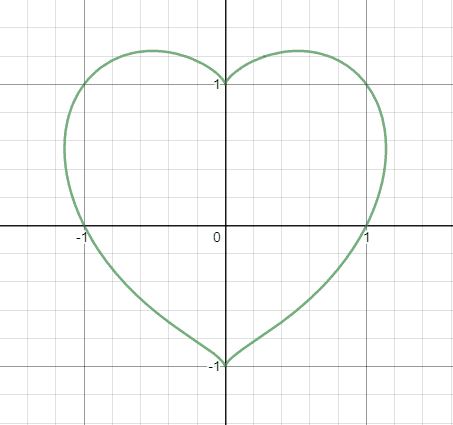
webheart.png

Now, next I should write it as 'y = ' but the problem is as I rewrite the above equation as y = x6y + 3x4y3 - 3x4y + 3x2y5 - x2y4 - 6x2y3 + 3x2y + y7 - 3y5 + 3y3

I get the curve correctly but there is a line going across the curve horizontally like this:
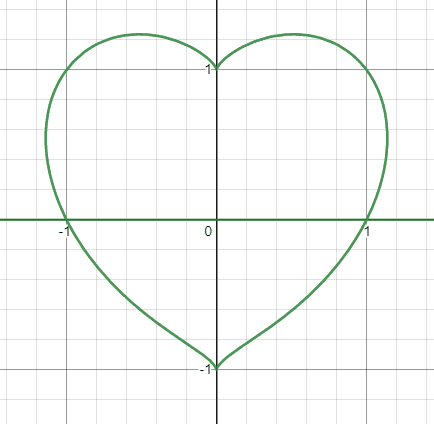
yequalstoheart.png


Question: How do I get rid of the line (green) from the above heart curve?

Thank you!
 
Mathematics news on Phys.org
Why do you want it as y= something? The other side includes y as well so you haven't actually made your life easier.
 
There is no a single value of y for any given x, hence in is not a function of x, ##y \neq f(x)##. It is a parametric equation, same as ##x^2 + y^2 = 1## to describe a circle.
 
DrClaude said:
There is no a single value of y for any given x, hence in is not a function of x, y≠f(x). It is a parametric equation, same as x2+y2=1 to describe a circle.

I am not able to understand "There is no single value of 'y' for any given 'x'".

I see that you've said that it is a parametric equation.
I searched web to find different types of equations.
I found:

Different Types of Equations
  • Quadratic Equation.
  • Linear Equation.
  • Radical Equation.
  • Exponential Equation.
  • Rational Equation.
In the list above there is no mention that there is a parametric equation as one of the types of equation.

Can you please list different types of equation?

Thanks!
 
Last edited:
You can't write this as y=f(x) because given an x value, there are multiple y values (pick an x value, draw a vertical line z observe you often hit the curve twice).

You wrote something that is of the form y=f(x,y). When you did so you introduced an extra factor of y which is why you got that line. It might be fixable, but first, why do you even care about writing it in this form?

To simplify the example, suppose you have the vertical line x=1. You can multiply both sides by y and get y=xy. This has the vertical line as a solution, but also y=0 is a solution for any x so you will add a horizontal line to the graph. It also doesn't give y as a function of x (no such function exists!) So it's not clear why you would want to do this anyway.
 
  • Like
Likes   Reactions: hutchphd
pairofstrings said:
n the list above there is no mention that there is a parametric equation as one of the types of equation.
You must not have searched very hard. Here's a wiki page on parametric equations: Parametric equation - Wikipedia
 
pairofstrings said:
Different Types of Equations
  • Quadratic Equation.
  • Linear Equation.
  • Radical Equation.
  • Exponential Equation.
  • Rational Equation.
In the list above there is no mention that there is a parametric equation as one of the types of equation.

Can you please list different types of equation?
That's a different "type of type".
As an analogy, you can group cars into red cars, blue cars, white cars, ... and you'll never find a Mazda in that list, because grouping cars by manufacturer is a different list.

The types you found are all descriptions how e.g. y can depend on x - if every value of x leads to a unique value of y.
In a parametric equation (or set of equations) you add a new variable - a parameter - and then have x and y both depend on that parameter. In that case a single value of x can have two or more corresponding values of y.
pairofstrings said:
I searched web to find different types of equations.
Just clicking the link you quoted would have been sufficient.

@DrClaude: It is not a parametric equation. Where is the parameter? It is locally an implicit function, however.
 
equationforms.png

The last one is Parametric Form.
(x-m)2 + (y-n)2 = r2 is standard form of an equation of circle.
What is Input form?
a x2 + b xy + c y2 + d x + e y = f is general form of equation of circle.
What happens if there is no 'b xy' in general form of equation of circle?
What is 'b xy'?
 
Last edited:
In the equation below (heart curve):
1607010481272.png


In the heart curve, I see that there is term like 'b xy' occurring too often.
To understand what 'b xy' is, let's look into the equation: 1 = x + y + xy.

1 = x + y + xy; it means x = 1, y = 1, and xy = 1
The graph looks like this for the equation that has no 'xy' in the equation 1 = x + y.

To plot x = 1 I can move 1 unit to right and to plot y = 1 I can move 1 unit up.
Hence, the following curve.
noxy.png


Now, how to move with 'xy' in 1 = x + y + xy the way I moved with x = 1 and y = 1 in 1 = x + y (I moved 1 unit to right and 1 unit up here, how will I move with xy here) to get the following curve? Why the impact of 'xy' in the equation 1 = x + y + xy is the way it is in the following graph? How is 'xy' in the equation 1 = x + y + xy affecting the graph 1 = x + y? How do I move with 'xy' (in equation 1 = x + y, I moved 1 unit right and 1 unit up, therefore it's 1 = x + y)? How do I move with 'xy' in 1 = x + y + xy?

withxy.png


Thanks.
 
Last edited:
  • #10
pairofstrings said:
What is Input form?
No idea. I don't know what program you are using. I suggest that you read the documentation for this program
pairofstrings said:
a x2 + b xy + c y2 + d x + e y = f is general form of equation of circle.
No, it is not. This is the general form of what's called a conic section. Depending on the values of the coefficients a, b, c, d, e, and f, the equation could be that of a circle, ellipse, parabola, or hyperbola or even a straight line. Some calculus textbooks include a section on analytic geometry, which would discuss these kinds of figures.
pairofstrings said:
What happens if there is no 'b xy' in general form of equation of circle?
What is 'b xy'?
The b coefficient determines whether and how much a basic conic section has been rotated. If b = 0, there has been no rotation.
 
  • #11
pairofstrings said:
In the heart curve, I see that there is term like 'b xy' occurring too often.
To understand what 'b xy' is, let's look into the equation: 1 = x + y + xy.

1 = x + y + xy; it means x = 1, y = 1, and xy = 1
Clearly this is not true.
If x = 1, y = 1, then xy = 1, so you have 1 = 1 + 1 + 1, which is not true.
pairofstrings said:
To plot x = 1 I can move 1 unit to right and to plot y = 1 I can move 1 unit up.
Hence, the following curve.
Well, the graph is correct, but your analysis of how to get it is incorrect. If you aren't able to figure out how to graph the simple equation x + y = 1 without using computer software, you are completely wasting your time trying to figure our what the graph of x + xy + y = 1 looks like.
 
  • Like
Likes   Reactions: Vanadium 50
  • #12
Mark44 said:
the equation could be that of a circle, ellipse, parabola, or hyperbola or even a straight line.

Or two straight lines!
 
  • #13
Vanadium 50 said:
Or two straight lines!
I thought of that situation, but didn't include it, given the level of knowledge of the OP. That case would technically be a degenerate hyperbola, which in the simplest form (i.e., unrotated) would be ##x^2 - y^2 = 0##. This equation is equivalent to ##y^2 - x^2 = 0##
 
  • #14
Are we using PEDMAS or BODMAS in the following equation to get the heart curve graph?
Are we practicing PEDMAS or BODMAS in the following equation to obtain the heart curve graph?
Are we adhering to PODMAS or BODMAS in the following equation to obtain the heart curve graph?

Equation:
x6 + 3x4y2 - 3x4 + 3x2y4 - x2y3 - 6x2y2 + 3x2 + y6 - 3y4 + 3y2 = 1
 
Last edited:
  • #15
I've never heard of bodmas before but Google says it's the same as pemdas. So I guess the answer is... Yes.
 
  • Haha
Likes   Reactions: etotheipi
  • #16
Office_Shredder said:
You wrote something that is of the form y=f(x,y). When you did so you introduced an extra factor of y which is why you got that line. It might be fixable, but first, why do you even care about writing it in this form?

The graph of the equation 1 = x + y is easy to draw. It says 'x' is 1 and 'y' is 1.
Therefore, I can plot the point at x = 1 and y = 1.

For the graph of the equation 1 = x y is there any short method to plot it?
 
  • Skeptical
Likes   Reactions: DaveE
  • #17
(1,1) is not a point on the curve 1=x+y so I'm not sure what you mean there.
 
  • #18
pairofstrings said:
The graph of the equation 1 = x + y is easy to draw. It says 'x' is 1 and 'y' is 1.
Therefore, I can plot the point at x = 1 and y = 1.
NO!
You've already said this, and I answered it a month ago, in post 11.
pairofstrings said:
For the graph of the equation 1 = x y is there any short method to plot it?
wolframalpha...
But I would recommend you get a precalculus textbook, one that discusses how to graph simple functions and geometric curves.

If you don't know how to sketch a graph of x + y = 1, you have absolutely no hope of being able to graph something way more complicated like the one you started this thread with.
 
Last edited:
  • #19
I think we're done here, so am closing this thread. It's pointless to discuss the graph of a fairly high-degree polynomial when the OP doesn't understand how to graph a straight line.

@pairofstrings, after you have studied or reviewed how to graph simple curves, please start a new thread.
 

Similar threads

  • · Replies 18 ·
Replies
18
Views
2K
  • · Replies 16 ·
Replies
16
Views
4K
  • · Replies 3 ·
Replies
3
Views
2K
  • · Replies 5 ·
Replies
5
Views
2K
  • · Replies 1 ·
Replies
1
Views
2K
  • · Replies 10 ·
Replies
10
Views
2K
  • · Replies 21 ·
Replies
21
Views
2K
  • · Replies 4 ·
Replies
4
Views
3K
  • · Replies 18 ·
Replies
18
Views
3K
  • · Replies 6 ·
Replies
6
Views
3K