New Reply

Finding the total resistance of a complex combination

 
Share Thread Thread Tools
Mar11-12, 10:48 AM   #1
 

Finding the total resistance of a complex combination


b]1. The problem statement, all variables and given/known data[/b]

Find the total resistance of this complex combination of resistors.
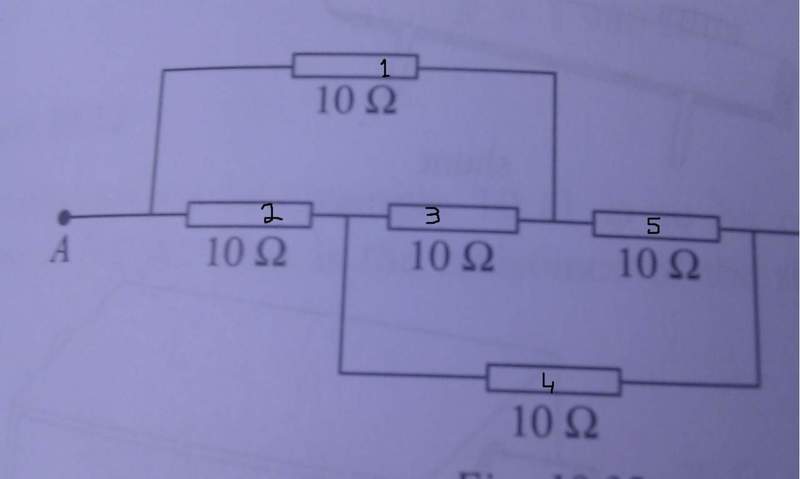
Click image for larger version

Name:	Final.jpg
Views:	33
Size:	32.1 KB
ID:	44961[

2. Relevant equations

R(total)= (Rr)/(R+r)

3. The attempt at a solution

resistance of r(2) and r(3) = 20Ω
resistance of the combination of r(1) and the resultant 20 Ω(ie r(2) and r(3) ) = 20/3
resistance of r(3) and r(5) = 20Ω
resistance of te combination of r(4) and the resultant 20 (ie r(3) and r(5) ) = 20/3

I can't deduce and answer from the above (correct) results.

Need urgent Help !!
PhysOrg.com
PhysOrg
science news on PhysOrg.com

>> Ants and carnivorous plants conspire for mutualistic feeding
>> Forecast for Titan: Wild weather could be ahead
>> Researchers stitch defects into the world's thinnest semiconductor
Mar11-12, 11:48 AM   #2
 
Blog Entries: 27
Recognitions:
Gold Membership Gold Member
Homework Helper Homework Help
Science Advisor Science Advisor
hi hms.tech!

have you tried using Kirchhoff's rules?
Mar11-12, 02:23 PM   #3
 
Quote by tiny-tim View Post
hi hms.tech!

have you tried using Kirchhoff's rules?
No!
Would you kindly guide me how and where do we apply them in this situation.

(i know what they are but am confused about thier appropriate application in this design of resistors)
Mar11-12, 02:36 PM   #4
 
Blog Entries: 27
Recognitions:
Gold Membership Gold Member
Homework Helper Homework Help
Science Advisor Science Advisor

Finding the total resistance of a complex combination


hi hms.tech!
Quote by hms.tech View Post
No!
Would you kindly guide me how and where do we apply them in this situation.

(i know what they are but am confused about thier appropriate application in this design of resistors)
just label the currents I1 I2 I3 I4 and I6 (with arrows of course!), do KVL and KCL, then find the total voltage drop between A and B, and divide by I6
what do you get?
Mar12-12, 10:29 AM   #5
 
as i said, i am confused about the way to apply these laws in this unusual situatuion
your 2nd answer did not help any more than the first one (@tiny tim).

Kind Sir, will elaborate on the proposed method.
to put it simply, i am unable to find the voltage drop between A and B.
Mar12-12, 11:22 AM   #6
 
Recognitions:
Homework Helper Homework Help
Quote by hms.tech View Post
as i said, i am confused about the way to apply these laws in this unusual situatuion
your 2nd answer did not help any more than the first one (@tiny tim).

Kind Sir, will elaborate on the proposed method.
to put it simply, i am unable to find the voltage drop between A and B.
Stick either a voltage source or a current source at terminals AB. If it's a current source, find the voltage drop across AB. If it's a voltage source, find the current it's driving into the circuit. Either way the overall resistance of the circuit will be the ratio of the voltage to the current that the source delivers.
Mar12-12, 06:21 PM   #7
 
http://en.wikipedia.org/wiki/Y-%CE%94_transform
This is how you gona solve it.
1,2 and 3 are in triangle, same 3,4,5, change one combination with triangle-star transform and its solved.
My result is 10 ohm.
With kirchhoff.
Lets make I6=10 (you can give it any value you want)
Now, when the current is at A it will be divided by 2, because R1=R2, I3=0 from KCL.
So I1=5, I2=5, i4=5, i5=5.
Now, what you gona do its to KVL in loop 1 (yellow) to find Uab.
After finding Uab, Rab=Uab/I6.
http://www.physicsforums.com/attachm...1&d=1331595516
Attached Thumbnails
Final.jpg  
Mar12-12, 07:36 PM   #8
 
Mentor
This circuit can be analyzed by the use of symmetry.

An equivalent circuit to this is on with A at one corner of a square, and B at the opposite corner.

Label the other two corners C & D respectively, the corners being labeled: A, C, B, and D in a clockwise sense.
Resistor 1 connects corners A and C.

Resistor 2 connects corners A and D.

Resistor 5 connects corners C and B.

Resistor 4 connects corners D and B.

Resistor 3 connects corners D and C.
New Reply
Thread Tools


Similar Threads for: Finding the total resistance of a complex combination
Thread Forum Replies
How do you solve the total # of combination for 3 variable for 2 equations General Math 7
Finding total resistance in parallel circuit Introductory Physics Homework 5
R Network- finding total resistance. Introductory Physics Homework 2
Finding the total resistance-combination circuit Introductory Physics Homework 0
Finding total resistance of circuits with cells in parallel Introductory Physics Homework 4