How to Maximize a Nonlinear Function with Limited Variables?

  • Context: Graduate 
  • Thread starter Thread starter ericdavid
  • Start date Start date
  • Tags Tags
    Function Nonlinear
Click For Summary

Discussion Overview

The discussion revolves around the optimization of a nonlinear function involving a summation index. Participants explore the relationship between the variables involved, particularly focusing on how to maximize the function given certain constraints and the nature of the summation.

Discussion Character

  • Exploratory
  • Technical explanation
  • Debate/contested
  • Mathematical reasoning

Main Points Raised

  • Eric initially presents a nonlinear function but lacks clarity on the relationship between the variables, particularly the summation index (i) and the variable (x).
  • Some participants question the definition of the summation index and its starting point, suggesting that it should have a clear integer starting value.
  • There is a proposal to set bounds for the summation to facilitate optimization, with Eric suggesting a relationship where i is defined as T/x.
  • Several participants express confusion over the relationship between i and x, indicating that i should not depend on x as it is an index of summation.
  • One participant suggests rewriting the function to eliminate the dependence on i, proposing a formula that simplifies the summation.
  • There are discussions about whether the optimization should be approached with or without constraints, and whether x is a real or integer variable.
  • Eric seeks clarification on how to express the function using a well-known formula and how to format mathematical expressions in the forum.
  • There is a suggestion to replace the index in the summation to align with Eric's specific case, but another participant questions the relevance of the previous function if it does not match Eric's needs.

Areas of Agreement / Disagreement

Participants express multiple competing views regarding the relationship between the variables and the structure of the summation. The discussion remains unresolved as there is no consensus on how to properly define the function for optimization.

Contextual Notes

There are limitations in the clarity of the function's definition, particularly regarding the starting point of the summation index and the relationship between the variables. The discussion also highlights the need for precise definitions and assumptions in mathematical expressions.
ericdavid
Messages
9
Reaction score
0
Hi to everyone,

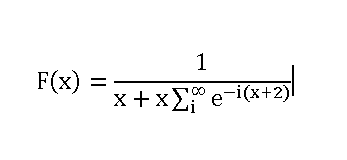
I'm optimizing a nonlinear function but I'm struggling to achieve it. The function is the following:
eq.PNG


X and i are relationed so i doesn't go to infinite. Do you have any idea how to maximize this function?

Thanks in advance,

Eric
 
Physics news on Phys.org
What do you mean by "related"? i is a summation index, not a free variable. The starting value is missing.

The sum has an explicit formula, this should be easy to simplify.
 
ericdavid said:
Hi to everyone,

I'm optimizing a nonlinear function but I'm struggling to achieve it. The function is the following:
View attachment 107800

X and i are relationed so i doesn't go to infinite.
What does this mean? Your summation appears to be from i = <something> to ##\infty##.
ericdavid said:
Do you have any idea how to maximize this function?
The summation in the formula for F(x) is unclear. Is this what you have in mind for the summation?
$$\sum_{i = 0}^{\infty}e^{-i(x + 2)}$$
 
Yes, it is from i to ∞, but if I want to optimize it I guess that I will have to set a bound.
And yes, the summation corresponds to what you have posted. Let's say that i is related to x as follows: i=T/x, T is a time. Therefore, x determines i.
 
Last edited by a moderator:
How can the summation index (i) start at i?
 
ericdavid said:
Yes, it is from i to ∞,
This makes no sense -- "from i to ∞". i is merely the index. You have to give a starting value, such as 0 or 1 or whatever, and an ending value, such as 10 or N or ∞.
ericdavid said:
but if I want to optimize it I guess that I will have to set a bound.
And yes, the summation corresponds to what you have posted. Let's say that i is related to x as follows: i=T/x, T is a time. Therefore, x determines i.
This also makes no sense. x is presumably a real number, and a summation index is usually an integer.

The summation that I wrote can be expanded like so:
##1 + e^{-(x + 2)} + e^{-2(x + 2)} + e^{-3(x + 2)} + \dots##

It's not at all clear to me or the other people replying in this thread what you're trying to do.
 
Apologies, I wanted to say that it goes from i=1 to inifinite. I will reformulate my question so you can understand it better.
I want to maximize this function:

Sin título.jpg

And x is related to i as follows; i=T/x, where T is a constant. Due to the nature of the problem, i is an integer.

Thanks for your patience.

Eric
 
ericdavid said:
And x is related to i as follows; i=T/x, where T is a constant.
This still doesn't make sense. i is an index of the summation, and x occurs outside the summation (as well as being part of the things being summed).
i takes on an infinite number of values: 1, 2, 3, ... in the summation, but the x that multiplies the summation can't change with the change in index values.

Based on what you said, you can write the summation as ##\sum_{i = 1}^{\infty}e^{-i(T/i + 2)}##, but you can't replace either x outside the summation by T/i.

It seems that you're trying to come up with a formula for a function that involves a summation, without understanding how a summation works.
 
If we forget about the relationship between i and T, how would you optimize it?
 
  • #10
ericdavid said:
I'm optimizing a nonlinear function

Your question is related to find the max of this function "in general" or with constraints ?
I don't understand well how this function is defined, ##i## is the integer index in the sum but what about ##x##?, is real or integer? Has this function a domain?
If it is a real function try with the derivative...

Ssnow
 
  • #11
ericdavid said:
If that is your function, it is identical to (just a different notation)
$$F(x)=\frac{1}{x+x \left( e^{-1(x+2)} + e^{-2(x+2)} + e^{-3(x+2)} + ... \right)}$$
You see how i disappears just by rewriting it? i cannot depend on anything.

You can use$$\sum_{i=1}^\infty e^{-i(x+2)} = \sum_{i=1}^\infty \left(e^{-(x+2)}\right)^i$$
The sum on the right (a sum over qi for some q) can be evaluated with a well-known formula.

Afterwards, you can use that a maximum of your function (which does not occur at 0) is a minimum of the inverse, 1/F(x). From there it should not be hard to look for minima.
 
  • Like
Likes   Reactions: ericdavid
  • #12
Ssnow said:
Your question is related to find the max of this function "in general" or with constraints ?
I don't understand well how this function is defined, ##i## is the integer index in the sum but what about ##x##?, is real or integer? Has this function a domain?
If it is a real function try with the derivative...

Ssnow
Hi Ssnow,

x is a real, I'm working on a domain and i do not have any constrains more.
 
  • #13
Hi, ok thanks for the clarification, I suggest you to follow the suggestions of @mfb.
 
  • #14
mfb said:
If that is your function, it is identical to (just a different notation)
$$F(x)=\frac{1}{x+x \left( e^{-1(x+2)} + e^{-2(x+2)} + e^{-3(x+2)} + ... \right)}$$
You see how i disappears just by rewriting it? i cannot depend on anything.

You can use$$\sum_{i=1}^\infty e^{-i(x+2)} = \sum_{i=1}^\infty \left(e^{-(x+2)}\right)^i$$
The sum on the right (a sum over qi for some q) can be evaluated with a well-known formula.

Afterwards, you can use that a maximum of your function (which does not occur at 0) is a minimum of the inverse, 1/F(x). From there it should not be hard to look for minima.
Thanks for your advice, so far the best I've received.

Can I use this formula?
Sin título.png


By the way, how do you introduce formulas in this forum?
 
  • #15
You can use this formula, to take the limit n->infinity you have to check if z is in the correct range for that.

You can use LaTeX for formulas. The quote in your post has two examples.
 
  • Like
Likes   Reactions: ericdavid
  • #16
In this formula, the summaton begins at i=0, while in my case it's i=1. How can I solve that?

Thanks
 
  • #17
You can replace i by i+1 everywhere (!) in your expression, then simplify.

There is a German Wikipedia article about - no English version, but the formulas are international.
 
  • Like
Likes   Reactions: ericdavid
  • #18
In fact, my function is this one:

Sin título.png


I posted a simplified one before, can I still express this one with a well-known formula?

Thanks
 
  • #19
No.

Where was the point of the other function if that is not what you actually want to solve?
 

Similar threads

  • · Replies 7 ·
Replies
7
Views
3K
  • · Replies 22 ·
Replies
22
Views
4K
  • · Replies 15 ·
Replies
15
Views
2K
  • · Replies 36 ·
2
Replies
36
Views
6K
  • · Replies 6 ·
Replies
6
Views
2K
  • · Replies 9 ·
Replies
9
Views
2K
  • · Replies 7 ·
Replies
7
Views
3K
  • · Replies 26 ·
Replies
26
Views
3K
  • · Replies 4 ·
Replies
4
Views
3K
  • · Replies 53 ·
2
Replies
53
Views
6K