First order differential equations (movement of a rotary solenoid)

Join the discussion
Registration is free. Ask a follow-up in this thread, or start your own.
4 replies · 2K views
Ben_Walker1978
Messages
113
Reaction score
6
Homework Statement
The movement of a rotary solenoid is given by the following differential equation
Relevant Equations
$${5} \frac{\text{d}\theta}{\text{d}t}+{6}\theta=0$$
My question i am trying to solve:
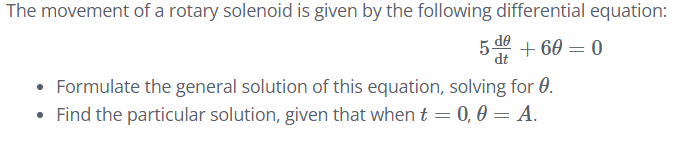
Untitled.png


I have successfully done first order equations before but this one has got me a little stuck. My attempt at the general solution below:

$${5} \frac{\text{d}\theta}{\text{d}t}=-6\theta$$

$${5} \frac{\text{d}\theta}{\text{d}t} =\frac{\text{-6}\theta}{5}$$

$$d\theta = \frac{-6\theta}{5} dt $$

The integral should then = $$\theta = \frac{1}{5} in(5)$$

$$\theta = -6 \times (\frac{1}{5}) in (5) + c$$

This is my attempt an the general solution. Is this correct? Or could anyone help if i have gone wrong please?

Thank you
 
Last edited:
Physics news on Phys.org
¥frac{d¥theta}{¥theta}=-¥frac{6}{5} dt
You can integrate the both sides.

Edit to fix broken LaTeX:
##\frac{d \theta} \theta = -\frac 6 5 dt##
 
Last edited by a moderator:
Ben_Walker1978 said:
Homework Statement:: The movement of a rotary solenoid is given by the following differential equation
Relevant Equations:: $${5} \frac{\text{d}\theta}{\text{d}t}+{6}\theta=0$$

My question i am trying to solve:

View attachment 300338

I have successfully done first order equations before but this one has got me a little stuck. My attempt at the general solution below:

$${5} \frac{\text{d}\theta}{\text{d}t}=-6\theta$$

$${5} \frac{\text{d}\theta}{\text{d}t} =\frac{\text{-6}\theta}{5}$$

$$d\theta = \frac{-6\theta}{5} dt $$

The integral should then = $$\theta = \frac{1}{5} in(5)$$

$$\theta = -6 \times (\frac{1}{5}) in (5) + c$$
There is no "in" function. If you're reading this off your calculator it is ln (lowercase ell n), short for logarithmus naturalis, or in English, natural logarithm.
Ben_Walker1978 said:
This is my attempt an the general solution. Is this correct? Or could anyone help if i have gone wrong please?
No, your solution is not correct.
Going from ##\frac{d\theta} \theta = -6/5 dt##, you should get ##\ln|\theta| = -6/5t + C##
How do then solve for ##\theta## in that equation?
Ben_Walker1978 said:
Thank you
 
If θo it is θ(t) for t=0 then θ(t)=θo*e^(-6/5*t). How to get it?​
 
The solution to these type of differential equations is called separation of variables. Where the idea is, to separate the infinitesimal dx and dy on opposite sides of the equal signs (if possible). Then integrate with respect to each infinitesimal on each side. Do not forget your constant of integration on the right.
 
Reply
  • Like
Likes   Reactions: Babadag