Material property comparison based on TDR and delta L

  • Thread starter Thread starter yefj
  • Start date Start date
Click For Summary

SUMMARY

The discussion focuses on comparing material properties using Time Domain Reflectometry (TDR) and loss per inch calculations derived from S-parameters (S21_10inch - S21_5inch)/L. It establishes that TDR provides broadband impedance versus time data but cannot directly yield tan_delta (dielectric loss tangent) or relative permittivity (εr) without additional frequency-domain measurements. The impedance observed in TDR reflects the transmission line characteristics, not intrinsic material properties, and attenuation affects the measured impedance over long lines. Accurate determination of tan_delta and εr requires Vector Network Analyzer (VNA) two-port measurements at specific frequencies rather than TDR alone.

PREREQUISITES

  • Time Domain Reflectometry (TDR) measurement principles
  • S-parameter analysis and calculation of loss per unit length
  • Vector Network Analyzer (VNA) two-port measurement techniques
  • Dielectric material properties: tan_delta and relative permittivity (εr)

NEXT STEPS

  • Perform VNA two-port measurements at target frequencies to extract tan_delta and εr
  • Analyze S-parameters (S21) for loss characterization over different line lengths
  • Use transmission line theory to separate material dielectric properties from line impedance
  • Apply exponential decay fitting on TDR data to estimate attenuation effects on impedance

USEFUL FOR

RF engineers, PCB designers, materials scientists, and test engineers involved in high-frequency material characterization and transmission line analysis seeking to accurately determine dielectric properties and select optimal materials based on TDR and S-parameter measurements.

yefj
Messages
122
Reaction score
2
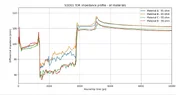
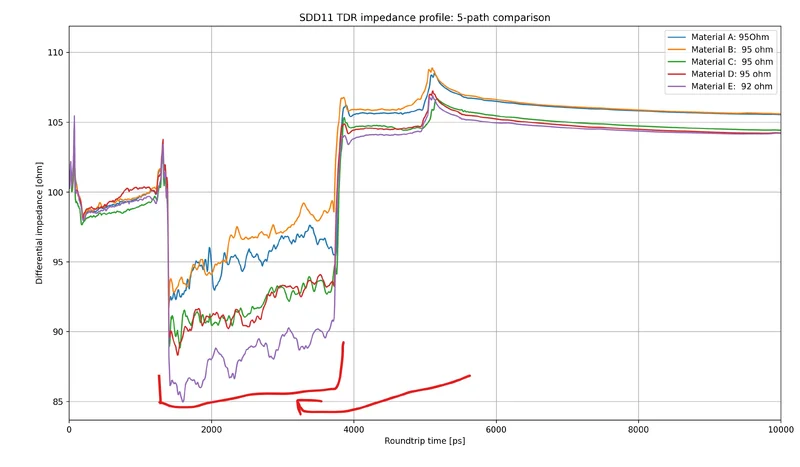
Hello ,As you can see in the plot bellow I have made several TDR of different materials on one plot.
I need to deside which is the best material to use.
Also I know that based on (S21_10inch-S21_5inch)/L I find the loss per inch.
Two questions:
1.after I find the loss per inch how do I find the tan_delta and e_r of the material?
2.looking at this TDR comparison how can I see the best performing material?
Thanks.
material_comp_up.webp
 
Engineering news on Phys.org
From the top right corner of your plot, how do you know the impedance of materials A-E? Were they calculated or were they measured using some instrument? You should be able to either, identify the Er was used for their computation, or extract Er from the TDR measurement.

In your case, with a very-long line, the TDR impedance will appear to be Zo = 100Ω. All plots will over longer times, decay exponentially to Zo. In effect, the impedance measurement is being attenuated with the attenuation of the signal. Try to extrapolate lines, (between zero and infinite resistance), with exponential decay towards Zo on the right.

Notice with TDR, that inductance appears to be infinite resistance, while capacitance appears to be zero resistance. I do not see how a TDR plot can give you Tan-d, as the TDR plots the magnitude of the reflected vector, without resolving the separate Z=R+jX components.

TDR is a broad-band plot of impedance against time, not against frequency or phase. To measure Tan-d, (which increases with frequency), you will need to make a two port VNA measurement at a single specified frequency.
 
Hello Baluncore,I know that as the los in bigger then tdr slope is larger.
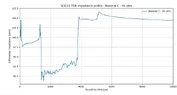
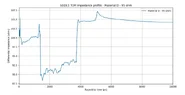
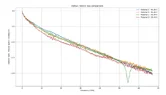
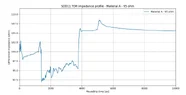
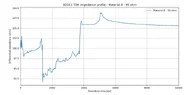
all material TDR is plotted together and loss per inch plot is attached.
what colclution can we get from these plots ?
Thanks.
 

Attachments

  • all_together.webp
    all_together.webp
    21.6 KB · Views: 4
  • photo_A.webp
    photo_A.webp
    13.6 KB · Views: 5
  • photo_B.webp
    photo_B.webp
    14 KB · Views: 9
  • photo_C.webp
    photo_C.webp
    13.9 KB · Views: 5
  • photo_D.webp
    photo_D.webp
    13.7 KB · Views: 5
  • loss_per inch.webp
    loss_per inch.webp
    19 KB · Views: 3
yefj said:
what colclution can we get from these plots ?
Without context, I can tell nothing.
Baluncore said:
From the top right corner of your plot, how do you know the impedance of materials A-E? Were they calculated or were they measured using some instrument?
 
Hello BalunCore 'The impedance is the impedance of the line.the material i think has the same er but different quality.the line impedance I think was simulated that how the PCB trace width was made.
is there something more which is needed to have a conclution on the plots at previos post?
Thanks.
 

Similar threads

  • · Replies 1 ·
Replies
1
Views
423
  • · Replies 74 ·
3
Replies
74
Views
11K
  • · Replies 15 ·
Replies
15
Views
5K
  • · Replies 16 ·
Replies
16
Views
5K
  • · Replies 27 ·
Replies
27
Views
4K
  • · Replies 1 ·
Replies
1
Views
2K
Replies
1
Views
3K
  • · Replies 1 ·
Replies
1
Views
3K
  • · Replies 2 ·
Replies
2
Views
3K
Replies
3
Views
2K