Geometrical meaning of ##(dx)^2##. Does ##(dx)^2## represent a point?

  • Level: Undergrad 
  • Thread starter Mike_bb
  • Start date
20 replies · 1K views · last reply
Mike_bb
Messages
397
Reaction score
45
Hello, PF!

Let we have ##dy=2xdx + (dx)^2## where ##dx## is infinitesimal quantity. We can neglect ##(dx)^2## as a high-order term than ##dx##.

In few sources I read that ##(dx)^2## represent a point (with zero measure).
Source: https://books.google.com/books/abou...Calculus_Dif.html?id=yU9LAAAAMAAJ&redir_esc=y
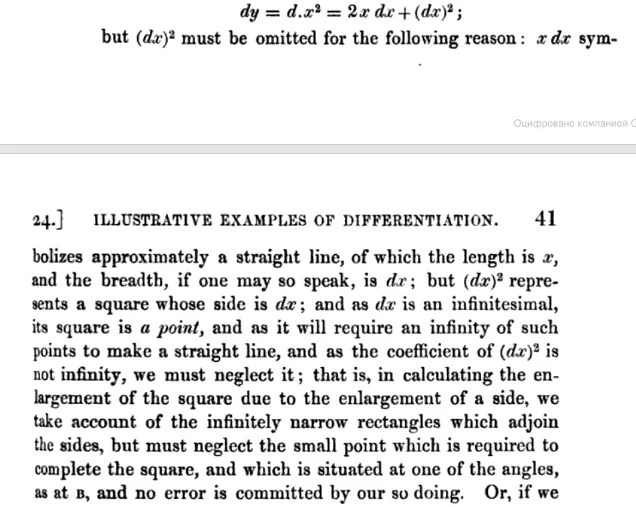
Scanned book page showing a geometric argument that (dx)^2 is a square of side dx, which is a point when dx is infinitesimal, so it is neglected; text is legible and continues across the page.


My question is: Does ##(dx)^2## represent a point indeed? Could anyone explain how is this possible?

Thanks, PF!
 
Mike_bb said:
My question is: Does ##(dx)^2## represent a point indeed? Could anyone explain how is this possible?

Thanks, PF!
In geometry a point is a zero-dimensional object. ## dx^2 ## does not define a zero-dimensional object; it represents an infinitesimal object. Therefore, ## dx^2 ## cannot be a point.
 
The book you quote, the one in the link, is from 1857! I'd say, try newer books.
 
  • Like
Likes   Reactions: Dale and Mike_bb
When you are discussing things like ##dx## you have to be very clear about what mathematical system you are using. In the real numbers with standard analysis ##dx## is a limit (or a variable that is taken to a limit as it approaches 0). If you do not want to treat it as a limit, then you need to use something like they hyperreal numbers with a non-standard analysis.

As a limit of real numbers ##dx^2## is not a point, it is the limit of a square with sides ##dx## as ##dx## approaches zero. Not as it "reaches" zero, but as it "approaches" zero. At no point during that approach is it not a square.

As an infinitesimal hyperreal number ##dx^2## is also not a point. It is just a square with infinitesimal sides.

In both cases, the error from neglecting it is small. In the real case it approaches 0, and in the hyperreal case it is infinitesimal. So the book is right to neglect it, even though its description as a point is an exaggeration.
 
It wasn’t until the early 20th century that calculus had all of its i’s dotted and t’s crossed. I would not get hung up on subtle points on things written before then.
 
Dale said:
When you are discussing things like ##dx## you have to be very clear about what mathematical system you are using. In the real numbers with standard analysis ##dx## is a limit (or a variable that is taken to a limit as it approaches 0). If you do not want to treat it as a limit, then you need to use something like they hyperreal numbers with a non-standard analysis.

As a limit of real numbers ##dx^2## is not a point, it is the limit of a square with sides ##dx## as ##dx## approaches zero. Not as it "reaches" zero, but as it "approaches" zero. At no point during that approach is it not a square.

As an infinitesimal hyperreal number ##dx^2## is also not a point. It is just a square with infinitesimal sides.

In both cases, the error from neglecting it is small. In the real case it approaches 0, and in the hyperreal case it is infinitesimal. So the book is right to neglect it, even though its description as a point is an exaggeration.
Ok. But how do you define infinitesimally small vector without using Leibniz's infinitesimals (##dx=1/N##)? Also infinitesimally small quantities appear in different branches of Physics. There are two opinions: 1. Leibniz's infinitesimals are wrong. 2. Leibniz's infinitesimals are useful tool for several areas of Math and Physics.
 
Mike_bb said:
Ok. But how do you define infinitesimally small vector without using Leibniz's infinitesimals (##dx=1/N##)?
Use Robinson's hyperreals instead: https://en.wikipedia.org/wiki/Hyperreal_number#From_Leibniz_to_Robinson

Mike_bb said:
There are two opinions: 1. Leibniz's infinitesimals are wrong. 2. Leibniz's infinitesimals are useful tool for several areas of Math and Physics.
Regardless of Leibniz's infinitesimals, Robinson's are mathematically rigorous and well accepted. They just haven't been adopted as part of standard instruction, so they are not as well known as the standard "epsilon delta" approach.
 
Last edited:
Dale said:
Use Robinson's hyperreals: https://en.wikipedia.org/wiki/Hyperreal_number#From_Leibniz_to_Robinson

Regardless of Leibniz's infinitesimals, Robinson's are mathematically rigorous and well accepted. They just haven't been adopted as part of standard instruction, so they are not as well known as the standard "sigma delta" approach
Lead Russian universities teach how to use Leibniz's infinitesimals.. There are many textbooks that use them instead of hyperreals. By the way, many (99%) Russian universities don't teach what hyppereals are.
 
Mike_bb said:
Lead Russian universities teach how to use Leibniz's infinitesimals.. There are many textbooks that use them
Interesting. In the US it is almost exclusively the “epsilon delta” approach. I don’t think I have ever seen one that teaches Leibniz’s approach. It is not rigorous
 
Dale said:
Interesting. In the US it is almost exclusively the “epsilon delta” approach. I don’t think I have ever seen one that teaches Leibniz’s approach. It is not rigorous
In the Russia we also have "epsilon delta" approach + Leibniz's approach (Strength of materials, Math, Physics etc.)
 
Mike_bb said:
In the Russia we also have "epsilon delta" approach + Leibniz's approach (Strength of materials, Math, Physics etc.)
Well, if someone chooses to use Leibniz approach then they are justifiably subject to all of the standard criticisms of that approach.
 
The modern perspective on these questions is that ##dx^i## is a coordinate basis covector (or basis 1-form) on a manifold, dual to the coordinate basis vector ##\frac{\partial}{\partial x^i}##. Modern rigorous textbooks on analysis do not invoke symbols such as ##dx## as infinitesimals and do not require such terminology.
From this perspective, ##dx^2 := dx \otimes dx##
 
wrobel said:
The modern perspective on these questions is that ##dx^i## is a coordinate basis covector (or basis 1-form) on a manifold, dual to the coordinate basis vector ##\frac{\partial}{\partial x^i}##. Modern rigorous textbooks on analysis do not invoke symbols such as ##dx## as infinitesimals and do not require such terminology.
From this perspective, ##dx^2 := dx \otimes dx##
True, assuming that ##x## is a coordinate. Something like ##d\tau^2## or ##ds^2## wouldn't be a coordinate basis covector.
 
wrobel said:
What ( which context) are you referring to?
Sorry, I forgot this was the math forum. I was referring to general relativity. ##ds^2## is the line element or spacetime interval and ##d\tau## is the proper time.
 
I don't understand anything about relativity, but I suspect that ##d\tau## might be considered a basis covector in spacetime . In the case of a Riemannian metric, ##ds## really is a basis covector on the one-dimensional manifold that is the curve

$$x=x(t),\quad ds=\sqrt{g_{ij}\dot x^i\dot x^j}dt.$$
dt -- a basis covector in coordinates t;
ds -- a basis covector in coordinates s
##ds^2## -- just a symbol indicating that there is a square root in the definition. We could easily do without this symbol.
 
wrobel said:
Actually, the symbol ##ds^2## can also be explained:

$$ds^2=g_{ij}dx^i\circledcirc dx^j,\quad dx^i\circledcirc dx^j=(dx^i\otimes dx^j+dx^j\otimes dx^i)/2$$
Sure, but ##ds^2## is not a coordinate basis covector itself. As you can see from the formula you posted, it is a scalar.
 
Dale said:
Sure, but ##ds^2## is not a coordinate basis covector itself. As you can see from the formula you posted, it is a scalar.
If I may be a translation service here haha.

What @wrobel wrote is not the scalar ##ds^2## we are familiar with in GR, it is just the coordinate representation of the metric using the coordinate one-form basis ##dx^i##.

Each ##dx^i## is a (basis) one form and the tensor product between them is a rank 2 tensor. So when you see ##ds^2## in post #17 just see (the coordinate representation of) ##g##. The ##ds^2## that we see in some standard SR/GR text is actually a contraction of what wrobel wrote with infinitesimal displacement vectors.

So if you want to stay rigorous, using pure differential geometry and no infinitesimals, ##ds^2## is just another symbol for the metric -- the symmetric tensor version.
 
I already said:
Dale said:
##ds^2## is the line element
Not the metric. It is indeed easy to go from one to the other, but the line element is a scalar.