Discussion Overview
The discussion revolves around troubleshooting a "10 particles lost" warning in MCNPX simulations, specifically related to modeling a neutron detection setup involving a point source, backscattered neutrons, and the configuration of various detector components. Participants explore issues with statistical checks, detector definitions, and output discrepancies, focusing on both theoretical and practical aspects of the simulation.
Discussion Character
- Technical explanation
- Debate/contested
- Mathematical reasoning
- Experimental/applied
Main Points Raised
- Some participants suggest that the point source should not coincide with a surface, recommending a slight adjustment to the source position to avoid errors.
- There are concerns about the definitions of the BPE and PE components, with some participants proposing that they were initially swapped in the input file.
- Statistical errors are noted as potentially indicating that too few particles are reaching the detector, with suggestions to increase the number of particles simulated to improve statistical reliability.
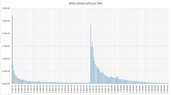
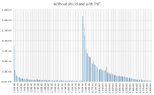
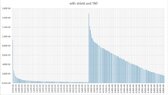
- One participant expresses confusion over the output flux values, questioning why there is little change in flux with and without TNT, suggesting that the model may not be accurately capturing backscattered neutrons.
- Another participant mentions the need for a new tally to differentiate between elastic and inelastic scattered neutrons, indicating a limitation in the current model setup.
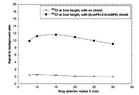
- There is a discussion about the capabilities of the detector and how it might differentiate neutron types based on energy and flux, referencing a paper that implies a more sophisticated detection method.
- Participants express a desire for feedback on their updated input files and plots related to flux versus energy.
Areas of Agreement / Disagreement
Participants do not reach a consensus on the cause of the warnings or the best approach to resolve the issues. Multiple competing views and suggestions remain, particularly regarding the configuration of the detector and the interpretation of output results.
Contextual Notes
Limitations include unresolved statistical checks, potential misconfigurations in the input file, and the challenge of accurately modeling neutron interactions in the presence of different materials. The discussion highlights the complexity of differentiating neutron types in the simulation.