Can You Solve This Initial Value Problem and Determine Its Solution Interval?

  • Context: MHB 
  • Thread starter Thread starter karush
  • Start date Start date
  • Tags Tags
    Explicit Form Ivp
Click For Summary
SUMMARY

The discussion centers on solving the initial value problem defined by the differential equation \(xdx + ye^{-x}dy = 0\) with the initial condition \(y(0) = 1\). Participants detail the process of separating variables, integrating both sides, and deriving the explicit solution \(y = 2[(1-x)e^x - 1]^{1/2}\). The solution's interval is determined to be approximately \(-1.68 < x < 0.77\), which is confirmed through graphical analysis using Desmos and the application of Lambert's W function for further evaluation.

PREREQUISITES
  • Understanding of differential equations and initial value problems
  • Proficiency in integration techniques, including integration by parts
  • Familiarity with Lambert's W function and its applications
  • Experience using graphing tools like Desmos for visualizing functions
NEXT STEPS
  • Explore the properties and applications of Lambert's W function
  • Learn advanced integration techniques, particularly integration by parts
  • Investigate the graphical behavior of solutions to differential equations
  • Study the implications of initial conditions on the solutions of differential equations
USEFUL FOR

Mathematics students, educators, and professionals working with differential equations, particularly those focusing on initial value problems and their graphical interpretations.

karush
Gold Member
MHB
Messages
3,240
Reaction score
5
View attachment 9112

Given #11
$\quad\displaystyle
xdx+ye^{-x}dy=0,\quad y(0)=1$
a. Initial value problem in explicit form.
$\quad xdx=-ye^{-x}dy$
separate
$\quad \frac{x}{e^{-x}}\, dx=-y\, dy$
simplify
$\quad xe^x\, dx=-y\, dy$
rewrite
$\quad y\,dy=-xe^x\,dx$
integrate (with boundaries)
$\quad \int_1^y u\,dy=-\int_0^x ve^v\,dv$

OK i did this so far hopefully ok but didnt know how to do b and c (on desmos)

b. Plot the graph of the solution
c. Interval of solution.
 

Attachments

  • 11.2.PNG
    11.2.PNG
    12 KB · Views: 149
Last edited:
Physics news on Phys.org
Re: 11.2

I recommend that you integrate both side to find the curve and the graph as well as provide that answer to us.
 
Re: 11.2

(You have a typo- your "dy" should be "du".)

Why stop there? Obviously you have to do the integrals! The "du" integral is straight forward. To do the "dv" integral, use "integration by parts".

Solving for y will involve a square root. The domain is determined by the fact that the square root must be of a non-negative number. The graph will have two parts, one with "+", the other with "-".
 
Re: 11.2

What title would you like me to give this thread so that the title is useful?
 
Re: 11.2

11.2 Initial value problem in explicit form.

I tried to fix it but couldn't

==================================

integrate (with boundaries)
$$\int_1^y y\,dy=-\int_0^x xe^x\,dx$$
then
$\frac{y^2}{2}-\frac{1}{2}=-e^xx+e^x-1$
isolate y
multiply thru by 2 and add 1
$y^2=-2e^xx+2e^x-2+1$
simplify RHS and factor
$y^2=2[1-x]e^x-1$
square both sides
$y = 2[(1-x)e^x-1]^{1/2}$

typo maybe??

when this is graphed you get nothing?
 
Last edited:
Re: 11.2

karush said:
thake the square (root) of both sides
$y = 2[(1-x)e^x-1]^{1/2}$

typo maybe??

when this is graphed you get nothing?
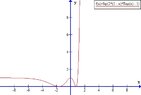
The "2" belongs under the square root. Typo? (Sun)

Here's the graph. I have no idea why this would cause you trouble.
View attachment 9113

And don't forget the part of the solution with the negative sign!

-Dan
 

Attachments

  • graph.jpg
    graph.jpg
    7.8 KB · Views: 130
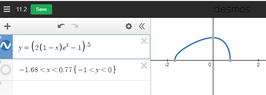
View attachment 9117
here is the desmos attemptalso I don't know where the interval of $−1.68<x<0.77$ which is the book answer comes from
I set y=0 but that didn't return those values
 

Attachments

  • 11.2d.PNG
    11.2d.PNG
    6.8 KB · Views: 136
Last edited:
karush said:
here is the desmos attemptalso I don't know where the interval of $−1.68<x<0.77$ which is the book answer comes from
I set y=0 but that didn't return those values
What values did you get? If I graph the function on Desmos (https://www.desmos.com/calculator) clicking on the y-intercept, I get x= -1.678 and x= 0.768)

If y= 0 then 2(1- x)e^x- 1= 0 then 2(1- x)e^x= 1.

Let u= 1- x so that x= 1- u. The equation becomes 2ue^{1- u}= 2eue^{-u}= 1. Let v= -u so that u= -v. The equation becomes -2eve^v= 1. Divide both sides by -2e. ve^v= -\frac{1}{2e}. Then v= W\left(\frac{-1}{2e}\right) where "W" is "Lambert's W function, defined as the inverse function to f(x)= xe^x.
 

Similar threads

Replies
5
Views
2K
Replies
4
Views
2K
  • · Replies 3 ·
Replies
3
Views
2K
  • · Replies 3 ·
Replies
3
Views
2K
  • · Replies 5 ·
Replies
5
Views
2K
  • · Replies 5 ·
Replies
5
Views
2K
  • · Replies 4 ·
Replies
4
Views
2K
Replies
6
Views
2K
  • · Replies 5 ·
Replies
5
Views
2K
  • · Replies 2 ·
Replies
2
Views
2K