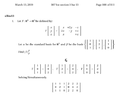
Find $\left[T\right]_\beta^\beta$ for NMH{823}

  • Context: MHB 
  • Thread starter Thread starter karush
  • Start date Start date
Click For Summary
SUMMARY

The discussion focuses on finding the transition matrix $\left[T\right]_\beta^\beta$ for the linear transformation T defined by T\begin{bmatrix}x \\ y \\ z\end{bmatrix}= \begin{bmatrix}x+ 2y- z \\ 2x- y+ z \\ x+ z\end{bmatrix}. The user calculates T\begin{bmatrix}1 \\ 0 \\ 1 \end{bmatrix} and derives the equations A + B + C = 0, 2B + C = 3, and A + B = 2 to find the coefficients A, B, and C. The resulting first column of the transition matrix is \begin{bmatrix}\frac{8}{5} \\ \frac{2}{5} \\ \frac{11}{5}\end{bmatrix}, demonstrating the correct approach to constructing the transition matrix.

PREREQUISITES
  • Understanding of linear transformations and their matrix representations
  • Familiarity with basis vectors and transition matrices
  • Knowledge of solving systems of linear equations
  • Proficiency in matrix multiplication and vector operations
NEXT STEPS
  • Learn how to compute the Reduced Row Echelon Form (RREF) of matrices
  • Study the properties of linear transformations in vector spaces
  • Explore the concept of change of basis in linear algebra
  • Practice solving systems of equations using matrix methods
USEFUL FOR

Students and professionals in mathematics, particularly those studying linear algebra, as well as educators looking to enhance their understanding of transition matrices and linear transformations.

karush
Gold Member
MHB
Messages
3,240
Reaction score
5
nmh{823}

13.PNG

ok just want to see if I went the right direction with this before I launch into the rref
of which I would use a online calculator to do if I could find one.
$\left[T\right]_\beta^\beta$ should be on the right after rref
 
Last edited:
Physics news on Phys.org
Given that T\begin{bmatrix}x \\ y \\ z\end{bmatrix}= \begin{bmatrix}x+ 2y- z \\ 2x- y+ z \\ x+ z\end{bmatrix}

Then T\begin{bmatrix}1 \\ 0 \\ 1 \end{bmatrix}= \begin{bmatrix}1+ 2(0)- 1 \\ 2(1)- 0+ 1 \\ 1+ 1\end{bmatrix}= \begin{bmatrix} 0 \\ 3\\ 2 \end{bmatrix}. That is very different from your "\begin{bmatrix}2 \\ 0 \\ 2 \end{bmatrix}". Am I misunderstanding something?

To write that in basis \beta you want to find numbers, A, B, C such that
A\begin{bmatrix}1 \\ 0 \\ 1 \end{bmatrix}+ B\begin{bmatrix}1 \\ 2 \\ 1 \end{bmatrix}+ C\begin{bmatrix}1 \\ 1 \\ 0 \end{bmatrix}= \begin{bmatrix}A+ B+ C \\ 2B+ C \\A+ B \end{bmatrix}= \begin{bmatrix} 0 \\ 3 \\ 2 \end{bmatrix}.

So we have the three equations, A+ B+ C= 0, 2B+ C= 3, and A+ B= 2. From the second equation C= 3- 2B, and from the third, A= 2- B. Putting those into the first equation, A+ B+ C= 2- B+ B+ 3- 2B= 5- 2B= 0. 2B= 5 so B= 2/5. Then C= 3- 4/5= 11/5 and A= 2- 2/5= 8/5. The first column of the transition matrix is \begin{bmatrix}\frac{8}{5} \\ \frac{2}{5} \\ \frac{11}{5}\end{bmatrix}.
 
https://www.physicsforums.com/attachments/8893

how did they get these (red)
 
karush said:
how did they get these (red)
They applied the operator T to the vector using either the explicit form of the matrix T just above or by using the original definition.

[math]T \left [ \begin{matrix} 1 \\ 1 \\ 2 \end{matrix} \right ] = \left ( \begin{matrix} 5 & 0 & 1 \\ 3 & 2 & -3 \\ 5 & 0 & 0 \end{matrix} \right ) \left [ \begin{matrix} 1 \\ 1 \\ 2 \end{matrix} \right ] = \left [ \begin{matrix} 5(1) + 0(1) + 1(2) \\ 3(1) + 2(1) - 3(2) \\ 5(1) + 0(1) + 0(2) \end{matrix} \right ] = \left [ \begin{matrix} 7 \\ -1 \\ 5 \end{matrix} \right ] [/math]

-Dan
 
Looks obvious now
But i couldn't see that

Sometimes I wish they would show more steps rather that assume things but then ..;)

Just glad there is a good forum to call on
 

Similar threads

  • · Replies 1 ·
Replies
1
Views
1K
Replies
8
Views
2K
  • · Replies 4 ·
Replies
4
Views
2K
  • · Replies 1 ·
Replies
1
Views
2K
  • · Replies 5 ·
Replies
5
Views
3K
  • · Replies 2 ·
Replies
2
Views
2K
  • · Replies 4 ·
Replies
4
Views
2K
  • · Replies 6 ·
Replies
6
Views
3K
  • · Replies 24 ·
Replies
24
Views
4K
  • · Replies 2 ·
Replies
2
Views
3K