1H NMR: Unsymmetric Peak Multiplicity and J Values

  • Context: Chemistry 
  • Thread starter Thread starter Organic_Student_2020
  • Start date Start date
  • Tags Tags
    multiplicity Nmr Peak
Click For Summary
SUMMARY

The discussion focuses on the complexities of 1H NMR spectroscopy, particularly regarding unsymmetric peak multiplicity and J values in the aromatic region (7-10 ppm). Participants note that the observed peaks integrate to a small number of hydrogens despite being surrounded by a larger number, indicating intricate coupling patterns. The peaks are likely influenced by multiple non-equivalent protons, leading to distorted and split signals that differ from typical aliphatic peak patterns. A resource link is provided for further understanding of splitting diagrams in NMR spectra.

PREREQUISITES
  • Understanding of 1H NMR spectroscopy principles
  • Familiarity with peak multiplicity and J coupling values
  • Knowledge of aromatic proton behavior in NMR
  • Ability to interpret NMR spectra
NEXT STEPS
  • Study 1H NMR peak splitting and multiplicity rules
  • Learn about J coupling constants and their significance in NMR
  • Explore the interpretation of aromatic region peaks in NMR spectra
  • Review resources on NMR spectroscopy, such as the provided link on splitting diagrams
USEFUL FOR

Chemists, organic chemistry students, and researchers analyzing complex NMR spectra, particularly those dealing with aromatic compounds and peak multiplicity challenges.

Organic_Student_2020
Messages
1
Reaction score
0
Homework Statement
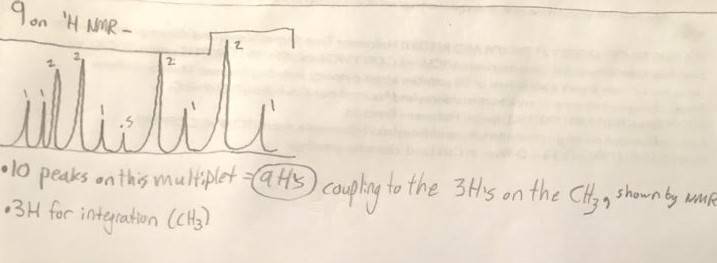
How to find multiplicity and J values for non symmetric 1H NMR spectra?
Relevant Equations
I have tried to figured this out but I can't, I need help on how to find the multiplicity of some of these arrangements of peaks. For example, there is one that looks like (from left to right), a doublet, 2 triplets, and then another doublet. I will Attach crude drawings below, but hopefully I can just get an answer on how to do this exercise.
The peaks all look unfamiliar, no symmetry, or very little, and they all integrate to a small number of hydrogen while being surrounded by a large number.

Here are the images.1.)
NMR Multiplets 1.jpg


2.)
NMR Multiplets 2.jpg


3.)
NMR Multiplets 3.jpg


4.)
NMR Multiplets 5.jpg


5.)
NMR Multiplets 6.jpg


Thanks for any explanations. I don't expect anyone to do it for me, I just have no other resources to figure this out.
 

Attachments

  • NMR Multiplets 4.jpg
    NMR Multiplets 4.jpg
    21.6 KB · Views: 297
Physics news on Phys.org
Without knowing exactly where these appear in your spectrum, it's tough to say, but I'm guessing these are in the aromatic region of the spectrum (between about 7 and 10 ppm). The aromatic region of proton NMR spectra can give some very complicated peak splittings. Aromatic protons often couple to multiple non-equivalent protons, and even protons that are further than nearest neighboring carbons, which distorts and splits peaks further than what you normally see in the aliphatic region of the spectrum. Here's a link that might help:
https://chem.libretexts.org/Bookshe...Diagrams_Explain_the_Multiplicity_of_a_Signal
 
  • Like
Likes   Reactions: etotheipi
can you post pictures of the spectra? It is difficult to do any analysis without knowing the exact shape of the peaks.
 

Similar threads

  • · Replies 1 ·
Replies
1
Views
12K
  • · Replies 1 ·
Replies
1
Views
4K
Replies
1
Views
4K
  • · Replies 3 ·
Replies
3
Views
3K
  • · Replies 4 ·
Replies
4
Views
12K
  • · Replies 9 ·
Replies
9
Views
4K
  • · Replies 6 ·
Replies
6
Views
3K
  • · Replies 3 ·
Replies
3
Views
2K
  • · Replies 2 ·
Replies
2
Views
2K
  • · Replies 1 ·
Replies
1
Views
2K