2 Conveyors with different speeds

Join the discussion
Ask a follow-up here, or get your own question answered by working scientists, mathematicians and engineers — people, not an autocomplete.
Real named experts · corrections over time · the nuance an AI answer skips
7 replies · 4K views
omarmorocci
Messages
47
Reaction score
0
(mentor note: moved here from a non-homework thread)

Hello
I am trying to find the time it will take for a parcel to pass over one conveyor belt
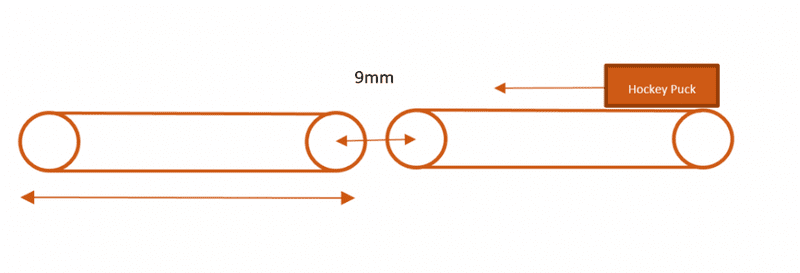
upload_2017-3-30_14-6-40.png


The conveyor on the right is Conveyor A The conveyor on the left is Conveyor B
they both have a length of 700mm
Conveyor A has a constant speed of X
Conveyor B has a constant speed of Y
The hockey pick has a radius of 80 mm
The coefficient of friction is Z
the hockey puck is initially moving at speed X

I need to find the time it will take for the parcel to pass completely over Conveyor B ( shown with arrow in picture).
 
Last edited by a moderator:
on Phys.org
jedishrfu said:
This looks like homework. We cannot solve it for you.

Please show some work so we can provide some hints to help you work it out.

Hello,

I am actually looking for a way to start as I am not sure how to approach it.

Here's what I have so far:
upload_2017-3-30_15-2-50.png


The question I believe lies at the point where the puck crosses from the first conevyor belt to the second.
I have this force diagram but I am not sure if it's right
 
omarmorocci said:
Hello,

I am actually looking for a way to start as I am not sure how to approach it.

Here's what I have so far:
View attachment 115271

The question I believe lies at the point where the puck crosses from the first conevyor belt to the second.
I have this force diagram but I am not sure if it's right
You need to consider a more general state during the cross-over. When there is a length x on conveyor B, how much weight will be on that conveyor? You will have to make some reasonable/idealised assumptions to answer this.
 
haruspex said:
You need to consider a more general state during the cross-over. When there is a length x on conveyor B, how much weight will be on that conveyor? You will have to make some reasonable/idealised assumptions to answer this.

I generalized the problem to get an approximate answer.
I removed the conveyor belt on the right and just assumed that the hockey puck has a speed of X when introduced on to the conveyor belt on the left
So U ( initial speed) = X
V ( final speed) = Y
S (distance) = 700
T (time taken)= T

I assumed that the acceleration is constant, hence s = (U+V)/2 *T

Is this approach correct to get an approximate answer ?
 
omarmorocci said:
Is this approach correct to get an approximate answer ?
No. Imagine making the B conveyor much longer. The distance the puck travels on B before coming to the same speed as B does not keep increasing. It is controlled by the coefficient of friction.
You could get an approximate answer by just supposing the puck is dropped onto B with the horizontal speed of A and calculating the time it would take to accelerate to the speed of B. But if that were the expected solution I do not see why they would have given you the 9mm separation distance.
 
  • Like
Likes   Reactions: jedishrfu
haruspex said:
No. Imagine making the B conveyor much longer. The distance the puck travels on B before coming to the same speed as B does not keep increasing. It is controlled by the coefficient of friction.
You could get an approximate answer by just supposing the puck is dropped onto B with the horizontal speed of A and calculating the time it would take to accelerate to the speed of B. But if that were the expected solution I do not see why they would have given you the 9mm separation distance.
It's not a homework questions, I am actually working with conveyor belts and need to calculate the speed the conveyor B based on time it takes for the parcel (hockey puck) to pass conveyor B. So this is real life problem not a homework.

With that said being said. Your second part suggesting calculating the time it would take for the puck to reach speed B, how do I do that ?
I figured that the puck would instantly have the speed of conveyor B as the puck won't slide and hence it will have a speed of 0 relative to the belt
 
omarmorocci said:
I figured that the puck would instantly have the speed of conveyor B
But in your earlier attempt you assumed a constant acceleration.
You quote a coefficient of friction. Is that kinetic or static? If it is kinetic, what is the frictional force when sliding? What acceleration does that give?