MHB 205.2.6.1-2 another implicit problem with tangent line.

Click For Summary
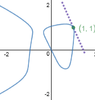
The discussion focuses on finding the slope of the curve defined by the equation 2y^8 + 7x^5 = 3y + 6x at the point (1,1). The variables are separated, leading to the derivative expression y' = (-35x^4 + 6) / (16y^7 - 3). Substituting the point (1,1) yields a slope of m = -29/13. The equation of the tangent line at this point is then established as y = -29/13(x - 1) + 1. Overall, the calculations confirm the tangent line's validity at the specified point.
karush
Gold Member
MHB
Messages
3,240
Reaction score
5
Find the slope of the curve at the given point}
$2y^8 + 7x^5 = 3y +6x \quad (1,1)$
Separate the variables
$2y^8-3y=-7x^5+6x$
d/dx
$16y^7y'-3y'=-35x^4+6$
isolate y'
$\displaystyle y'=\frac{-35x^4+6}{16y^7-3}$
plug in (1,1)
$\displaystyle y'=\frac{-35(1)^4+6}{16(1)^7-3}=-\frac{29}{13}=m$
so equation of tangent line is
$\displaystyle y=-\frac{29}{13}(x-1)+1$

well at least the graph seemed ok
 

Attachments

  • 205_2_6_1-2.PNG
    205_2_6_1-2.PNG
    4.8 KB · Views: 152
Physics news on Phys.org
Looks good to me. :)
 
There are probably loads of proofs of this online, but I do not want to cheat. Here is my attempt: Convexity says that $$f(\lambda a + (1-\lambda)b) \leq \lambda f(a) + (1-\lambda) f(b)$$ $$f(b + \lambda(a-b)) \leq f(b) + \lambda (f(a) - f(b))$$ We know from the intermediate value theorem that there exists a ##c \in (b,a)## such that $$\frac{f(a) - f(b)}{a-b} = f'(c).$$ Hence $$f(b + \lambda(a-b)) \leq f(b) + \lambda (a - b) f'(c))$$ $$\frac{f(b + \lambda(a-b)) - f(b)}{\lambda(a-b)}...

Similar threads

  • · Replies 4 ·
Replies
4
Views
2K
  • · Replies 2 ·
Replies
2
Views
2K
Replies
3
Views
2K
  • · Replies 7 ·
Replies
7
Views
2K
  • · Replies 2 ·
Replies
2
Views
2K
  • · Replies 4 ·
Replies
4
Views
2K
  • · Replies 2 ·
Replies
2
Views
2K
  • · Replies 13 ·
Replies
13
Views
4K
  • · Replies 1 ·
Replies
1
Views
2K
  • · Replies 1 ·
Replies
1
Views
3K