Calculating 2D Momentum Collision with Unknown Speeds and Angles

Click For Summary
SUMMARY

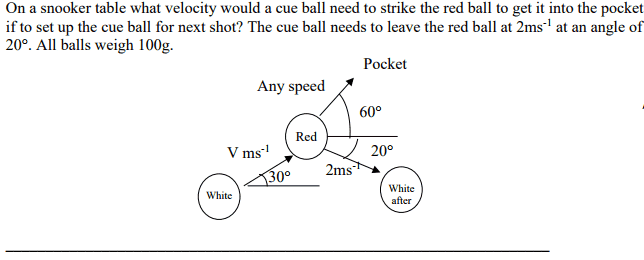
The discussion focuses on calculating the momentum collision in a 2D scenario involving unknown speeds and angles. The equations used include P = mv, with specific angle calculations for the cue ball's trajectory. The final angles determined are +60° for the red ball and -20° for the white ball. The participants emphasize the importance of correctly applying trigonometric functions to resolve the momentum equations.

PREREQUISITES
  • Understanding of momentum and the equation P = mv
  • Knowledge of trigonometric functions, specifically sine and cosine
  • Familiarity with 2D vector resolution
  • Basic skills in solving systems of equations
NEXT STEPS
  • Study the principles of 2D momentum conservation in collisions
  • Learn how to apply trigonometric identities in physics problems
  • Explore methods for solving systems of linear equations
  • Investigate the effects of angle and speed on collision outcomes in billiards
USEFUL FOR

Students studying physics, particularly those focusing on mechanics and momentum, as well as anyone interested in understanding collision dynamics in billiards or similar scenarios.
Theudius
Messages
20
Reaction score
0
1.
lAsytPR.png

Homework Equations


[/B]
P = mv

The Attempt at a Solution


[/B]
VCos(30) + 0 = nCos(60) + 2Cos(20)
VSin(30) + 0 = nSin(60) + 2Sin(20)

where I let n = any speed,
I'm not sure if my attempt at the solution is correct.
 
Physics news on Phys.org
Theudius said:
1. View attachment 211369

Homework Equations


[/B]
P = mv

The Attempt at a Solution


[/B]
VCos(30) + 0 = nCos(60) + 2Cos(20)
VSin(30) + 0 = nSin(60) + 2Sin(20)
Check signs in 2nd equation.
 
I don't see anything wrong with the signs in the second equation could you explain further also how would I obtain V?
 
Theudius said:
I don't see anything wrong with the signs in the second equation could you explain further
What direction does the cue ball go after impact?
also how would I obtain V?
2 equations, 2 unknowns.[/QUOTE]
 
Last edited:
  • Like
Likes   Reactions: Theudius
Theudius said:
I don't see anything wrong with the signs in the second equation could you explain further also how would I obtain V?

The final angles are ##+60^o## for red and ##-20^o## for white.
 
  • Like
Likes   Reactions: Theudius

Similar threads

Replies
3
Views
1K
  • · Replies 10 ·
Replies
10
Views
2K
  • · Replies 71 ·
3
Replies
71
Views
3K
Replies
1
Views
2K
  • · Replies 23 ·
Replies
23
Views
4K
  • · Replies 2 ·
Replies
2
Views
1K
Replies
9
Views
4K
  • · Replies 7 ·
Replies
7
Views
2K
  • · Replies 4 ·
Replies
4
Views
3K
  • · Replies 4 ·
Replies
4
Views
2K