A billiard ball moves at a speed of 4.00 m/s and collides elastically....

  • Thread starter Thread starter ejantz
  • Start date Start date
  • Tags Tags
    Ball Speed
Click For Summary

Homework Help Overview

The discussion revolves around a physics problem involving an elastic collision between two billiard balls, one moving at a speed of 4.00 m/s and the other initially stationary. Participants are tasked with determining the final speed and direction of the incoming ball after the collision, as well as the direction of the stationary ball post-collision.

Discussion Character

  • Mixed

Approaches and Questions Raised

  • Participants explore various equations related to kinetic energy and momentum conservation. There are attempts to manipulate trigonometric identities and quadratic equations to find the angles of deflection post-collision. Questions arise about the correctness of substitutions and the application of mathematical principles.

Discussion Status

The discussion is ongoing, with participants providing insights and corrections to each other's reasoning. Some participants express uncertainty about their calculations and seek clarification on specific steps, indicating a collaborative effort to understand the problem better.

Contextual Notes

Participants mention the use of trigonometric identities and the implications of elastic collisions, indicating a focus on the mathematical relationships involved. There is a recognition of potential errors in previous calculations, and ongoing adjustments to the approach are noted.

ejantz
Messages
5
Reaction score
0
Homework Statement
A billiard ball moves at a speed of 4.00m/s and collides elastically with an identical stationary ball. As a result, the stationary ball flies away at a speed of 1.69m/s, as shown in Figure A2.12. Determine the final speed and direction of the incoming ball after the collision and the direction of the stationary ball after the collision
Relevant Equations
KEi = KE1 + KE2
p1x + p2x = p'1x + p'2x
p1y + p2y = p'1y + p'2y
cos(theta1)^2 + sin(theta1)^2 = cos(theta2)^2 + sin(theta2)^2
I know this question has been asked before but I really need some help finishing this final piece of the puzzle.. I have attached an image of my work to show how far I have gotten towards the solution but my unfamiliarity with trigonometry equations has gotten my stuck. Please assist! thank you
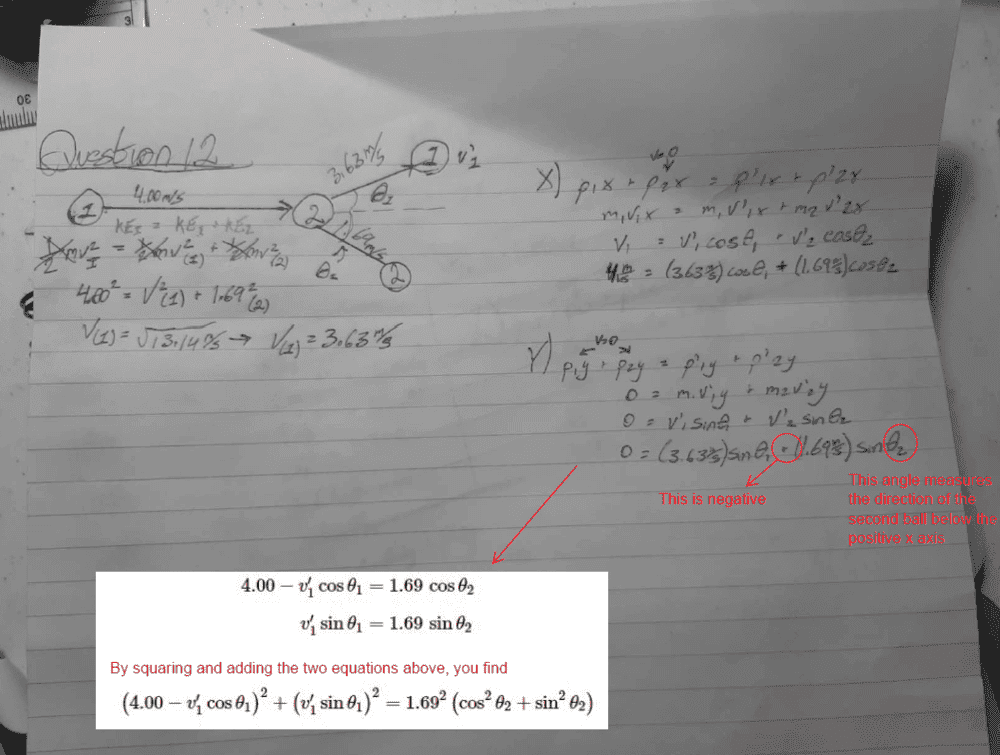
243402
 

Attachments

  • 20190506_211049.jpg
    20190506_211049.jpg
    51.4 KB · Views: 446
Physics news on Phys.org
ejantz said:
Problem Statement: A billiard ball moves at a speed of 4.00m/s and collides elastically with an identical stationary ball. As a result, the stationary ball flies away at a speed of 1.69m/s, as shown in Figure A2.12. Determine the final speed and direction of the incoming ball after the collision and the direction of the stationary ball after the collision
Relevant Equations: KEi = KE1 + KE2
p1x + p2x = p'1x + p'2x
p1y + p2y = p'1y + p'2y
cos(theta1)^2 + sin(theta1)^2 = cos(theta2)^2 + sin(theta2)^2
Remember, ##\sin^2(\theta) + \cos^2(\theta) = 1 ## for any angle.
 
  • Like
Likes   Reactions: ejantz
okay perfect, yes. so next step:
(4 - v'1 cosθ1)^2 + (v'1 sinθ1)^2 = 1.69^2 (cos^2 θ2 + sin^2 θ2)
this second part would be: = 2.8561 X 1 = 2.8561
but the first half now I am still struggling.. should i substitute in the v'1 (3.63) value?
(4^2 - 3.63^2 X cos^2 θ1) + (3.63^2 X sin^2 θ1) = 2.8561
2.8231 X cos^2 θ1 + 13.1769 X sin^2 θ1 = 2.8561
2.8231 X cos^2 θ1 = 2.8561 - 13.1769 X sin^2 θ1
2.8231 X cos^2 θ1 = -10.32 X sin^2 θ1
(2.82 / -10.32) = (sin^2 θ1 / cos^2 θ1)
-0.2735 = tan θ1
θ1 = tan-1(-0.2735) = -15.3

θ1 + θ2 = 90
θ2 = 90 - (-15.3)
θ2 = 105.3

I know I went wrong somewhere.. thank you for your help!
 
ejantz said:
okay perfect, yes. so next step:
(4 - v'1 cosθ1)^2 + (v'1 sinθ1)^2 = 1.69^2 (cos^2 θ2 + sin^2 θ2)
this second part would be: = 2.8561 X 1 = 2.8561
but the first half now I am still struggling.. should i substitute in the v'1 (3.63) value?
(4^2 - 3.63^2 X cos^2 θ1) + (3.63^2 X sin^2 θ1) = 2.8561
##(4 - v'1 \cosθ1)^2 ## is not equal to ##(4^2 - 3.63^2 \cos^2 θ1)##
How do you get the square of (a-b)?
 
  • Like
Likes   Reactions: ejantz
ohhh right, okay:
(4 − v′1 cosθ1)^2 = 2.8561
v'1^2 cos^2 θ1 − 8v'1 cos θ1 +16 = 2.8561
(3.63)^2 cos^2 θ1 - 8(3.63)cos(θ) + 16 = 2.8561
13.1769 cos^2 θ1 - 29.04 cos θ1 + 13.1439

apply the quadratic equation for: 13.1769 x^2 - 29.04 x + 13.1439
= 1.57 and 0.63
θ1 = cos-1 0.63 (cannot take inverse of 1.57)
θ1 = 50.95

θ1 + θ2 = 90
θ2 = 90 - (50.95)
θ2 = 39.1

does that look correct??
 
ah no sorry i completely forgot about the other half of the equation! ignore the previous post, check this:

(4 - v'1 cosθ1)^2 + (v'1 sinθ1)^2 = 1.69^2 (cos^2 θ2 + sin^2 θ2)
(4 − v′1 cosθ1)^2 + ((3.63)^2 X sin^2 θ1) = 2.8561

(4 − v′1 cosθ1)^2 --> v'1^2 cos^2 θ1 − 8v'1 cos θ1 +16

(3.63)^2 cos^2 θ1 - 8(3.63)cos(θ) + 16 + (13.1769 X sin^2 θ1) = 2.856
13.1769 cos^2 θ1 - 29.04 cos θ1 + 13.1769 sin^2 θ1 +13.144 = 0
 
ooo okay, then what about this:
13.1769 (cos^2 θ1 + sin^2 θ1) = 29.04 cos θ1 - 13.144
13.1769 = 29.04 cos θ1 - 13.144
cos θ1 = (13.1769 + 13.144) / 29.04
θ1 = cos-1 (0.906)
θ1 = 25.0

θ1 + θ2 = 90
θ2 = 90 - (25.0)
θ2 = -25

woww that was such a struggle, I am sorry, I think I may have it this time though??
 
ejantz said:
ah no sorry i completely forgot about the other half of the equation! ignore the previous post, check this:

(4 - v'1 cosθ1)^2 + (v'1 sinθ1)^2 = 1.69^2 (cos^2 θ2 + sin^2 θ2)
(4 − v′1 cosθ1)^2 + ((3.63)^2 X sin^2 θ1) = 2.8561

(4 − v′1 cosθ1)^2 --> v'1^2 cos^2 θ1 − 8v'1 cos θ1 +16

(3.63)^2 cos^2 θ1 - 8(3.63)cos(θ) + 16 + (13.1769 X sin^2 θ1) = 2.856
13.1769 cos^2 θ1 - 29.04 cos θ1 + 13.1769 sin^2 θ1 +13.144 = 0
OK. apply sin2(θ1 )+cos2(θ1 )=1 again.
 
  • Informative
Likes   Reactions: ejantz

Similar threads

  • · Replies 4 ·
Replies
4
Views
3K
Replies
1
Views
4K
Replies
12
Views
7K
Replies
16
Views
5K
  • · Replies 1 ·
Replies
1
Views
3K
Replies
3
Views
2K
  • · Replies 2 ·
Replies
2
Views
3K
  • · Replies 11 ·
Replies
11
Views
2K
  • · Replies 4 ·
Replies
4
Views
5K
Replies
7
Views
2K